Thank you for visiting SNEWPapers!
Sign up free
Alexandria Daily Advertiser
Alexandria, Virginia
What is this article about?
Commodore James Barron defends himself in a court-martial against charges of cowardice and improper surrender during the 1807 Chesapeake-Leopard naval incident. He refutes accusations of deserting his post, using ruses to gain time, and premature surrender, citing unprepared crew, superior enemy force, and lack of ammunition as justifications.
Merged-components note: Continuation of the story 'Commodore Barron's Defence' from page 2 to page 3, indicated by '[CONTINUED.]' and seamless text flow.
Clippings
1 of 2
OCR Quality
Full Text
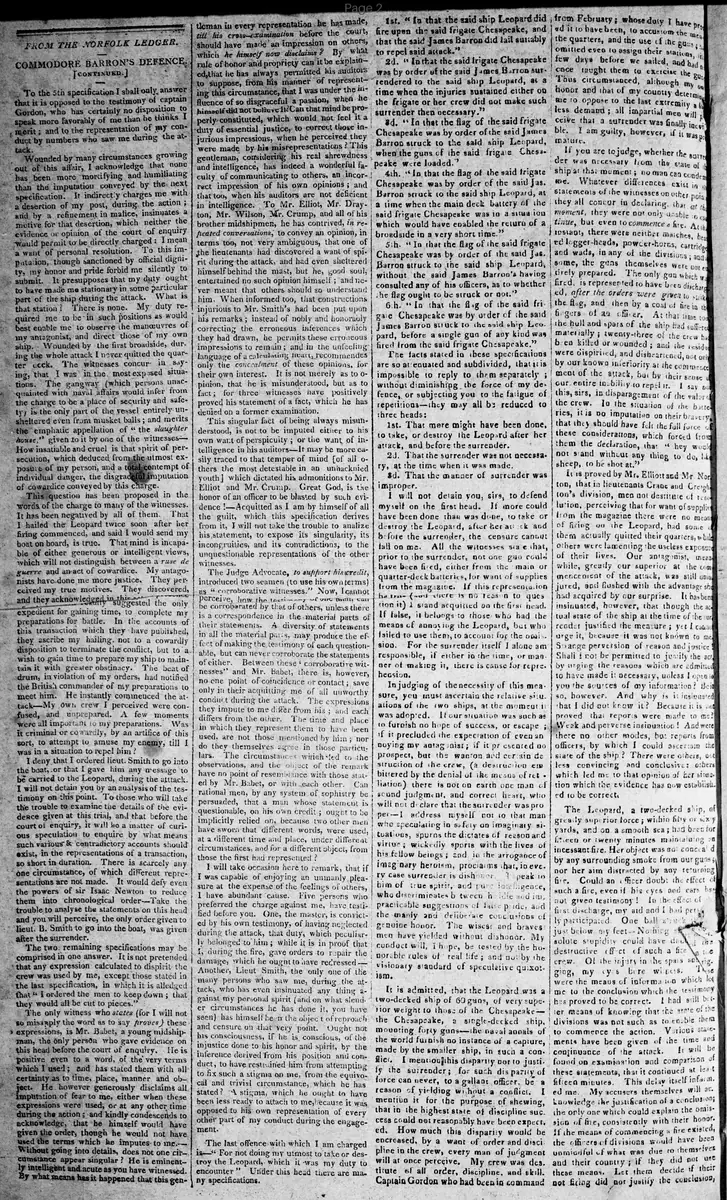
COMMODORE BARRON'S DEFENCE.
[CONTINUED.]
To the 5th specification I shall only answer that it is opposed to the testimony of captain Gordon, who has certainly no disposition to merit; and to the representation of my conduct by numbers who saw me during the attack.
Wounded by many circumstances growing out of this affair, I acknowledge that none has been more mortifying and humiliating than the imputation conveyed by the next specification. It indirectly charges me with a desertion of my post, during the action; and by a refinement in malice, insinuates a motive for that desertion, which neither the evidence or opinion of the court of enquiry would permit to be directly charged: I mean a want of personal resolution. To this imputation, though sanctioned by official dignity, my honor and pride forbid me silently to submit. It presupposes that my duty ought to have made me stationary in some particular part of the ship during the attack. What is that station! There is none. My duty required me to be in such positions as would best enable me to observe the manoeuvres of my antagonist, and direct those of my own ship. Wounded by the first broadside, during the whole attack I never quitted the quarter deck. The witnesses concur in saying, that I was in the most exposed situations. The gangway (which persons unacquainted with naval affairs would infer from the charge to be a place of security and safety) is the only part of the vessel entirely unsheltered even from musket balls; and merits the emphatic appellation of "the slaughter house," given to it by one of the witnesses. How insatiable and cruel is that spirit of persecution, which deduced from the utmost exposure of my person, and a total contempt of individual danger, the disgraceful imputation of cowardice conveyed by this charge.
This question has been proposed in the words of the charge to many of the witnesses. It has been negatived by all of them. That I hailed the Leopard twice soon after her firing commenced, and said I would send my boat on board, is true. That mind is incapable of either generous or intelligent views, which will not distinguish between a ruse de guerre and an act of cowardice. My antagonists have done me more justice. They perceived my true motives. They discovered, and they acknowledge, I instigated the only expedient for gaining time, to complete my preparations for battle. In the accounts of this transaction which they have published, they ascribe my hailing, not to a cowardly disposition to terminate the conflict, but to 'a wish to gain time to prepare my ship to maintain it with greater obstinacy. The beat of drum, in violation of my orders, had notified the British commander of my preparations to meet him. He instantly commenced the attack. My own crew I perceived were confused, and unprepared. A few moments were all important to my preparations. Was it criminal or cowardly, by an artifice of this sort, to attempt to amuse my enemy, till I was in a situation to repel him?
I deny that I ordered lieut. Smith to go into the boat, or that I gave him any message to be carried to the Leopard, during the attack. I will not detain you by an analysis of the testimony on this point. To those who will take the trouble to examine the details of the evidence given at this trial, and that before the court of enquiry, it will be a matter of curious speculation to enquire by what means such various & contradictory accounts should exist, in the representations of a transaction, so short in duration. There is scarcely any one circumstance, of which different representations are not made. It would defy even the powers of sir Isaac Newton to reduce them into chronological order. Take the trouble to analyse the statements on this head and you will perceive, the only order given to lieut. B. Smith to go into the boat, was given after the surrender.
The two remaining specifications may be comprised in one answer. It is not pretended that any expression calculated to dispirit the crew was used by me, except those stated in the last specification, in which it is alledged that "I ordered the men to keep down; that they would all be cut to pieces."
The only witness who states (for I will not so misapply the word as to say proves) these expressions, is Mr. Babet, a young midshipman, the only person who gave evidence on this head before the court of enquiry. He is positive even to a word, of the very terms which I used; and has stated them with all certainty as to time, place, manner, and object. He however generously disclaims all imputation of fear to me, either when these expressions were used, or at any other time during the action; and kindly condescends to acknowledge, that he himself would have given the order, though he would not have used the terms which he imputes to me.
Without going into details, does not one circumstance appear singular? He is eminently intelligent and acute as you have witnessed. By what means has it happened that this gentleman in every representation he has made, till his cross-examination before the court should have made an impression on others, which he himself now disclaims? By what rule of honor and propriety can it be explained to suppose, from his manner of representing this circumstance, that I was under the influence of so disgraceful a passion, when he himself did not believe it? Can that mind be properly constituted, which would not feel it a duty of essential justice, to correct those injurious impressions, when he perceived they were made by his misrepresentations? This gentleman, considering his real shrewdness and intelligence, has indeed a wonderful faculty of communicating to others, an incorrect impression of his own opinions; and that too, when his auditors are not deficient in intelligence. To Mr. Elliot, Mr. Drayton, Mr. Wilson, Mr. Crump, and all of his brother midshipmen, he has contrived, in repeated conversations, to convey an opinion, in terms too, not very ambiguous, that one of the lieutenants had discovered a want of spirit during the attack, and had even sheltered himself behind the mast, but he, good soul entertained no such opinion himself; and never meant that others should so understand him. When informed too, that constructions injurious to Mr. Smith's had been put upon his remarks; instead of nobly and honorably correcting the erroneous inferences which they had drawn, he permits these erroneous impressions to remain; and in the unfeeling language of a calculating heart, recommends only the concealment of these opinions, for their own interest. It is not merely as to opinion, that he is misunderstood, but as to fact; for three witnesses have positively proved his statement of a fact, which he has denied on a former examination.
This singular fact of being always misunderstood, is not to be imputed either to his own want of perspicuity; or the want of intelligence in his auditors. It may be more easily traced to that temper of mind [of all others the most detestable in an unhabituated youth] which dictated his admonitions to Mr. Elliot and Mr. Crump. Great God, is the honor of an officer to be blasted by such evidence!--Acquitted as I am by himself of all the guilt, which this specification derives from it, I will not take the trouble to analyse his statement, to expose its singularity, its incongruities, and its contradictions, to the unquestionable representations of the other witnesses.
The Judge Advocate, to support his credit, introduced two seamen (to use his own terms) as "corroborative witnesses." Now, I cannot perceive, how the testimony of one man can be corroborated by that of others, unless there is a correspondence in the material parts of their statements. A diversity of statements in all the material parts, may produce the effect of making the testimony of each questionable, but can never corroborate the statements of either. Between these "corroborative witnesses" and Mr. Babet, there is, however no one point of coincidence or contact; save only in their acquitting me of all unworthy conduct during the attack. The expressions they impute to me differ from his; and each differs from the other. The time and place in which they represent them to have been used, are not those mentioned by him; nor do they themselves agree in those particulars. The circumstances which led to the observations, and the object of the remark have no point of resemblance with those stated by Mr. Babet, or with each other. Can rational men, by any system of sophistry be persuaded, that a man whose statement is questionable, on his own credit; ought to be implicitly relied on, because two other men have sworn that different words, were used, at a different time and place, under different circumstances, and for a different object, from those the first had represented?
I will take occasion here to remark, that if I was capable of enjoying an unmanly pleasure at the expense of the feelings of others, I have abundant cause. Five persons who preferred the charge against me, have testified before you. One, the master, is convicted by his own testimony, of having neglected during the attack, that duty, which peculiarly belonged to him; while it is in proof that I, during the fire, gave orders to repair the damage, which he ought to have redressed. Another, Lieut Smith, the only one of the many persons who saw me, during the attack, who has even insinuated any thing against my personal spirit (and on what slender circumstances he has done it, you have seen) has himself been the object of reproach and censure on that very point. Ought not his consciousness, if he is conscious, of the injustice done to his honor and spirit, by the inference derived from his position and conduct, to have restrained him from attempting to fix such a stigma on me, from the equivocal and trivial circumstance, which he has stated? A stigma, which he ought to have been less ready to attach to me, because it was opposed to his own representation of every other part of my conduct during the engagement.
The last offence with which I am charged is "For not doing my utmost to take or destroy the Leopard, which it was my duty to encounter." Under this head there are many specifications.
1st. "In that the said ship Leopard did fire upon the said Frigate Chesapeake, and that the said James Barron did fail suitably to repel said attack."
2d. "In that the said frigate Chesapeake was by order of the said James Barron surrendered to the said ship Leopard, at a time when the injuries sustained either on the frigate or her crew did not make such surrender then necessary."
3d. "In that the flag of the said frigate Chesapeake was by order of the said James Barron struck to the said ship Leopard, when the guns of the said frigate Chesapeake were loaded."
4th. "In that the flag of the said frigate Chesapeake was by order of the said Jas. Barron struck to the said ship Leopard, at a time when the main deck battery of the said frigate Chesapeake was in a situation which would have enabled her return of a broadside in a very short time."
5th. "In that the flag of the said frigate Chesapeake was by order of the said Jas. Barron struck to the said ship Leopard, without the said James Barron's having consulted any of his officers, as to whether the flag ought to be struck or not."
6th. "In that the flag of the said frigate Chesapeake was by order of the said James Barron struck to the said ship Leopard, before a single gun of any kind was fired from the said frigate Chesapeake."
The facts stated in these specifications are so artificially and subdivided, that it is impossible to reply to them separately; without diminishing the force of my defence, or subjecting you to the fatigue of repetitions. They may all be reduced to three heads:
1st. That more might have been done, to take, or destroy the Leopard after her attack, and before the surrender.
2d. That the surrender was not necessary, at the time when it was made.
3d. That the manner of surrender was improper.
I will not detain you, sirs, to defend myself on the first head. If more could have been done than was done, to take or destroy the Leopard, after her attack and before the surrender, the censure cannot fall on me. All the witnesses state that, prior to the surrender, not one gun could have been fired, either from the main or quarter-deck batteries, for want of supplies from the magazine. If this representation has truth (and there is no reason to question it) I stand acquitted on the first head. If false, it belongs to those who had the means of annoying the Leopard, but who failed to use them, to account for the omission. For the surrender itself I alone am responsible. If either in the time, or manner of making it, there is cause for reprehension.
In judging of the necessity of this measure, you must ascertain the relative situations of the two ships, at the moment it was adopted. If our situation was such as to furnish no hope of success, or escape; if it precluded the expectation of even annoying my antagonist; if it presented no prospect, but the wanton and certain destruction of the crew, (a destruction embittered by the denial of the means of retaliation) there is not on earth one man of sound judgment, and correct heart, who will not declare that the surrender was proper. I address myself not to that man who speculating in safety on imaginary situations, spurns the dictates of reason and virtue; wickedly sports with the lives of his fellow beings; and, in the arrogance of imaginary heroism, proclaims that, in every case surrender is dishonor. I speak to him of true spirit, and pure intelligence, who discriminates between idle and impracticable suggestions of false pride, and the manly and deliberate conclusions of genuine honor. The wisest and bravest men have yielded without dishonor. My conduct will, I hope, be tested by the honorable rules of real life; and not by the visionary standard of speculative quixotism.
It is admitted, that the Leopard was a two-decked ship of 60 guns, of very superior weight to those of the Chesapeake. The Chesapeake, a single-decked ship, mounting forty guns. The naval annals of the world furnish no instance of a capture, made by the smaller ship, in such a conflict. I mention this disparity not to justify the surrender; for such disparity of force can never, to a gallant officer, be a reason of yielding without a conflict: I mention it for the purpose of showing, that in the highest state of discipline success could not reasonably have been expected. How much this disparity would be increased, by a want of order and discipline in the crew, every man of judgment will at once perceive. My crew was destitute of all order, discipline, and skill. Captain Gordon who had been in command from February; whose duty I have proved it to have been, to accustom the men to the quarters, and the use of the guns; omitted even to assign their stations, a few days before we sailed, and had once taught them to exercise the gun. Thus circumstanced, although my honor and that of my country determined me to oppose to the last extremity all hostile demand; all impartial men will perceive that a surrender was only inevitable. I am guilty, however, if it was premature.
If you are to judge, whether the surrender was necessary from the state of the ship at that moment; no man can condemn me. Whatever differences exist in the statements of the witnesses on other points, they all concur in declaring, that at that moment, they were not only unable to continue, but even to commence a fire. At that instant, there were neither matches, heated logger-heads, powder-horns, cartridges and wads, in any of the divisions; and in some, the guns themselves were not entirely prepared. The only gun which was fired, is represented to have been discharged, after the orders were given to strike the flag, and then by a coal of fire in the fingers of an officer. At that time too the hull and spars of the ship had suffered materially; twenty-three of the crew had been killed or wounded; and the residue were dispirited, and disheartened, not only by our known inferiority at the commencement of the attack, but by their sense of our entire inability to repel it. I say this, sirs, in disparagement of the valor of the crew. In the situation of the batteries, it is no imputation on their bravery that they should have felt the full force of these considerations, which forced from them the declaration, that "they would not stand without any thing to do, like sheep, to be shot at."
It is proved by Mr. Elliott and Mr. Not too, that in lieutenants Crane and Creighton's division, men not destitute of resolution, perceiving that for want of supplies from the magazine there were no means of firing on the Leopard, had some of them actually quitted their quarters, while others were lamenting the useless exposure of their lives. Our antagonist, meanwhile, greatly our superior at the commencement of the attack, was still uninjured, and flushed with the advantage she had acquired by our surprise. It has been insinuated, however, that though the actual state of the ship at the time of the surrender justified the measure; yet I cannot urge it, because it was not known to me. Strange perversion of reason and justice. Shall I not be permitted to justify the act by urging the reasons which are admitted to have made it necessary, unless I open to you the sources of my information? Be it so, however. And why is it insinuated that I did not know it? Because it is not proved that reports were made to me? Weak and perverse insinuation! And were there no other modes, but reports from officers, by which I could ascertain the state of the ship? There were others, not less convincing and conclusive: others which led me to that opinion of her situation which the evidence has now established to be correct.
The Leopard, a two-decked ship, of greatly superior force; within fifty or sixty yards, and on a smooth sea; had been for fifteen or twenty minutes maintaining an incessant fire. Her object was not concealed by any surrounding smoke from our guns; nor her aim distracted by any returning fire. Could an officer doubt the effect of such a fire, even if his eyes and ears had not given testimony! In the effect of the first discharge, my aid and I had personally participated. One ball struck just below my feet. Nothing short of absolute stupidity could have deceived the destructive effect of such a fire on the crew.
Of the injury in the spars and rigging, my own eyes were witnesses. These were the means of information which led me to the conclusion which the testimony has proved to be correct. I had still better means of knowing that the state of the divisions was not such as to enable them to commence the action. Various statements have been given of the time and continuance of the attack. It will be found on examination and comparison of these statements, that it continued at least fifteen minutes.
This delay itself informed me. My accusers themselves will acknowledge the justification of a conclusion; the only one which could explain the omission of fire, consistently with their honor. If the means of commencing a fire existed, the officers of divisions would have been mindful of what was due to themselves and their country: if they did not use these means, let them decide if their not firing did not justify the conclusion.
Of the want of powder, matches, loggerheads, cartridges and every means of discharging a gun on the quarter deck: I had ocular evidence. These deficiencies, I not only observed, but as has been proved by Mr. Smith and Mr. Brooks, vainly endeavored to supply, I could not doubt, that the same causes which left the quarter deck unprovided with every means of firing a gun, occasioned the delay on the gun deck.
[To be continued.]
What sub-type of article is it?
What themes does it cover?
What keywords are associated?
What entities or persons were involved?
Where did it happen?
Story Details
Key Persons
Location
On The Frigate Chesapeake
Story Details
Commodore Barron defends his conduct in the Chesapeake-Leopard engagement, refuting charges of cowardice, improper commands, and premature surrender by citing witness testimonies, unprepared crew, superior enemy force, and lack of ammunition, arguing his actions preserved lives without dishonor.