Thank you for visiting SNEWPapers!
Sign up free
Lynchburg Star
Lynchburg, Virginia
What is this article about?
A letter to Doctor Graham offering advice on proper pronunciation and reading techniques for speeches, highlighting the importance of preparation, pauses, cadence, emphasis, and voice management to accurately convey the author's intent, inspired by a poorly read speech on 'THE CALL OF A CONVENTION'.
Merged-components note: The text in the first component is the incomplete start of a letter to the editor on pronunciation, which continues directly into the second component on page 3.
Clippings
1 of 2
OCR Quality
Full Text
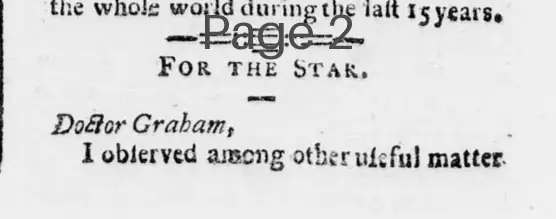
Doctor Graham,
I observed among other useful matter
Contained in your valuable paper, some excellent speeches; and having lately heard a very interesting one—'THE CALL OF A CONVENTION'—read in a manner so injurious to the nature of the subject, occasioned through a neglect of attending to the rules of pronunciation, I have taken the liberty to offer a few observations relative to that subject. These, if you deem them worthy of a place in the 'Star,' you are welcome to publish, for the benefit of those persons, who have been neglected in that useful part of education.
PRONUNCIATION, or utterance of speech, may be defined, 'the proper management of the voice and gestures in speaking, whether extempore, or by form.'
From the preceding definition it is obvious, that no man can pronounce well, unless he either memorize the matter, and thereby make it his own, or examine it so carefully as to discover the author's drift.
First then, and principally, examine the piece you are about to read for the information of others. Search your Dictionary for every word that you do not perfectly know the meaning or pronunciation of—I would recommend Jones's pronouncing Dictionary to those who are unprovided with one, which may be had for a dollar. And who, that knows his letters, would be without one for a dollar?
Attention must also be paid to the pauses or stops, that you do not confound one clause or sentence with another.
Those who have been instructed by careless teachers seldom know the proper pauses or rests: I would recommend to such, Louth's Essay on punctuation, which is contained in the Dictionary before mentioned.
Cadence and Emphasis demand particular attention also. Cadence is the falling of the voice, which generally takes place at the end of a sentence; unless the sentence close with an emphatical word.
Emphasis is the force or stress of the voice laid on some significant word, or member of a sentence... e.g.... Hervey was a flowery writer; Newton was a great philosopher; Washington was a prudent general:—Here the words,—flowery—great—prudent, are to be spoken emphatically.
It is worthy of remark to notice how the sense of a sentence may be changed by placing the emphasis on different words,—as for example—'Will you ride to town to day?'—This question may be varied four different ways, and the answers agree accordingly. If the emphasis be placed on the word you, the answer may be—no: I will send a boy. If the emphasis be placed on the word ride, the answer may be—no: I shall walk. If it be laid on the words to town, the answer may be—no: I shall ride to mill. If it be put on the words to day, the answer may still be—no: I shall go to-morrow.
Those words which require an emphatic voice are to be marked by a dash underneath in manuscript writings; which words are generally printed in italics: so that a good reader may deliver a piece exactly correspondent with the mind of the author, though a thousand miles apart, or written years before.
In the management of the voice it is proper to avoid pronouncing too loud: This is not only an inconvenience to the speaker, and disgusting to an audience; but it prevents an elevation of the voice when emphatical words require it.
Nor should the voice be too low: This defeats the intention of informing those whom we wish to hear, and it renders the reading irksome, dry, and insipid.
Beware of pronouncing too quick: rapidity of speech destroys the force, perspicuity, and utility of the subject. This method may do in the perusal of deeds, leases, and the preambles of legislative acts, which contain little useful matter; but it is very improper in the examination of any serious or important subject, which demands attention.
An irregular or uneven voice, that is rising and falling suddenly without regard to cadence, emphasis, pauses, or even the sense of the subject, should be carefully avoided or corrected.
Hoping that the above observations may prove beneficial to some of my fellow citizens, I subscribe myself the public's most obedient, and real friend.
Philanthropos.
Virginia, 30th year of Independence.
What sub-type of article is it?
What themes does it cover?
What keywords are associated?
What entities or persons were involved?
Letter to Editor Details
Author
Philanthropos
Recipient
Doctor Graham
Main Argument
proper pronunciation and reading of speeches require careful preparation, including understanding the text, using correct pauses, cadence, emphasis, and voice modulation to accurately convey the author's intent and avoid misinterpretation.
Notable Details