Thank you for visiting SNEWPapers!
Sign up free
Editorial
November 25, 1789
Gazette Of The United States
New York, New York County, New York
What is this article about?
John Adams's Letter XIII from Amsterdam, Oct. 26, 1780, outlines untried resources America could use to sustain the Revolutionary War, including retrenching luxury, imposing duties, land sales, loans from Europe, and expanding trade and privateering, emphasizing optimism for victory without extreme measures.
Clipping
OCR Quality
98%
Excellent
Full Text
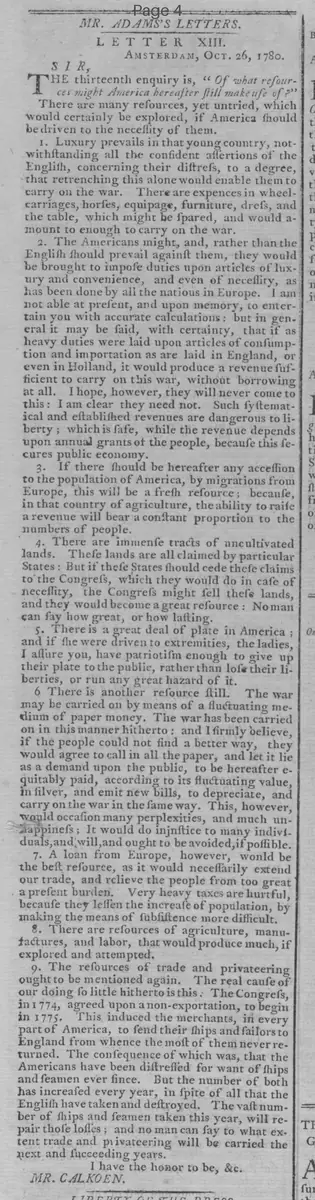
MR. ADAMS'S LETTERS.
LETTER XIII.
Amsterdam, Oct. 26, 1780.
SIR,
The thirteenth enquiry that refers
There are many resources, yet untried, which
would certainly be explored, if America should
be driven to the necessity of them.
1. Luxury prevails in that young country, notwithstanding all the confident assertions of the
English, concerning their distress, to a degree,
that retrenching this alone would enable them to
carry on the war. There are expenses in wheel-
carriages, horses, equipage, furniture, dress, and
the table, which might be pared, and would amount to enough to carry on the war.
2. The Americans might, and, rather than the
English should prevail against them, they would
be brought to impose duties upon articles of lux-
ury and convenience, and even of necessity, as
has been done by all the nations in Europe. I am
not able at present, and upon memory, to enter-
tain you with accurate calculations: but in gen.
eral it may be said, with certainty, that if as
heavy duties were laid upon articles of consumption and importation as are laid in England, or
even in Holland, it would produce a revenue suf-
ficient to carry on this war, without borrowing
at all. I hope, however, they will never come to
this: I am clear they need not. Such systematic and established revenues are dangerous to li-
berty; which is safe, while the revenue depends
upon annual grants of the people, because this ensures public economy.
3. If there should be hereafter any accession
to the population of America, by migrations from
Europe, this will be a fresh resource; because,
in that country of agriculture, the ability to raise
a revenue will bear a constant proportion to the
numbers of people.
4. There are immense tracts of uncultivated
lands. These lands are all claimed by particular
States: But if these States should cede these claims to the Congress, which they would do in case of
necessity, the Congress might sell these lands,
and they would become a great resource: No man
can say how great, or how lasting.
5. There is a great deal of plate in America;
and if she were driven to extremities, the ladies,
I assure you, have patriotism enough to give up
their plate to the public, rather than lose their li-
berties, or run any great hazard of it.
6. There is another resource still. The war
may be carried on by means of a fluctuating me-
dium of paper money. The war has been carried
on in this manner hitherto: and I firmly believe,
if the people could not find a better way, they
would agree to call in all the paper, and let it lie
as a demand upon the public, to be hereafter e-
quitably paid, according to its fluctuating value,
in silver, and emit new bills, to depreciate, and
carry on the war in the same way. This, however,
would occasion many perplexities, and much un-
happiness; It would do injustice to many indivi-
duals, and will, and ought to be avoided, if possible.
7. A loan from Europe, however, would be
the best resource, as it would necessarily extend
our trade, and relieve the people from too great
a present burden. Very heavy taxes are hurtful,
because they lessen the increase of population, by
making the means of subsistence more difficult.
8. There are resources of agriculture, manu-
factures, and labor, that would produce much, if
explored and attempted.
9. The resources of trade and privateering
ought to be mentioned again. The real cause of
our doing so little hitherto is this: The Congress,
in 1774, agreed upon a non-exportation, to begin
in 1775. This induced the merchants, in every
part of America, to send their ships and sailors to
England from whence the most of them never re-
turned. The consequence of which was, that the
Americans have been distressed for want of ships
and seamen ever since. But the number of both
has increased every year, in spite of all that the
English have taken and destroyed. The vast num-
ber of ships and seamen taken this year, will re-
pair those losses; and no man can say to what ex-
tent trade and privateering will be carried the
next and succeeding years.
I have the honor to be, &c.
MR. ADAMS.
LETTER XIII.
Amsterdam, Oct. 26, 1780.
SIR,
The thirteenth enquiry that refers
There are many resources, yet untried, which
would certainly be explored, if America should
be driven to the necessity of them.
1. Luxury prevails in that young country, notwithstanding all the confident assertions of the
English, concerning their distress, to a degree,
that retrenching this alone would enable them to
carry on the war. There are expenses in wheel-
carriages, horses, equipage, furniture, dress, and
the table, which might be pared, and would amount to enough to carry on the war.
2. The Americans might, and, rather than the
English should prevail against them, they would
be brought to impose duties upon articles of lux-
ury and convenience, and even of necessity, as
has been done by all the nations in Europe. I am
not able at present, and upon memory, to enter-
tain you with accurate calculations: but in gen.
eral it may be said, with certainty, that if as
heavy duties were laid upon articles of consumption and importation as are laid in England, or
even in Holland, it would produce a revenue suf-
ficient to carry on this war, without borrowing
at all. I hope, however, they will never come to
this: I am clear they need not. Such systematic and established revenues are dangerous to li-
berty; which is safe, while the revenue depends
upon annual grants of the people, because this ensures public economy.
3. If there should be hereafter any accession
to the population of America, by migrations from
Europe, this will be a fresh resource; because,
in that country of agriculture, the ability to raise
a revenue will bear a constant proportion to the
numbers of people.
4. There are immense tracts of uncultivated
lands. These lands are all claimed by particular
States: But if these States should cede these claims to the Congress, which they would do in case of
necessity, the Congress might sell these lands,
and they would become a great resource: No man
can say how great, or how lasting.
5. There is a great deal of plate in America;
and if she were driven to extremities, the ladies,
I assure you, have patriotism enough to give up
their plate to the public, rather than lose their li-
berties, or run any great hazard of it.
6. There is another resource still. The war
may be carried on by means of a fluctuating me-
dium of paper money. The war has been carried
on in this manner hitherto: and I firmly believe,
if the people could not find a better way, they
would agree to call in all the paper, and let it lie
as a demand upon the public, to be hereafter e-
quitably paid, according to its fluctuating value,
in silver, and emit new bills, to depreciate, and
carry on the war in the same way. This, however,
would occasion many perplexities, and much un-
happiness; It would do injustice to many indivi-
duals, and will, and ought to be avoided, if possible.
7. A loan from Europe, however, would be
the best resource, as it would necessarily extend
our trade, and relieve the people from too great
a present burden. Very heavy taxes are hurtful,
because they lessen the increase of population, by
making the means of subsistence more difficult.
8. There are resources of agriculture, manu-
factures, and labor, that would produce much, if
explored and attempted.
9. The resources of trade and privateering
ought to be mentioned again. The real cause of
our doing so little hitherto is this: The Congress,
in 1774, agreed upon a non-exportation, to begin
in 1775. This induced the merchants, in every
part of America, to send their ships and sailors to
England from whence the most of them never re-
turned. The consequence of which was, that the
Americans have been distressed for want of ships
and seamen ever since. But the number of both
has increased every year, in spite of all that the
English have taken and destroyed. The vast num-
ber of ships and seamen taken this year, will re-
pair those losses; and no man can say to what ex-
tent trade and privateering will be carried the
next and succeeding years.
I have the honor to be, &c.
MR. ADAMS.
What sub-type of article is it?
Economic Policy
War Or Peace
Trade Or Commerce
What keywords are associated?
American Resources
Revolutionary War
Luxury Retrenchment
Import Duties
European Loans
Paper Money
Privateering
Land Sales
What entities or persons were involved?
John Adams
Congress
English
American States
Europe
Editorial Details
Primary Topic
Untried Resources For America To Sustain The Revolutionary War
Stance / Tone
Optimistic And Advisory On Fiscal Measures To Avoid Defeat
Key Figures
John Adams
Congress
English
American States
Europe
Key Arguments
Retrenched Luxury Spending Could Fund The War.
Imposing European Style Duties On Imports Could Generate Sufficient Revenue Without Borrowing.
Population Growth From European Migration Would Proportionally Increase Revenue Capacity.
Selling Uncultivated Lands Ceded By States To Congress Would Provide A Major Resource.
Patriotic Donation Of Household Plate By Americans, Especially Women, In Extremity.
Continued Use Of Depreciating Paper Money As A Fluctuating Medium, Though Undesirable.
European Loans Preferred As They Extend Trade And Ease Domestic Burdens.
Development Of Agriculture, Manufactures, And Labor Resources.
Expansion Of Trade And Privateering, Recovering From 1774 Non Exportation Losses.