Thank you for visiting SNEWPapers!
Sign up free
The Kentucky Gazette
Lexington, Fayette County, Kentucky
What is this article about?
An essay exploring the origins of surnames from ancient additions to family names, their evolution in England, and amusing ironies when names match or mismatch professions, social roles, and virtues. It critiques superstition in names and emphasizes personal merit over ancestry, ending with a 16th-century poem excerpt.
Merged-components note: These two components are a continuation of the same essay on the origins and amusing aspects of surnames, signed by ATTICUS, and should be merged into a single literary piece.
Clipping
OCR Quality
Full Text
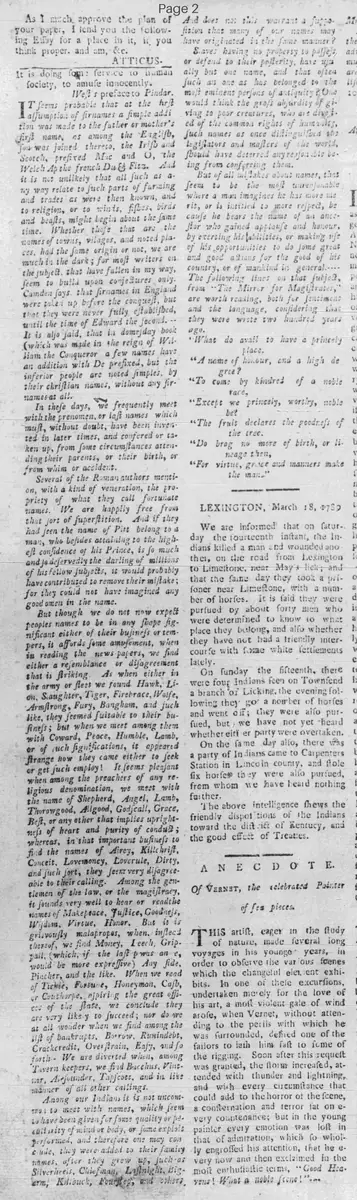
ATTICUS.
It is doing some service to human society, to amuse innocently.
Warton's preface to Pindar.
It seems probable that at the first assumption of surnames a simple addition was made to the father or mother's first name, as among the English, 'son' was joined thereto, the Irish and Scotch prefixed Mac and O, the Welch Ap, the French Du & Fitz. And it is not unlikely that all such as any way relate to such parts of farming and trades as were then known, and to religion, or to mounts, fishes, birds and beasts, might begin about the same time. Whether those that are the names of towns, villages, and noted places, had the same origin or not, we are much in the dark; for most writers on the subject, that have fallen in my way, seem to build upon conjectures only.
Camden says, that surnames in England until the time of Edward the second--that they were never fully established, were taken up before the conquest, but it is also said, that in Domesday book (which was made in the reign of William the Conqueror) a few names have an addition with De prefixed, but the inferior people are noted simply, by their Christian names, without any surnames at all.
In these days, we frequently meet with the prenomen, or last names which must, without doubt, have been invented in later times, and conferred or taken up, from some circumstances attending their parents, or their birth, or from whim or accident.
Several of the Roman authors mention, with a kind of veneration, the propriety of what they call fortunate names. We are happily free from that sort of superstition. And if they had seen the name of Pitt belong to a man, who besides attaining to the highest confidence of his Prince, is so much and so deservedly the darling of millions of his fellow subjects, it would probably have contributed to remove their mistake; for they could not have imagined any good omen in the name.
But though we do not nor expect peoples names to be in any hope significant either of their business or tempers, it affords some amusement, when in reading the news papers, we find either a resemblance or disagreement that is striking. As when either in the army or fleet we found Hawk, Lion, Slaughter, Tiger, Firebrace, Wolfe, Armstrong, Fury, Bangham, and such like, they seemed suitable to their business; but when we meet among them with Coward, Peace, Humble, Lamb, or of such significations, it appeared strange how they came either to seek or get such employ! It seems pleasant when among the preachers of any religious denomination, we meet with the name of Shepherd, Angel, Lamb, Thorowgood, Allgood, Godsall, Grace, Best, or any other that implies uprightness of heart and purity of conduct; whereas, in that important business to find the names of Airey, Killchrist, Conceit, Lovemoney, Loverule, Dirty, and such sort, they seem very disagreeable to their calling. Among the gentlemen of the law, or the magistracy, it sounds very well to hear or read the names of Makepeace, Justice, Goodness, Wisdom, Virtue, Honour. But it is grievously malapropos, when, instead thereof, we find Money, Leech, Grip, Snail, (which, if the last was an e, would be more expressive) Any idea. Pincher, and the like. When we read of Tickell, Fortune, Honeyman, Cash, or Couthorpe, aspiring the great offices of the state, we conclude they are very likely to succeed; nor do we at all wonder when we find among the list of bankrupts, Borrow, Runindebt, Crackcredit, Overtrade, Easy, and so forth. We are diverted while, among Tavern keepers, we find Bacchus, Vintner, Alesounder, Tapscott, and in like manner of all other callings.
Among our Indians it is not uncommon to meet with names, which seem to have been given for some quality or peculiarity of mind or body, or some exploit performed, and therefore one may conclude, they were added to their family names, after they grew up, such as Silverheels, Chiefman, Lightning, Bigarm, Killbuck, Footstep, and others.
And does not this warrant a supposition that many of our names may have originated in the same manner?
Slaves having no property to possess or descend to their posterity, have usually but one name, and that often such an one as has belonged to the most eminent persons of antiquity? One would think the gross absurdity of giving to poor creatures, who are divested of the common rights of humanity, such names as once distinguished the legislators and masters of the world, should have deterred any reasonable being from conferring them.
But of all mistakes about names, that seems to be the most unreasonable where a man imagines he has more merit, or is entitled to more respect, because he bears the name of an ancestor who gained applause and honour, by exerting his abilities, or making use of his opportunities to do some great and good actions for the good of his country, or of mankind in general.
The following lines on that subject, from "The Mirror for Magistrates," are worth reading, both for sentiments and the language, considering that they were wrote two hundred years ago.
What do avail to have a princely place,
A name of honour, and a high degree?
To come by kindred of a noble race,
Except we princely, worthy, noble be?
The fruit declares the goodness of the tree.
Do brag no more of birth, or lineage then,
For virtue, grace and manners make the man.
What sub-type of article is it?
What themes does it cover?
What keywords are associated?
What entities or persons were involved?
Literary Details
Author
Atticus
Subject
On The Origins And Significances Of Surnames
Form / Style
Prose Essay With Historical Reflections And Satirical Examples
Key Lines