Thank you for visiting SNEWPapers!
Sign up free
Literary
March 7, 1828
Rhode Island American And Providence Gazette
Providence, Providence County, Rhode Island
What is this article about?
A contributor provides a scientific description of the Mysticetus whale for the American & Microcosm, covering its Linnaean classification, anatomy, habits, commercial importance in oil and whalebone production, and details of a young specimen exhibited, measuring 39 feet in length.
Clipping
OCR Quality
95%
Excellent
Full Text
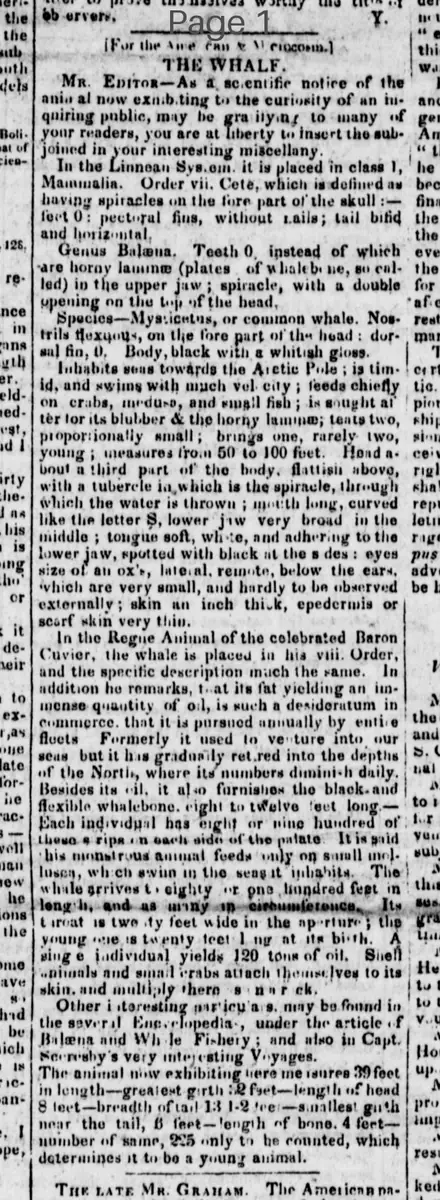
[For the American & Microcosm.]
THE WHALE.
Mr. Editor—As a scientific notice of the animal now exhibiting to the curiosity of an inquiring public, may be gratifying to many of your readers, you are at liberty to insert the subjoined in your interesting miscellany.
In the Linnaean System, it is placed in class I, Mammalia. Order vii. Cete, which is defined as having spiracles on the fore part of the skull:— feet or pectoral fins, without nails; tail bifid and horizontal,
Genus Balana. Teeth none, instead of which are horny laminae (plates of whalebone, so called) in the upper jaw; spiracle, with a double opening on the top of the head,
Species—Mysticetus, or common whale. Nostrils fleshy, on the fore part of the head: dorsal fin, none. Body, black with a whitish gloss.
Inhabits seas towards the Arctic Pole; is timid, and swims with much velocity; feeds chiefly on crabs, medusae, and small fish; is sought after for its blubber & the horny laminae; teats two, proportionally small; brings one, rarely two, young; measures from 50 to 100 feet. Head about a third part of the body, flattish above, with a tubercle in which is the spiracle, through which the water is thrown; mouth long, curved like the letter S, lower jaw very broad in the middle; tongue soft, white, and adhering to the lower jaw, spotted with black at the sides: eyes size of an ox's, lateral, remote, below the ears, which are very small, and hardly to be observed externally; skin an inch thick, epidermis or scarf skin very thin.
In the Règne Animal of the celebrated Baron Cuvier, the whale is placed in his viii. Order, and the specific description much the same. In addition he remarks, that its fat yielding an immense quantity of oil, is such a desideratum in commerce, that it is pursued annually by entire fleets. Formerly it used to venture into our seas but it has gradually retired into the depths of the North, where its numbers diminish daily. Besides its oil, it also furnishes the black and flexible whalebone, eight to twelve feet long.—Each individual has eight or nine hundred of these on each side of the palate. It is said this monstrous animal feeds only on small molluscae, which swim in the sea it inhabits. The whale grows to eighty or one hundred feet in length, and as many in circumference. Its throat is twenty feet wide in the aperture; the young one is twenty feet long at its birth. A single individual yields 120 tons of oil. Small animals and small crabs attach themselves to its skin, and multiply them soon richly.
Other interesting particulars, may be found in the several Encyclopedias, under the article of Balæna and Whale Fishery; and also in Capt. Scoresby's very interesting Voyages.
The animal now exhibiting measures 39 feet in length—greatest girth 22 feet—length of head 8 feet—breadth of tail 11 1-2 feet—smallest girth near the tail, 8 feet—length of bone, 4 feet—number of same, 25 only to be counted, which determines it to be a young animal.
THE WHALE.
Mr. Editor—As a scientific notice of the animal now exhibiting to the curiosity of an inquiring public, may be gratifying to many of your readers, you are at liberty to insert the subjoined in your interesting miscellany.
In the Linnaean System, it is placed in class I, Mammalia. Order vii. Cete, which is defined as having spiracles on the fore part of the skull:— feet or pectoral fins, without nails; tail bifid and horizontal,
Genus Balana. Teeth none, instead of which are horny laminae (plates of whalebone, so called) in the upper jaw; spiracle, with a double opening on the top of the head,
Species—Mysticetus, or common whale. Nostrils fleshy, on the fore part of the head: dorsal fin, none. Body, black with a whitish gloss.
Inhabits seas towards the Arctic Pole; is timid, and swims with much velocity; feeds chiefly on crabs, medusae, and small fish; is sought after for its blubber & the horny laminae; teats two, proportionally small; brings one, rarely two, young; measures from 50 to 100 feet. Head about a third part of the body, flattish above, with a tubercle in which is the spiracle, through which the water is thrown; mouth long, curved like the letter S, lower jaw very broad in the middle; tongue soft, white, and adhering to the lower jaw, spotted with black at the sides: eyes size of an ox's, lateral, remote, below the ears, which are very small, and hardly to be observed externally; skin an inch thick, epidermis or scarf skin very thin.
In the Règne Animal of the celebrated Baron Cuvier, the whale is placed in his viii. Order, and the specific description much the same. In addition he remarks, that its fat yielding an immense quantity of oil, is such a desideratum in commerce, that it is pursued annually by entire fleets. Formerly it used to venture into our seas but it has gradually retired into the depths of the North, where its numbers diminish daily. Besides its oil, it also furnishes the black and flexible whalebone, eight to twelve feet long.—Each individual has eight or nine hundred of these on each side of the palate. It is said this monstrous animal feeds only on small molluscae, which swim in the sea it inhabits. The whale grows to eighty or one hundred feet in length, and as many in circumference. Its throat is twenty feet wide in the aperture; the young one is twenty feet long at its birth. A single individual yields 120 tons of oil. Small animals and small crabs attach themselves to its skin, and multiply them soon richly.
Other interesting particulars, may be found in the several Encyclopedias, under the article of Balæna and Whale Fishery; and also in Capt. Scoresby's very interesting Voyages.
The animal now exhibiting measures 39 feet in length—greatest girth 22 feet—length of head 8 feet—breadth of tail 11 1-2 feet—smallest girth near the tail, 8 feet—length of bone, 4 feet—number of same, 25 only to be counted, which determines it to be a young animal.
What sub-type of article is it?
Essay
What themes does it cover?
Commerce Trade
Nature
What keywords are associated?
Whale
Mysticetus
Linnaean System
Cuvier
Whalebone
Whale Fishery
Arctic Seas
Exhibition
Literary Details
Title
The Whale
Subject
Scientific Notice Of The Animal Now Exhibiting
Key Lines
In The Linnaean System, It Is Placed In Class I, Mammalia. Order Vii. Cete, Which Is Defined As Having Spiracles On The Fore Part Of The Skull:— Feet Or Pectoral Fins, Without Nails; Tail Bifid And Horizontal,
Genus Balana. Teeth None, Instead Of Which Are Horny Laminae (Plates Of Whalebone, So Called) In The Upper Jaw; Spiracle, With A Double Opening On The Top Of The Head,
Species—Mysticetus, Or Common Whale. Nostrils Fleshy, On The Fore Part Of The Head: Dorsal Fin, None. Body, Black With A Whitish Gloss.
Its Fat Yielding An Immense Quantity Of Oil, Is Such A Desideratum In Commerce, That It Is Pursued Annually By Entire Fleets.
The Animal Now Exhibiting Measures 39 Feet In Length—Greatest Girth 22 Feet—Length Of Head 8 Feet—Breadth Of Tail 11 1 2 Feet—Smallest Girth Near The Tail, 8 Feet—Length Of Bone, 4 Feet—Number Of Same, 25 Only To Be Counted, Which Determines It To Be A Young Animal.