Thank you for visiting SNEWPapers!
Sign up free
Story
March 13, 1843
Lynchburg Virginian
Lynchburg, Virginia
What is this article about?
A political commentary criticizes the Virginia Legislature's gerrymandered congressional districts, designed to limit Whig representation to one seat despite their significant vote share in 1840. Highlights the absurdly long Bedford-Madison district spanning over 300 miles.
Clipping
OCR Quality
75%
Good
Full Text
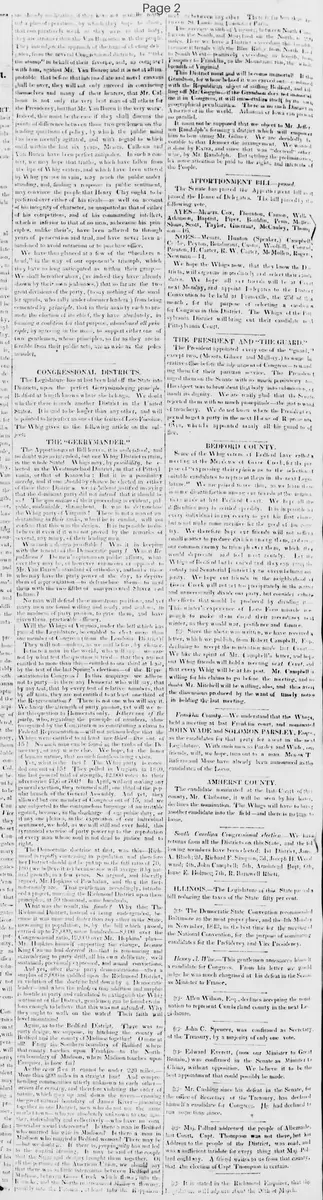
CONGRESSIONAL DISTRICTS
The Legislature has at last laid off the State into Districts, upon the perfect Gerrymandering principle. Bedford at length knows where she belongs. We doubt whether there is such another District in the United States. It is said to be longer than any other, and will be pointed to hereafter as one of the fruits of Loco Focoism.
The Whig gives us the following article on the subject:
THE "GERRYMANDER."
The Apportionment Bill leaves, it is understood, and no doubt was so intended, but one Whig District certain, in the whole State! Whigs may, by possibility, be elected in the Westmoreland District, in that of Pittsylvania, or that of Kanawha: But it is a possibility merely, and if one should by chance be elected in either of these three Districts, we are at least justified in saying that the dominant party did not intend that it should be so! The quo animo of their proceeding is evident, palpable, undeniable, throughout. It was to disfranchise the Whig party of Virginia! There is not a man of ordinary understanding in their ranks, who if he is candid, will not confess that this was the design. It is more possible to believe it even if it was not proved by the remarks of several, nay many, of their leading men.
Was such a design justifiable? Was it in keeping with the tenets of the Democratic party? Was it Republican? On men's opinions on public affairs, whatever they may be, or however erroneously or opposed to Mr. Van Buren's standard of orthodoxy, authorize those who may have the party power of the day, to deprive them of representation—to disfranchise them to compare them with the two fifths of unrepresented slaves; and Indians?
No man will defend these monstrous positions, and yet many men are found willing and ready, and mad in the madness of party passion, to give them, and have given them, practicable efficacy.
Will the Whigs of Virginia, under the bill which has passed the Legislature, be enabled to elect more than one member of Congress (from the Loudoun Dist.) They will not—unless, as we said before, by chance.
Is there a man in the world, who will say we care not by what test the pistol is loaded—that they are not entitled to more than this—entitled to one third at least by the test of the last Spring's elections—of the Representatives in Congress? In this umpirage we adhere not to party—is there any Democrat who will say, that by any test, that by every test of relative numbers, that by all tests, they are not entitled to at least one third of the Representation? There is not one who will say it.
We know the strength of party passion, yet will we refer this question to Democrats only. Is there one of the party, who, regarding the principle of numbers, alone recognized by the Constitution as constituting a claim to Federal Representation—will not acknowledge that the Whigs were entitled to at least one third—five out of 15? No such man can be found in the ranks of the Democracy, or any where else. We hope, for the honor of human nature, that no such frontless being exists.
Yet, what is the fact? The Whig party is conceded one out of 15! They polled in Virginia in 1840 the last general trial of strength, 42,000 votes to their adversaries 43,000 or 700! In April, without making a general exertion, they returned still, one third of the popular branch of the General Assembly. And yet, they allowed but one member of Congress out of 15, and we are subjected to the contumelious language of an irritable egotist, because, in the discharge of our public duty, or if any one pleases, in the expression of our individual sentiment, we hold, as we will still and ever hold, this tyrannical exercise of party power up to the reprobation of every man whose soul is not dead to justice and to right.
The Democratic doctrine at first, was this—Richmond is rapidly increasing in population and therefore her District should not be put up to the full ratio of 70,000 (we believe it is) because she will average why natural growth, in a few years. So argued, and liberally argued, Mr. Hopkins of Powhatan, and this the fact notoriously is. That gentleman accordingly, introduced a project, assessing the Richmond District upon these principles, at 50 thousand, some hundreds.
What was the result, the finale? Why this: The Richmond District, instead of being undergraded, because it was more and faster than any other in the State. mere asing in population, is, by the bill which passed, carried up to 78,000, some hundreds—8,000 over the Congressional ratio, 19,000 over Mr. Hopkins' plan— Mr. Hopkins himself supporting the change, because King Caucus had decreed it—that is renouncing and surrendering to party drill, all his own deliberate, well sustained, previously expressed, and sound convictions.
And yet, after all party demonstrations—after a surplus of 8,000 is saddled upon the Richmond District, in violation of the doctrine laid down by a Democratic leader—and when the vote of this addition and surplus is hostile in party and calculated to extinguish the Whig sentiment of the District, gentlemen can be found credulous enough to believe that this was not intended. Why they ought to wash on the wanted Their faith will level mountains!
Again, as to the Bedford District, There was no party design, we suppose, in hitching the county of Bedford and the county of Madison together! O none at all From the Southern boundary of Bedford where that county touches upon Franklin—to the Northern boundary of Madison, where Madison touches upon Fauquier, is how far?
As the crow flies it cannot be under 220 miles.— More than 300 miles in a straight line! And comprehending communities utterly unknown to each other— across the country, and therefore violating the order of nature. when gas up and down the rivers—crossing the great natural boundary of James River—joining together in one District, men who do not use the same language— who are absolutely unknown to one another. individually and collectively—who have no commercial or social intercourse! Is there a man in Bedford who married his wife in Madison? Is there a man in Madison who married a Bedford woman? There may be—but we doubt it. If there is, propinquity has not led to the putative blessing. It may be said of the couple that the State and destiny brought them together. Of all the portions of the American Union, we should say that there was as little intercourse between Bedford and Madison as between Gas Creek and the Rhine, at the North end, or between any other. That the full breadth of the true between St. Lawrence to look trap at. The avia width of Ingunt., between North Carolina the South, and Maryland in the North, is 200 miles. Here we have a District exceeding that and, in length it traverses with the Blue Ridge from North East to South West—parallelly running in both, from Fauquier to Franklin, as the Mountains run, the whole breadth of Virginia. This District must and will become immortal! It thus Grandison, for whose behalf it was carved out—emulous with the Republican object of stuffing Bedford, and bringing off Mr. Goggin—if the Grandison does not indorse it in Congress, It will immortalize itself by its own geographical peculiarities. There is no such District in America or in the world. Arkansas or Iowa can boast no parallel.
It must not be supposed that we object to Mr. Jefferson Randolph's forming a district which will empower him to beat strong Mr. Gilmer. We are decidedly favorable to that Democratic arrangement. We wished it done by Extra, and since that was "decreed" otherwise, by Mr. Randolph. But setting the predominant, his some attention be paid to the rights and interests of the People.
The Legislature has at last laid off the State into Districts, upon the perfect Gerrymandering principle. Bedford at length knows where she belongs. We doubt whether there is such another District in the United States. It is said to be longer than any other, and will be pointed to hereafter as one of the fruits of Loco Focoism.
The Whig gives us the following article on the subject:
THE "GERRYMANDER."
The Apportionment Bill leaves, it is understood, and no doubt was so intended, but one Whig District certain, in the whole State! Whigs may, by possibility, be elected in the Westmoreland District, in that of Pittsylvania, or that of Kanawha: But it is a possibility merely, and if one should by chance be elected in either of these three Districts, we are at least justified in saying that the dominant party did not intend that it should be so! The quo animo of their proceeding is evident, palpable, undeniable, throughout. It was to disfranchise the Whig party of Virginia! There is not a man of ordinary understanding in their ranks, who if he is candid, will not confess that this was the design. It is more possible to believe it even if it was not proved by the remarks of several, nay many, of their leading men.
Was such a design justifiable? Was it in keeping with the tenets of the Democratic party? Was it Republican? On men's opinions on public affairs, whatever they may be, or however erroneously or opposed to Mr. Van Buren's standard of orthodoxy, authorize those who may have the party power of the day, to deprive them of representation—to disfranchise them to compare them with the two fifths of unrepresented slaves; and Indians?
No man will defend these monstrous positions, and yet many men are found willing and ready, and mad in the madness of party passion, to give them, and have given them, practicable efficacy.
Will the Whigs of Virginia, under the bill which has passed the Legislature, be enabled to elect more than one member of Congress (from the Loudoun Dist.) They will not—unless, as we said before, by chance.
Is there a man in the world, who will say we care not by what test the pistol is loaded—that they are not entitled to more than this—entitled to one third at least by the test of the last Spring's elections—of the Representatives in Congress? In this umpirage we adhere not to party—is there any Democrat who will say, that by any test, that by every test of relative numbers, that by all tests, they are not entitled to at least one third of the Representation? There is not one who will say it.
We know the strength of party passion, yet will we refer this question to Democrats only. Is there one of the party, who, regarding the principle of numbers, alone recognized by the Constitution as constituting a claim to Federal Representation—will not acknowledge that the Whigs were entitled to at least one third—five out of 15? No such man can be found in the ranks of the Democracy, or any where else. We hope, for the honor of human nature, that no such frontless being exists.
Yet, what is the fact? The Whig party is conceded one out of 15! They polled in Virginia in 1840 the last general trial of strength, 42,000 votes to their adversaries 43,000 or 700! In April, without making a general exertion, they returned still, one third of the popular branch of the General Assembly. And yet, they allowed but one member of Congress out of 15, and we are subjected to the contumelious language of an irritable egotist, because, in the discharge of our public duty, or if any one pleases, in the expression of our individual sentiment, we hold, as we will still and ever hold, this tyrannical exercise of party power up to the reprobation of every man whose soul is not dead to justice and to right.
The Democratic doctrine at first, was this—Richmond is rapidly increasing in population and therefore her District should not be put up to the full ratio of 70,000 (we believe it is) because she will average why natural growth, in a few years. So argued, and liberally argued, Mr. Hopkins of Powhatan, and this the fact notoriously is. That gentleman accordingly, introduced a project, assessing the Richmond District upon these principles, at 50 thousand, some hundreds.
What was the result, the finale? Why this: The Richmond District, instead of being undergraded, because it was more and faster than any other in the State. mere asing in population, is, by the bill which passed, carried up to 78,000, some hundreds—8,000 over the Congressional ratio, 19,000 over Mr. Hopkins' plan— Mr. Hopkins himself supporting the change, because King Caucus had decreed it—that is renouncing and surrendering to party drill, all his own deliberate, well sustained, previously expressed, and sound convictions.
And yet, after all party demonstrations—after a surplus of 8,000 is saddled upon the Richmond District, in violation of the doctrine laid down by a Democratic leader—and when the vote of this addition and surplus is hostile in party and calculated to extinguish the Whig sentiment of the District, gentlemen can be found credulous enough to believe that this was not intended. Why they ought to wash on the wanted Their faith will level mountains!
Again, as to the Bedford District, There was no party design, we suppose, in hitching the county of Bedford and the county of Madison together! O none at all From the Southern boundary of Bedford where that county touches upon Franklin—to the Northern boundary of Madison, where Madison touches upon Fauquier, is how far?
As the crow flies it cannot be under 220 miles.— More than 300 miles in a straight line! And comprehending communities utterly unknown to each other— across the country, and therefore violating the order of nature. when gas up and down the rivers—crossing the great natural boundary of James River—joining together in one District, men who do not use the same language— who are absolutely unknown to one another. individually and collectively—who have no commercial or social intercourse! Is there a man in Bedford who married his wife in Madison? Is there a man in Madison who married a Bedford woman? There may be—but we doubt it. If there is, propinquity has not led to the putative blessing. It may be said of the couple that the State and destiny brought them together. Of all the portions of the American Union, we should say that there was as little intercourse between Bedford and Madison as between Gas Creek and the Rhine, at the North end, or between any other. That the full breadth of the true between St. Lawrence to look trap at. The avia width of Ingunt., between North Carolina the South, and Maryland in the North, is 200 miles. Here we have a District exceeding that and, in length it traverses with the Blue Ridge from North East to South West—parallelly running in both, from Fauquier to Franklin, as the Mountains run, the whole breadth of Virginia. This District must and will become immortal! It thus Grandison, for whose behalf it was carved out—emulous with the Republican object of stuffing Bedford, and bringing off Mr. Goggin—if the Grandison does not indorse it in Congress, It will immortalize itself by its own geographical peculiarities. There is no such District in America or in the world. Arkansas or Iowa can boast no parallel.
It must not be supposed that we object to Mr. Jefferson Randolph's forming a district which will empower him to beat strong Mr. Gilmer. We are decidedly favorable to that Democratic arrangement. We wished it done by Extra, and since that was "decreed" otherwise, by Mr. Randolph. But setting the predominant, his some attention be paid to the rights and interests of the People.
What sub-type of article is it?
Historical Event
Deception Fraud
What themes does it cover?
Deception
Justice
Misfortune
What keywords are associated?
Gerrymandering
Congressional Districts
Virginia Legislature
Whig Party
Democratic Party
Apportionment Bill
Bedford District
What entities or persons were involved?
Mr. Van Buren
Mr. Hopkins Of Powhatan
Mr. Jefferson Randolph
Mr. Goggin
Mr. Gilmer
Where did it happen?
Virginia
Story Details
Key Persons
Mr. Van Buren
Mr. Hopkins Of Powhatan
Mr. Jefferson Randolph
Mr. Goggin
Mr. Gilmer
Location
Virginia
Event Date
1840 1841
Story Details
The Virginia Legislature's Apportionment Bill creates gerrymandered congressional districts to limit Whig representation to one certain seat out of 15, despite their near-equal votes in 1840. The Bedford-Madison district spans over 300 miles, connecting unrelated communities to disadvantage Whigs.