Thank you for visiting SNEWPapers!
Sign up free
Story
September 20, 1934
The Redwood Gazette
Redwood Falls, Redwood County, Minnesota
What is this article about?
Practical advice on utilizing Russian thistles as animal feed during shortages: cut before spines harden for hay comparable to alfalfa in protein; mix with straw; use hardened ones for silage with added water or mixed with corn.
Clipping
OCR Quality
98%
Excellent
Full Text
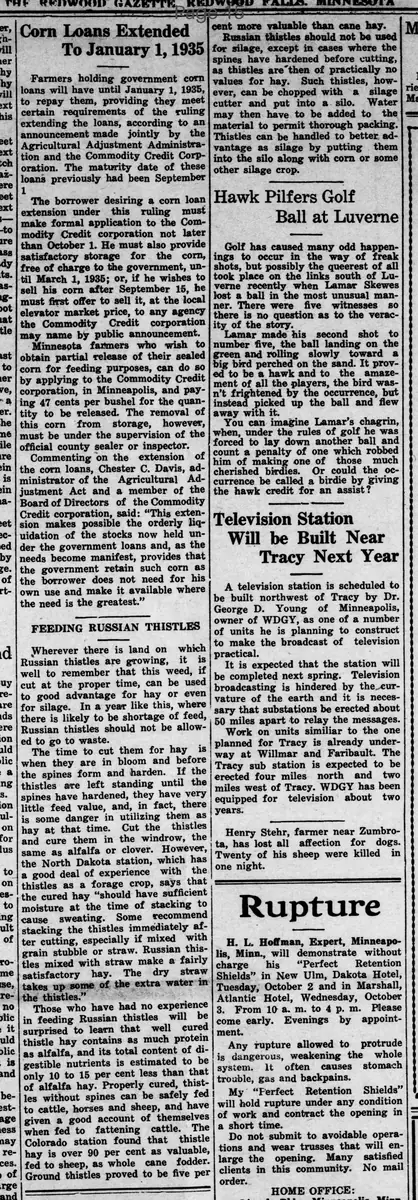
FEEDING RUSSIAN THISTLES
Wherever there is land on which Russian thistles are growing, it is well to remember that this weed, if cut at the proper time, can be used to good advantage for hay or even for silage. In a year like this, where there is likely to be shortage of feed, Russian thistles should not be allowed to go to waste.
The time to cut them for hay is when they are in bloom and before the spines form and harden. If the thistles are left standing until the spines have hardened, they have very little feed value, and, in fact, there is some danger in utilizing them as hay at that time. Cut the thistles and cure them in the windrow, the same as alfalfa or clover. However, the North Dakota station, which has a good deal of experience with the thistles as a forage crop, says that the cured hay "should have sufficient moisture at the time of stacking to cause sweating. Some recommend stacking the thistles immediately after cutting, especially if mixed with grain stubble or straw. Russian thistles mixed with straw make a fairly satisfactory hay. The dry straw takes up some of the extra water in the thistles."
Those who have had no experience in feeding Russian thistles will be surprised to learn that well cured thistle hay contains as much protein as alfalfa, and its total content of digestible nutrients is estimated to be only 10 to 15 per cent less than that of alfalfa hay. Properly cured, thistles without spines can be safely fed to cattle, horses and sheep, and have given a good account of themselves when fed to fattening cattle. The Colorado station found that thistle hay is over 90 per cent as valuable, fed to sheep, as whole cane fodder. Ground thistles proved to be five per cent more valuable than cane hay.
Russian thistles should not be used for silage, except in cases where the spines have hardened before cutting, as thistles are then of practically no value for hay. Such thistles, however, can be chopped with a silage cutter and put into a silo. Water may then have to be added to the material to permit thorough packing. Thistles can be handled to better advantage as silage by putting them into the silo along with corn or some other silage crop.
Wherever there is land on which Russian thistles are growing, it is well to remember that this weed, if cut at the proper time, can be used to good advantage for hay or even for silage. In a year like this, where there is likely to be shortage of feed, Russian thistles should not be allowed to go to waste.
The time to cut them for hay is when they are in bloom and before the spines form and harden. If the thistles are left standing until the spines have hardened, they have very little feed value, and, in fact, there is some danger in utilizing them as hay at that time. Cut the thistles and cure them in the windrow, the same as alfalfa or clover. However, the North Dakota station, which has a good deal of experience with the thistles as a forage crop, says that the cured hay "should have sufficient moisture at the time of stacking to cause sweating. Some recommend stacking the thistles immediately after cutting, especially if mixed with grain stubble or straw. Russian thistles mixed with straw make a fairly satisfactory hay. The dry straw takes up some of the extra water in the thistles."
Those who have had no experience in feeding Russian thistles will be surprised to learn that well cured thistle hay contains as much protein as alfalfa, and its total content of digestible nutrients is estimated to be only 10 to 15 per cent less than that of alfalfa hay. Properly cured, thistles without spines can be safely fed to cattle, horses and sheep, and have given a good account of themselves when fed to fattening cattle. The Colorado station found that thistle hay is over 90 per cent as valuable, fed to sheep, as whole cane fodder. Ground thistles proved to be five per cent more valuable than cane hay.
Russian thistles should not be used for silage, except in cases where the spines have hardened before cutting, as thistles are then of practically no value for hay. Such thistles, however, can be chopped with a silage cutter and put into a silo. Water may then have to be added to the material to permit thorough packing. Thistles can be handled to better advantage as silage by putting them into the silo along with corn or some other silage crop.
What sub-type of article is it?
Agricultural Advice
Farming Practice
What keywords are associated?
Russian Thistles
Animal Feed
Hay Production
Silage Making
Feed Shortage
Agricultural Weed Use
Story Details
Story Details
Guidance on harvesting and using Russian thistles as hay or silage for cattle, horses, and sheep, noting nutritional value similar to alfalfa when cut timely, and methods to handle hardened spines.