Thank you for visiting SNEWPapers!
Sign up free
Editorial
October 16, 1925
Union Labor Bulletin
Little Rock, Pulaski County, Arkansas
What is this article about?
This satirical editorial critiques the cultural trope of the poor boy who builds sterling character through poverty, self-denial, and resisting temptation, arguing it produces more criminals than heroes and serves as an excuse for hardship. References figures like Lincoln and Washington to debunk the idea.
Clipping
OCR Quality
98%
Excellent
Full Text
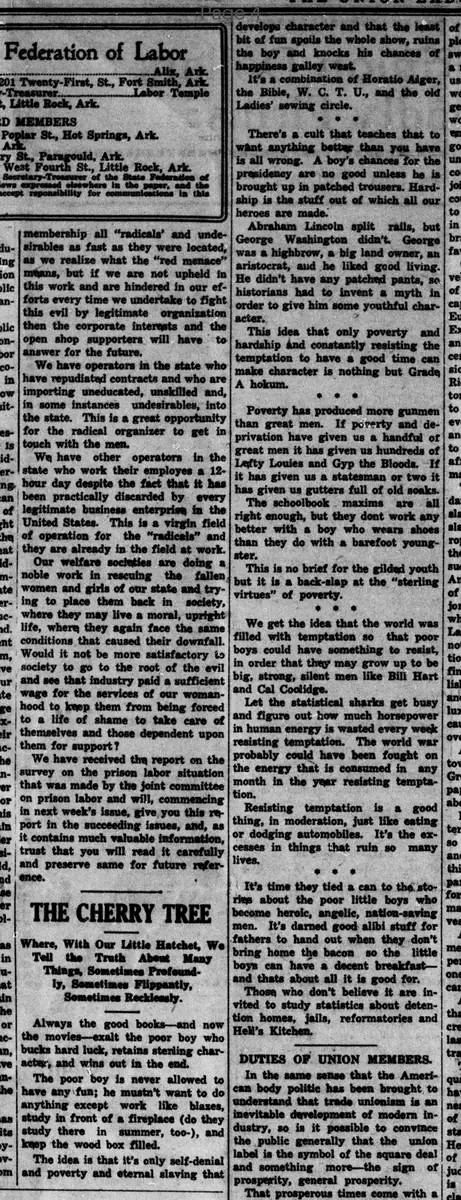
THE CHERRY TREE
Where, With Our Little Hatchet, We Tell the Truth About Many Things, Sometimes Profoundly, Sometimes Flippantly, Sometimes Recklessly.
Always the good books and now the movies--exalt the poor boy who bucks hard luck, retains sterling character, and wins out in the end.
The poor boy is never allowed to have any fun; he mustn't want to do anything except work like blazes, study in front of a fireplace (do they study there in summer, too-), and keep the wood box filled.
The idea is that it's only self-denial and poverty and eternal slaving that develops character and that the least bit of fun spoils the whole show, ruins the boy and knocks his chances of happiness rally west.
It's a combination of Horatio Alger the Bible, W. C. T. U., and the old Ladies' sewing circle.
There's a cult that teaches that to want anything better than you have is all wrong. A boy's chances for the presidency are no good unless he is brought up in patched trousers. Hardship is the stuff out of which all our heroes are made.
Abraham Lincoln split rails, but George Washington didn't. George was a highbrow, a big land owner, an aristocrat, and he liked good living.
He didn't have any patched pants, so historians had to invent a myth in order to give him some youthful character.
This idea that only poverty and hardship and constantly resisting the temptation to have a good time can make character is nothing but Grade A hokum.
Poverty has produced more gunmen than great men. If poverty and deprivation have given us a handful of great men it has given us hundreds of Lefty Louies and Gyp the Bloods. If it has given us a statesman or two it has given us gutters full of old soaks.
The schoolbook maxims are all right enough, but they dont work any better with a boy who wears shoes than they do with a barefoot youngster.
This is no brief for the gilded youth but it is a back-slap at the "sterling virtues" of poverty.
We get the idea that the world was filled with temptation so that poor boys could have something to resist, in order that they may grow up to be big, strong, silent men like Bill Hart and Cal Coolidge.
Let the statistical sharks get busy and figure out how much horsepower in human energy is wasted every week resisting temptation. The world war probably could have been fought on the energy that is consumed in any month in the year resisting temptation.
Resisting temptation is a good thing, in moderation, just like eating or dodging automobiles. It's the excesses in things that ruin so many lives.
It's time they tied a can to the stories about the poor little boys who become heroic, angelic, nation-saving men. It's darned good alibi stuff for fathers to hand out when they don't bring home the bacon so the little boys can have a decent breakfast- and thats about all it is good for.
Those who don't believe it are invited to study statistics about detention homes, jails, reformatories and Hell's Kitchen.
Where, With Our Little Hatchet, We Tell the Truth About Many Things, Sometimes Profoundly, Sometimes Flippantly, Sometimes Recklessly.
Always the good books and now the movies--exalt the poor boy who bucks hard luck, retains sterling character, and wins out in the end.
The poor boy is never allowed to have any fun; he mustn't want to do anything except work like blazes, study in front of a fireplace (do they study there in summer, too-), and keep the wood box filled.
The idea is that it's only self-denial and poverty and eternal slaving that develops character and that the least bit of fun spoils the whole show, ruins the boy and knocks his chances of happiness rally west.
It's a combination of Horatio Alger the Bible, W. C. T. U., and the old Ladies' sewing circle.
There's a cult that teaches that to want anything better than you have is all wrong. A boy's chances for the presidency are no good unless he is brought up in patched trousers. Hardship is the stuff out of which all our heroes are made.
Abraham Lincoln split rails, but George Washington didn't. George was a highbrow, a big land owner, an aristocrat, and he liked good living.
He didn't have any patched pants, so historians had to invent a myth in order to give him some youthful character.
This idea that only poverty and hardship and constantly resisting the temptation to have a good time can make character is nothing but Grade A hokum.
Poverty has produced more gunmen than great men. If poverty and deprivation have given us a handful of great men it has given us hundreds of Lefty Louies and Gyp the Bloods. If it has given us a statesman or two it has given us gutters full of old soaks.
The schoolbook maxims are all right enough, but they dont work any better with a boy who wears shoes than they do with a barefoot youngster.
This is no brief for the gilded youth but it is a back-slap at the "sterling virtues" of poverty.
We get the idea that the world was filled with temptation so that poor boys could have something to resist, in order that they may grow up to be big, strong, silent men like Bill Hart and Cal Coolidge.
Let the statistical sharks get busy and figure out how much horsepower in human energy is wasted every week resisting temptation. The world war probably could have been fought on the energy that is consumed in any month in the year resisting temptation.
Resisting temptation is a good thing, in moderation, just like eating or dodging automobiles. It's the excesses in things that ruin so many lives.
It's time they tied a can to the stories about the poor little boys who become heroic, angelic, nation-saving men. It's darned good alibi stuff for fathers to hand out when they don't bring home the bacon so the little boys can have a decent breakfast- and thats about all it is good for.
Those who don't believe it are invited to study statistics about detention homes, jails, reformatories and Hell's Kitchen.
What sub-type of article is it?
Satire
Social Reform
Moral Or Religious
What keywords are associated?
Poor Boy Myth
Poverty Hardship
Character Development
Success Stories
Temptation Resistance
Social Myths
What entities or persons were involved?
Horatio Alger
Abraham Lincoln
George Washington
Bill Hart
Cal Coolidge
Editorial Details
Primary Topic
Critique Of The Romanticized Poor Boy Success Myth
Stance / Tone
Satirical Mockery Of Poverty And Hardship As Character Builders
Key Figures
Horatio Alger
Abraham Lincoln
George Washington
Bill Hart
Cal Coolidge
Key Arguments
The Idealization Of The Poor Boy Who Succeeds Through Self Denial And Hardship Is Unrealistic And Overly Moralistic
Poverty Produces More Criminals And Failures Than Great Men
The Myth Combines Influences From Horatio Alger, The Bible, W.C.T.U., And Sewing Circles
George Washington Was An Aristocrat, Not Shaped By Poverty, Yet Historians Invented Myths For Him
Resisting Temptation In Excess Wastes Energy And Is Unnecessary For Character Development
Stories Of Poor Boys Becoming Heroes Serve As Alibis For Parental Failure
Statistics From Detention Homes And Jails Show Poverty's Negative Outcomes