Thank you for visiting SNEWPapers!
Sign up free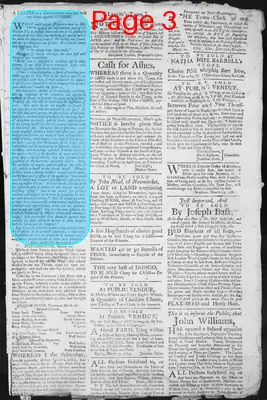
Letter to Editor
March 22, 1765
The New Hampshire Gazette And Historical Chronicle
Portsmouth, Greenland, Rockingham County, New Hampshire
What is this article about?
A letter defends women against a friend's severe satirical criticism, praising their amiable qualities, virtues, and essential role in humanizing men and promoting happiness through love and moral influence.
Clipping
OCR Quality
98%
Excellent
Full Text
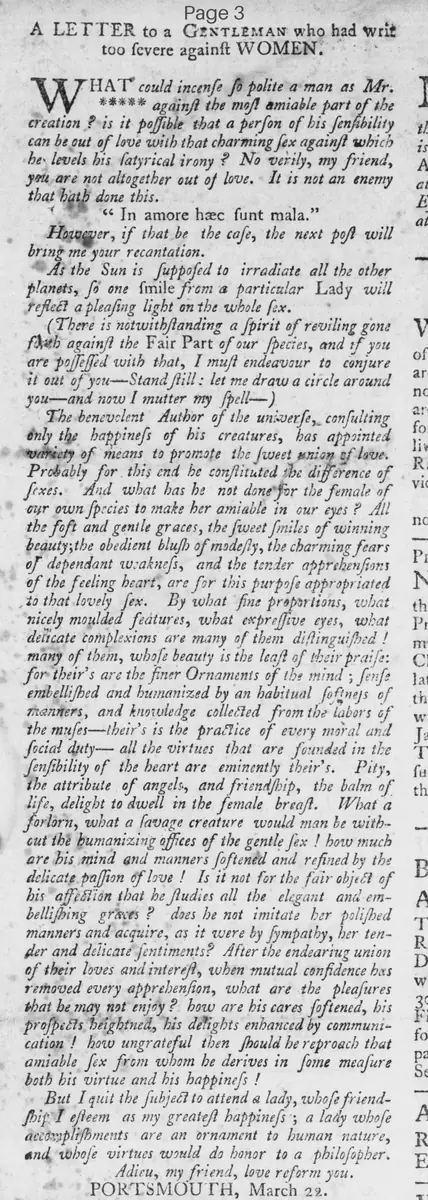
A LETTER to a GENTLEMAN who had writ too severe against WOMEN.
WHAT could incense one man against the most amiable part of the creation? is it possible that a person of his sensibility can be out of love with that charming sex against which he levels his Satyrical irony? No verily, my friend, you are not altogether out of love. It is not an enemy that hath done this.
"In amore hæc sunt mala."
However, if that be the case, the next post will bring me your recantation.
As the Sun is supposed to irradiate all the other planets, one smile from a particular Lady will reflect a pleasing light on the whole sex.
(There is notwithstanding a spirit of reviling gone forth against the Fair Part of our species, and if you are possessed with that, I must endeavour to conjure it out of you--Stand still: let me draw a circle around you--and now I mutter my spell--)
The benevolent Author of the universe, consulting only the happiness of his creatures, has appointed variety of means to promote the sweet union of love. Probably for this end he constituted the difference of sexes. And what has he not done for the female of our own species to make her amiable in our eyes? All the soft and gentle graces, the sweet smiles of winning beauty; the obedient blush of modesty, the charming fears of dependant weakness, and the tender apprehensions of the feeling heart, are for this purpose appropriated to that lovely sex. By what fine proportions, what nicely moulded features, what expressive eyes, what delicate complexions are many of them distinguished! many of them, whose beauty is the least of their praise: for theirs are the finer Ornaments of the mind; sense embellished and humanized by an habitual softness of manners, and knowledge collected from the labors of the muses--theirs is the practice of every moral and social duty-- all the virtues that are founded in the sensibility of the heart are eminently theirs. Pity, the attribute of angels, and friendship, the balm of life, delight to dwell in the female breast. What a forlorn, what a savage creature would man be without the humanizing offices of the gentle sex! how much are his mind and manners softened and refined by the delicate passion of love! Is it not for the fair object of his affection that he studies all the elegant and embellishing graces? does he not imitate her polished manners and acquire, as it were by sympathy, her tender and delicate sentiments? After the endearing union of their loves and interests, when mutual confidence has removed every apprehension, what are the pleasures that he may not enjoy? how are his cares softened, his prospects heightened, his delights enhanced by communication! how ungrateful then should he reproach that amiable sex from whom he derives in some measure both his virtue and his happiness!
But I quit the subject to attend a lady, whose friendship I esteem as my greatest happiness; a lady whose accomplishments are an ornament to human nature, and whose virtues would do honor to a philosopher.
Adieu, my friend, love reform you.
WHAT could incense one man against the most amiable part of the creation? is it possible that a person of his sensibility can be out of love with that charming sex against which he levels his Satyrical irony? No verily, my friend, you are not altogether out of love. It is not an enemy that hath done this.
"In amore hæc sunt mala."
However, if that be the case, the next post will bring me your recantation.
As the Sun is supposed to irradiate all the other planets, one smile from a particular Lady will reflect a pleasing light on the whole sex.
(There is notwithstanding a spirit of reviling gone forth against the Fair Part of our species, and if you are possessed with that, I must endeavour to conjure it out of you--Stand still: let me draw a circle around you--and now I mutter my spell--)
The benevolent Author of the universe, consulting only the happiness of his creatures, has appointed variety of means to promote the sweet union of love. Probably for this end he constituted the difference of sexes. And what has he not done for the female of our own species to make her amiable in our eyes? All the soft and gentle graces, the sweet smiles of winning beauty; the obedient blush of modesty, the charming fears of dependant weakness, and the tender apprehensions of the feeling heart, are for this purpose appropriated to that lovely sex. By what fine proportions, what nicely moulded features, what expressive eyes, what delicate complexions are many of them distinguished! many of them, whose beauty is the least of their praise: for theirs are the finer Ornaments of the mind; sense embellished and humanized by an habitual softness of manners, and knowledge collected from the labors of the muses--theirs is the practice of every moral and social duty-- all the virtues that are founded in the sensibility of the heart are eminently theirs. Pity, the attribute of angels, and friendship, the balm of life, delight to dwell in the female breast. What a forlorn, what a savage creature would man be without the humanizing offices of the gentle sex! how much are his mind and manners softened and refined by the delicate passion of love! Is it not for the fair object of his affection that he studies all the elegant and embellishing graces? does he not imitate her polished manners and acquire, as it were by sympathy, her tender and delicate sentiments? After the endearing union of their loves and interests, when mutual confidence has removed every apprehension, what are the pleasures that he may not enjoy? how are his cares softened, his prospects heightened, his delights enhanced by communication! how ungrateful then should he reproach that amiable sex from whom he derives in some measure both his virtue and his happiness!
But I quit the subject to attend a lady, whose friendship I esteem as my greatest happiness; a lady whose accomplishments are an ornament to human nature, and whose virtues would do honor to a philosopher.
Adieu, my friend, love reform you.
What sub-type of article is it?
Persuasive
Reflective
Philosophical
What themes does it cover?
Feminism
Morality
Social Issues
What keywords are associated?
Defense Of Women
Gender Virtues
Love And Morality
Female Amiability
Humanizing Influence
What entities or persons were involved?
A Gentleman Who Had Writ Too Severe Against Women
Letter to Editor Details
Recipient
A Gentleman Who Had Writ Too Severe Against Women
Main Argument
women possess inherent amiable qualities and virtues that humanize men, refine their manners, and contribute to their happiness and moral development; criticizing them is ungrateful and misguided.
Notable Details
Quotes Latin: 'In Amore Hæc Sunt Mala.'
References The Benevolent Author Of The Universe (God) In Creating Sexes For Love And Happiness.
Uses Metaphorical Spell Casting To 'Conjure' Out Reviling Spirit.
Ends By Attending To A Virtuous Lady.