Thank you for visiting SNEWPapers!
Sign up free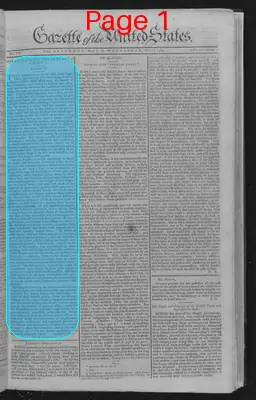
Editorial
May 6, 1789
Gazette Of The United States
New York, New York County, New York
What is this article about?
This editorial critiques the post-Revolutionary political state of America, highlighting moral decay from fluctuating currency and war habits, economic inactivity, weak congressional authority, prevailing injustice, and the rise of anarchy, urging stronger national regulations for prosperity.
Clipping
OCR Quality
95%
Excellent
Full Text
A SKETCH of the POLITICAL STATE of AMERICA.
NUMBER IV.
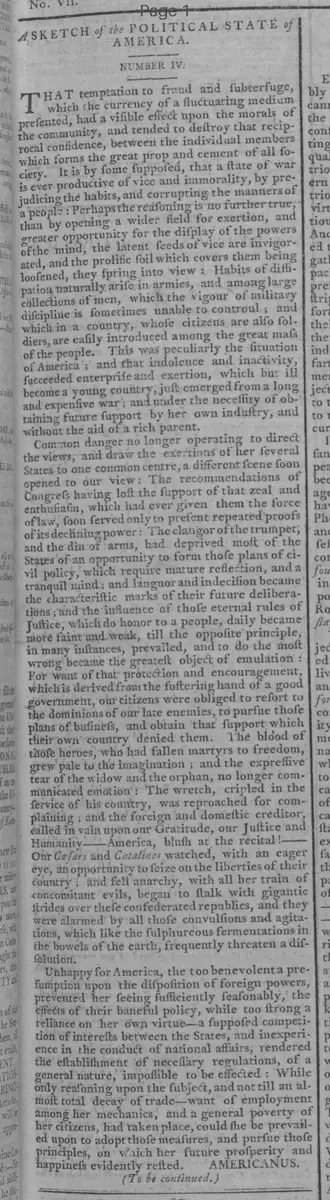
That temptation to fraud and subterfuge, which the currency of a fluctuating medium presented, had a visible effect upon the morals of the community, and tended to destroy that reciprocal confidence between the individual members of society. It is by some opposed, that a state of war which forms the great prop and cement of all societies, is ever productive of vice and immorality, by prejudicing the habits, and corrupting the manners of a people: Perhaps the reasoning is no further true, than by opening a wider field for exertion, and greater opportunity for the display of the powers of the mind, the latent seeds of vice are invigorated, and the prolific soil which covers them being loosened, they spring into view: Habits of dissipation naturally arise in armies, and among large collections of men, which the vigour of military discipline is sometimes unable to controul; and which in a country, whose citizens are also soldiers, are easily introduced among the great mass of the people. This was peculiarly the situation of America; and that indolence and inactivity succeeded enterprise and exertion, which but ill became a young country, just emerged from a long and expensive war; and under the necessity of obtaining future support by her own industry, and without the aid of a rich parent. The common danger no longer operating to direct the views, and draw the exertions of her several States to one common centre, a different scene soon opened to our view: The recommendations of Congress having lost the support of that zeal and enthusiasm, which had ever given them the force of law, soon served only to present repeated proofs of its declining power: The clangor of the trumpet, and the din of arms, had deprived most of the States of an opportunity to form those plans of civil policy, which require mature reflection, and a tranquil mind; and languor and indecision became the characteristic marks of their future deliberations; and the influence of those eternal rules of Justice, which do honor to a people, daily became more faint and weak, till the opposite principle, in many instances, prevailed, and to do the most wrong became the greatest object of emulation: For want of that protection and encouragement, which is derived from the fostering hand of a good government, our citizens were obliged to resort to the dominions of our late enemies, to pursue those plans of business, and obtain that support which their own country denied them. The blood of those heroes, who had fallen martyrs to freedom, grew pale to the imagination; and the expressive tear of the widow and the orphan, no longer communicated emotion: The wretch, crippled in the service of his country, was reproached for complaining; and the foreign and domestic creditor, called in vain upon our Gratitude, our Justice and Humanity—America, blush at the recital!— Our Caesars and Catalines watched, with an eager eye, an opportunity to seize on the liberties of their country; and fell anarchy, with all her train of concomitant evils, began to stalk with gigantic strides over these confederated republics, and they were alarmed by all those convulsions and agitations, which like the sulphureous fermentations in the bowels of the earth, frequently threaten a dissolution. Unhappy for America, the too benevolent presumption upon the disposition of foreign powers, prevented her seeing sufficiently early, the effects of their baneful policy, while too strong a reliance on her own virtue a supposed competition of interests between the States, and inexperience in the conduct of national affairs, rendered the establishment of necessary regulations, of a general nature, impossible to be effected: While only reasoning upon the subject, and not till an almost total decay of trade—want of employment among her mechanics, and a general poverty of her citizens, had taken place, could she be prevailed upon to adopt those measures, and pursue those principles, on which her future prosperity and happiness evidently rested. AMERICANUS.
(To be continued.)
NUMBER IV.
That temptation to fraud and subterfuge, which the currency of a fluctuating medium presented, had a visible effect upon the morals of the community, and tended to destroy that reciprocal confidence between the individual members of society. It is by some opposed, that a state of war which forms the great prop and cement of all societies, is ever productive of vice and immorality, by prejudicing the habits, and corrupting the manners of a people: Perhaps the reasoning is no further true, than by opening a wider field for exertion, and greater opportunity for the display of the powers of the mind, the latent seeds of vice are invigorated, and the prolific soil which covers them being loosened, they spring into view: Habits of dissipation naturally arise in armies, and among large collections of men, which the vigour of military discipline is sometimes unable to controul; and which in a country, whose citizens are also soldiers, are easily introduced among the great mass of the people. This was peculiarly the situation of America; and that indolence and inactivity succeeded enterprise and exertion, which but ill became a young country, just emerged from a long and expensive war; and under the necessity of obtaining future support by her own industry, and without the aid of a rich parent. The common danger no longer operating to direct the views, and draw the exertions of her several States to one common centre, a different scene soon opened to our view: The recommendations of Congress having lost the support of that zeal and enthusiasm, which had ever given them the force of law, soon served only to present repeated proofs of its declining power: The clangor of the trumpet, and the din of arms, had deprived most of the States of an opportunity to form those plans of civil policy, which require mature reflection, and a tranquil mind; and languor and indecision became the characteristic marks of their future deliberations; and the influence of those eternal rules of Justice, which do honor to a people, daily became more faint and weak, till the opposite principle, in many instances, prevailed, and to do the most wrong became the greatest object of emulation: For want of that protection and encouragement, which is derived from the fostering hand of a good government, our citizens were obliged to resort to the dominions of our late enemies, to pursue those plans of business, and obtain that support which their own country denied them. The blood of those heroes, who had fallen martyrs to freedom, grew pale to the imagination; and the expressive tear of the widow and the orphan, no longer communicated emotion: The wretch, crippled in the service of his country, was reproached for complaining; and the foreign and domestic creditor, called in vain upon our Gratitude, our Justice and Humanity—America, blush at the recital!— Our Caesars and Catalines watched, with an eager eye, an opportunity to seize on the liberties of their country; and fell anarchy, with all her train of concomitant evils, began to stalk with gigantic strides over these confederated republics, and they were alarmed by all those convulsions and agitations, which like the sulphureous fermentations in the bowels of the earth, frequently threaten a dissolution. Unhappy for America, the too benevolent presumption upon the disposition of foreign powers, prevented her seeing sufficiently early, the effects of their baneful policy, while too strong a reliance on her own virtue a supposed competition of interests between the States, and inexperience in the conduct of national affairs, rendered the establishment of necessary regulations, of a general nature, impossible to be effected: While only reasoning upon the subject, and not till an almost total decay of trade—want of employment among her mechanics, and a general poverty of her citizens, had taken place, could she be prevailed upon to adopt those measures, and pursue those principles, on which her future prosperity and happiness evidently rested. AMERICANUS.
(To be continued.)
What sub-type of article is it?
Constitutional
Moral Or Religious
Economic Policy
What keywords are associated?
Post War America
Moral Decay
Weak Congress
Economic Hardship
Political Anarchy
Social Trust
Vice And Dissipation
National Regulations
What entities or persons were involved?
Congress
States
Foreign Powers
Caesars And Catalines
Editorial Details
Primary Topic
Critique Of Post Revolutionary American Confederation And Moral Decline
Stance / Tone
Critical Lamentation Urging Stronger Government
Key Figures
Congress
States
Foreign Powers
Caesars And Catalines
Key Arguments
Fluctuating Currency Tempted Fraud And Eroded Social Trust
War Opened Opportunities For Vice And Dissipation Among Citizens
Post War Indolence Ill Suited A Young Nation Reliant On Industry
Congressional Recommendations Lost Force Without Zeal
States Lacked Time For Civil Policy Due To War Distractions
Injustice Prevailed Over Justice In Deliberations
Citizens Sought Business Abroad Due To Lack Of Domestic Support
War Heroes And Victims Forgotten, Creditors Ignored
Ambitious Leaders Eyed Liberties Amid Anarchy
Overreliance On Virtue And Inexperience Hindered Regulations
Economic Decay Forced Adoption Of Necessary Measures