Thank you for visiting SNEWPapers!
Sign up free
Daily National Intelligencer
Washington, District Of Columbia
What is this article about?
Extract of a letter from a gentleman at Harper's Ferry, Aug. 3, 1800s, describing the new turnpike road from Little Falls to Leesburg, prosperous small farms in upper Virginia once leased by the Fairfax family, the scenic beauty and U.S. Armory at Harper's Ferry, and potential for improved Potomac and Shenandoah navigation to boost western commerce.
Clipping
OCR Quality
Full Text
SATURDAY, AUGUST 9.
EDITORS' CORRESPONDENCE.
Extract of a letter from a gentleman on an excursion to the upper counties of Virginia.
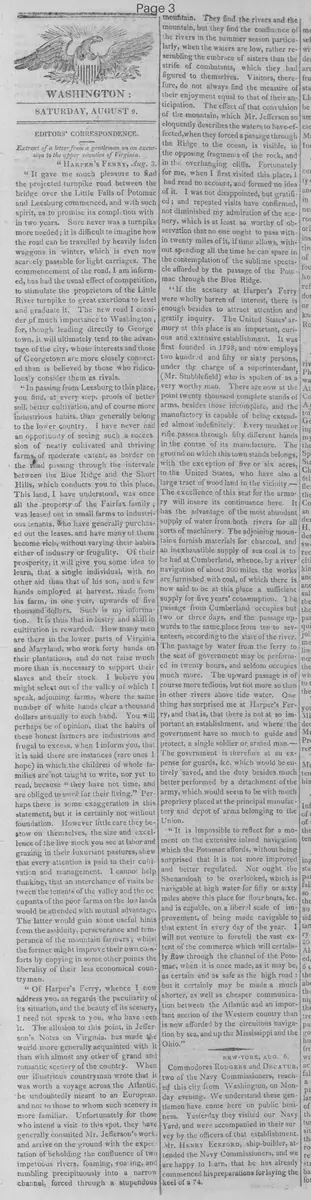
"Harper's Ferry, Aug. 3.
"It gave me much pleasure to find the projected turnpike road between the bridge over the Little Falls of Potomac and Leesburg commenced, and with such spirit, as to promise its completion within two years. Sure never was a turnpike more needed; it is difficult to imagine how the road can be travelled by heavily laden waggons in winter, which is even now scarcely passable for light carriages. The commencement of the road, I am informed, has had the usual effect of competition, to stimulate the proprietors of the Little River turnpike to great exertions to level and graduate it. The new road I consider of much importance to Washington: for, though leading directly to Georgetown, it will ultimately tend to the advantage of the city, whose interests and those of Georgetown are more closely connected than is believed by those who ridiculously consider them as rivals.
"In passing from Leesburg to this place, you find, at every step, proofs of better soil, better cultivation, and of course more industrious habits, than generally belong to the lower country. I have never had an opportunity of seeing such a succession of neatly cultivated and thriving farms, of moderate extent, as border on the road passing through the intervale between the Blue Ridge and the Short Hills, which conducts you to this place. This land, I have understood, was once all the property of the Fairfax family; was leased out in small farms to industrious tenants, who have generally purchased out the leases, and have many of them become rich, without varying their habits either of industry or frugality. Of their prosperity, it will give you some idea to learn, that a single individual, with no other aid than that of his son, and a few hands employed at harvest, made from his farm, in one year, upwards of five thousand dollars. Such is my information. It is thus that industry and skill in cultivation is rewarded. How many men are there in the lower parts of Virginia and Maryland, who work forty hands on their plantations, and do not raise much more than is necessary to support their slaves and their stock. I believe you might select out of the valley of which I speak, adjoining farms, where the same number of white hands clear a thousand dollars annually to each hand. You will perhaps be of opinion, that the habits of these honest farmers are industrious and frugal to excess, when I inform you, that it is said there are instances (rare ones I hope) in which the children of whole families are not taught to write, nor yet to read, because "they have not time, and are obliged to work for their living." Perhaps there is some exaggeration in this statement, but it is certainly not without foundation. However little care they bestow on themselves, the size and excellence of the live stock you see at labor and grazing in their luxuriant pastures, shew that every attention is paid to their cultivation and management. I cannot help thinking, that an interchange of visits between the tenants of the valley and the occupants of the poor farms on the low lands would be attended with mutual advantage. The latter would gain some useful hints from the assiduity, perseverance and temperance of the mountain farmers; whilst the former might improve their own comforts by copying in some other points the liberality of their less economical countrymen.
"Of Harper's Ferry, whence I now address you, as regards the peculiarity of its situation, and the beauty of its scenery, I need not speak to you, who have seen it. The allusion to this point, in Jefferson's Notes on Virginia, has made the world more generally acquainted with it than with almost any other of grand and romantic scenery of the country. When our illustrious countryman wrote that it was worth a voyage across the Atlantic, he undoubtedly meant to an European, and not to those to whom such scenery is more familiar. Unfortunately for those who intend a visit to this spot, they have generally consulted Mr. Jefferson's work, and arrive on the ground with the expectation of beholding the confluence of two impetuous rivers, foaming, roaring, and tumbling precipituously into a narrow channel, forced through a stupendous mountain. They find the rivers and the mountain, but they find the confluence of the rivers in the summer season particularly, when the waters are low, rather resembling the embrace of sisters than the strife of combatants, which they had figured to themselves. Visitors, therefore, do not always find the measure of their enjoyment equal to that of their anticipation. The effect of that convulsion of the mountain, which Mr. Jefferson so eloquently describes the waters to have effected, when they forced a passage through the Ridge to the ocean, is visible, in the opposing fragments of the rock, and in the overhanging cliffs. Fortunately for me, when I first visited this place, I had read no account, and formed no idea of it. I was not disappointed, but gratified; and repeated visits have confirmed, not diminished my admiration of the scenery, which is at least so worthy of observation that no one ought to pass within twenty miles of it, if time allows, without spending all the time he can spare in the contemplation of the sublime spectacle afforded by the passage of the Potomac through the Blue Ridge.
"If the scenery at Harper's Ferry were wholly barren of interest, there is enough besides to attract attention and gratify inquiry. The United States' armory at this place is an important, curious and extensive establishment. It was first founded in 1798, and now employs two hundred and fifty or sixty persons, under the charge of a superintendant (Mr. Stubblefield) who is spoken of as a very worthy man. There are now at the point twenty thousand complete stands of arms, besides those incomplete, and the manufactory is capable of being extended almost indefinitely. Every musket or rifle passes through fifty different hands in the course of its manufacture. The ground on which this town stands belongs, with the exception of five or six acres, to the United States, who have also a large tract of wood land in the vicinity. The excellence of this seat for the armory will insure its continuance here. It has the advantage of the most abundant supply of water from both rivers for all sorts of machinery. The adjoining mountains furnish materials for charcoal, and an inexhaustible supply of sea coal is to be had at Cumberland, whence, by a river navigation of about 200 miles, the works are furnished with coal, of which there is now said to be at this place a sufficient supply for five years' consumption. The passage from Cumberland occupies but two or three days, and the passage upwards to the same place from ten to seventeen, according to the state of the river. The passage by water from the ferry to the seat of government may be performed in twenty hours, and seldom occupies much more. The upward passage is of course more tedious, but not more so than in other rivers above tide water. One thing has surprised me at Harper's Ferry, and that is, that there is not at so important an establishment, and where the government have so much to guard and protect, a single soldier or armed man. The government is therefore at an expense for guards, &c. which would be entirely saved, and the duty besides much better performed by a detachment of the army, which would seem to be with much propriety placed at the principal manufactory and depot of arms belonging to the Union.
"It is impossible to reflect for a moment on the extensive inland navigation which the Potomac affords, without being surprised that it is not more improved and better regulated. Nor ought the Shenandoah to be overlooked, which is navigable at high water for fifty or sixty miles above this place for flour boats, &c. and is capable, on a liberal scale of improvement, of being made navigable to that extent in every day of the year. I will not venture to foretell the vast extent of the commerce which will certainly flow through the channel of the Potomac, when it is once made, as it may be, as certain and as safe as the high road: but it certainly may be made a much shorter, as well as cheaper communication between the Atlantic and an important section of the Western country than is now afforded by the circuitous navigation by sea, and up the Mississippi and the Ohio."
What sub-type of article is it?
What themes does it cover?
What keywords are associated?
What entities or persons were involved?
Letter to Editor Details
Author
A Gentleman
Recipient
Editors
Main Argument
the letter reports on the promising new turnpike road, thriving small farms in upper virginia, the scenic and strategic importance of harper's ferry including the u.s. armory, and advocates for improved navigation on the potomac and shenandoah rivers to enhance commerce with the west.
Notable Details