Thank you for visiting SNEWPapers!
Sign up free
Letter to Editor
March 3, 1790
The New Hampshire Gazette And General Advertiser
Portsmouth, Rockingham County, New Hampshire
What is this article about?
A farmer from Hampshire County advises sowing turnips late in August rather than July to avoid heat, drought, and black fly damage, reporting a yield of 900 bushels per acre on sandy loam soil in 1789.
Clipping
OCR Quality
95%
Excellent
Full Text
AGRICULTURE.
From the HAMPSHIRE GAZETTE.
Mr. Printer,
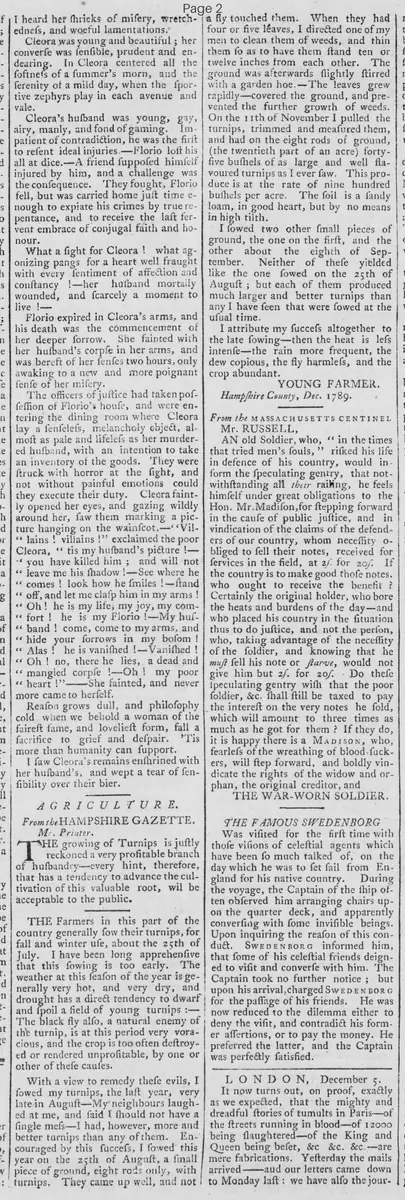
THE growing of Turnips is justly reckoned a very profitable branch of husbandry—every hint, therefore, that has a tendency to advance the cultivation of this valuable root, will be acceptable to the public.
THE Farmers in this part of the country generally sow their turnips, for fall and winter use, about the 25th of July. I have been long apprehensive that this sowing is too early. The weather at this season of the year is generally very hot, and very dry, and drought has a direct tendency to dwarf and spoil a field of young turnips:— The black fly also, a natural enemy of the turnip, is at this period very voracious, and the crop is too often destroyed or rendered unprofitable, by one or other of these causes.
With a view to remedy these evils, I sowed my turnips, the last year, very late in August—My neighbours laughed at me, and said I should not have a single mess—I had, however, more and better turnips than any of them. Encouraged by this success, I sowed this year on the 25th of August, a small piece of ground, eight rods only, with turnips. They came up well, and not a fly touched them. When they had four or five leaves, I directed one of my men to clean them of weeds, and thin them so as to have them stand ten or twelve inches from each other. The ground was afterwards slightly stirred with a garden hoe.—The leaves grew rapidly—covered the ground, and prevented the further growth of weeds.
On the 11th of November I pulled the turnips, trimmed and measured them, and had on the eight rods of ground, (the twentieth part of an acre) forty-five bushels of as large and well flavoured turnips as I ever saw. This produce is at the rate of nine hundred bushels per acre. The soil is a sandy loam, in good heart, but by no means in high tilth.
I sowed two other small pieces of ground, the one on the first, and the other about the eighth of September. Neither of these yielded like the one sowed on the 25th of August; but each of them produced much larger and better turnips than any I have seen that were sowed at the usual time.
I attribute my success altogether to the late sowing—then the heat is less intense—the rain more frequent, the dew copious, the fly harmless, and the crop abundant.
YOUNG FARMER.
Hampshire County, Dec. 1789.
From the HAMPSHIRE GAZETTE.
Mr. Printer,
THE growing of Turnips is justly reckoned a very profitable branch of husbandry—every hint, therefore, that has a tendency to advance the cultivation of this valuable root, will be acceptable to the public.
THE Farmers in this part of the country generally sow their turnips, for fall and winter use, about the 25th of July. I have been long apprehensive that this sowing is too early. The weather at this season of the year is generally very hot, and very dry, and drought has a direct tendency to dwarf and spoil a field of young turnips:— The black fly also, a natural enemy of the turnip, is at this period very voracious, and the crop is too often destroyed or rendered unprofitable, by one or other of these causes.
With a view to remedy these evils, I sowed my turnips, the last year, very late in August—My neighbours laughed at me, and said I should not have a single mess—I had, however, more and better turnips than any of them. Encouraged by this success, I sowed this year on the 25th of August, a small piece of ground, eight rods only, with turnips. They came up well, and not a fly touched them. When they had four or five leaves, I directed one of my men to clean them of weeds, and thin them so as to have them stand ten or twelve inches from each other. The ground was afterwards slightly stirred with a garden hoe.—The leaves grew rapidly—covered the ground, and prevented the further growth of weeds.
On the 11th of November I pulled the turnips, trimmed and measured them, and had on the eight rods of ground, (the twentieth part of an acre) forty-five bushels of as large and well flavoured turnips as I ever saw. This produce is at the rate of nine hundred bushels per acre. The soil is a sandy loam, in good heart, but by no means in high tilth.
I sowed two other small pieces of ground, the one on the first, and the other about the eighth of September. Neither of these yielded like the one sowed on the 25th of August; but each of them produced much larger and better turnips than any I have seen that were sowed at the usual time.
I attribute my success altogether to the late sowing—then the heat is less intense—the rain more frequent, the dew copious, the fly harmless, and the crop abundant.
YOUNG FARMER.
Hampshire County, Dec. 1789.
What sub-type of article is it?
Informative
Persuasive
What themes does it cover?
Agriculture
What keywords are associated?
Turnip Cultivation
Late Sowing
Black Fly
Agricultural Yield
Drought Avoidance
Hampshire County
What entities or persons were involved?
Young Farmer
Mr. Printer
Letter to Editor Details
Author
Young Farmer
Recipient
Mr. Printer
Main Argument
sowing turnips late in august avoids hot, dry weather and black fly damage, leading to higher yields compared to the usual july sowing.
Notable Details
Yield Of 900 Bushels Per Acre On Eight Rods Of Sandy Loam Soil
Sowed On 25th August, Harvested 11th November
Neighbors Ridiculed The Late Sowing But It Succeeded