Thank you for visiting SNEWPapers!
Sign up free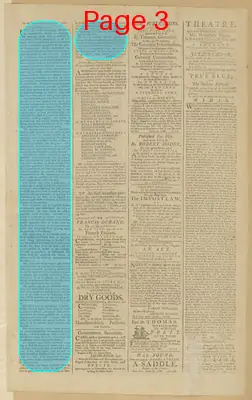
Letter to Editor
April 26, 1788
The New York Journal, And Daily Patriotic Register
New York, New York County, New York
What is this article about?
A letter to Mr. Greenleaf arguing that common mechanics and tradesmen, lacking education, should not comment on the proposed U.S. Constitution drafted by enlightened leaders, using trade analogies to illustrate their incompetence in political matters.
Clipping
OCR Quality
98%
Excellent
Full Text
FOR THE DAILY PATRIOTIC REGISTER.
MR. GREENLEAF,
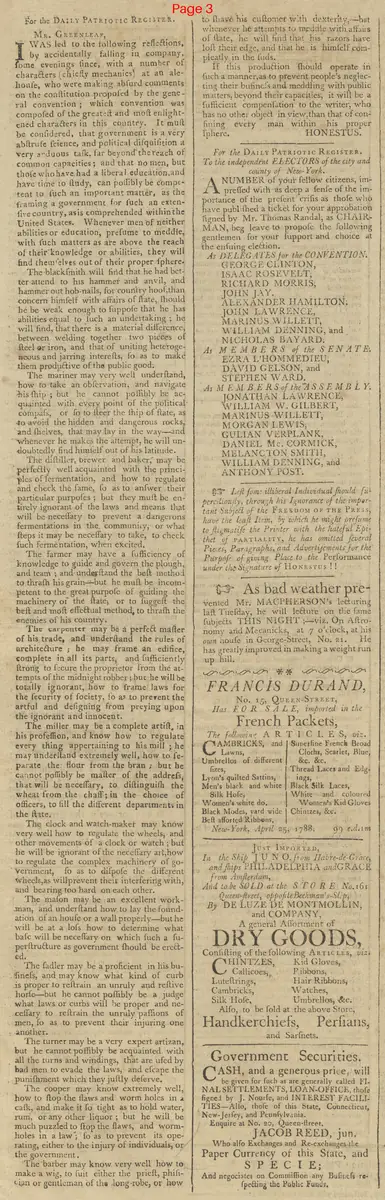
I was led to the following reflections by accidentally falling in company, some evenings since, with a number of characters (chiefly mechanics) at an ale-house, who were making absurd comments on the constitution proposed by the general convention; which convention was composed of the greatest and most enlightened characters in this country. It must be considered, that government is a very abstruse science, and political disquisition a very arduous task, far beyond the reach of common capacities; and that no men, but those who have had a liberal education, and have time to study, can possibly be competent to such an important matter, as the framing a government for such an extensive country, as is comprehended within the United States. Whenever men of neither abilities nor education presume to meddle with such matters as are above the reach of their knowledge or abilities, they will find themselves out of their proper sphere. The blacksmith will find that he had better attend to his hammer and anvil, and hammer out hob-nails for country hoof, than concern himself with affairs of state, should he be weak enough to suppose that he has abilities equal to such an undertaking; he will find, that there is a material difference between welding together two pieces of steel or iron, and that of uniting heterogeneous and jarring interests, so as to make them productive of the public good.
The mariner may very well understand how to take an observation, and navigate his ship: but he cannot possibly be acquainted with every point of the political compass, or so to steer the ship of state, as to avoid the hidden and dangerous rocks and shelves, that may lay in the way—and whenever he makes the attempt, he will undoubtedly find himself out of his latitude.
The distiller, brewer and baker, may be perfectly well acquainted with the principles of fermentation, and how to regulate and check the same, so as to answer their particular purposes; but they must be entirely ignorant of the laws and means that will be necessary to prevent dangerous fermentations in the community, or what steps it may be necessary to take, to check such fermentation, when excited.
The farmer may have a sufficiency of knowledge to guide and govern the plough and team: and understand the best method to thrash his grain—but he must be incompetent to the great purpose of guiding the machinery of the state, or to suggest the best and most effectual method, to thrash the enemies of his country.
The carpenter may be a perfect master of his trade, and understand the rules of architecture; he may frame an edifice complete in all its parts, and sufficiently strong to secure the proprietor from the attempts of the midnight robber; but he will be totally ignorant, how to frame laws for the security of society, so as to prevent the artful and designing from preying upon the ignorant and innocent.
The miller may be a complete artist, in his profession, and know how to regulate every thing appertaining to his mill: he may understand extremely well, how to separate the flour from the bran; but he cannot possibly be master of the address that will be necessary, to distinguish the wheat from the chaff: in the choice of officers, to fill the different departments in the state.
The clock and watch-maker may know very well how to regulate the wheels, and other movements of a clock or watch; but he will be ignorant of the necessary art, how to regulate the complex machinery of government, so as to dispose the different wheels, as will prevent their interfering with, and bearing too hard on each other.
The mason may be an excellent workman, and understand how to lay the foundation of a house or a wall properly—but he will be at a loss how to determine what basis will be necessary on which such a superstructure as government should be erected.
The saddler may be a proficient in his business, and may know what kind of curb is proper to restrain an unruly and restive horse but he cannot possibly be a judge what laws or curbs will be proper and necessary to restrain the unruly passions of men, so as to prevent their injuring one another.
The turner may be a very expert artizan, but he cannot possibly be acquainted with all the turns and windings, that are used by bad men to evade the laws, and escape the punishment which they justly deserve.
The cooper may know extremely well how to stop the flaws and worm holes in a cask, and make it so tight as to hold water, rum, or any other liquor; but he will be much puzzled to stop the flaws, and worm-holes in a law; so as to prevent its operating, either to the injury of individuals, or the government.
The barber may know very well how to make a wig, to suit either the priest, physician or gentleman of the long-robe, or how to have his customer with dexterity.—but whenever he attempts to meddle with affairs of state, he will find that his razors have lost their edge, and that he is himself completely in the suds.
If this production should operate in such a manner, as to prevent people's neglecting their business and meddling with public matters, beyond their capacities, it will be a sufficient compensation to the writer, who has no other object in view, than that of confining every man within his proper sphere.
HONESTUS.
MR. GREENLEAF,
I was led to the following reflections by accidentally falling in company, some evenings since, with a number of characters (chiefly mechanics) at an ale-house, who were making absurd comments on the constitution proposed by the general convention; which convention was composed of the greatest and most enlightened characters in this country. It must be considered, that government is a very abstruse science, and political disquisition a very arduous task, far beyond the reach of common capacities; and that no men, but those who have had a liberal education, and have time to study, can possibly be competent to such an important matter, as the framing a government for such an extensive country, as is comprehended within the United States. Whenever men of neither abilities nor education presume to meddle with such matters as are above the reach of their knowledge or abilities, they will find themselves out of their proper sphere. The blacksmith will find that he had better attend to his hammer and anvil, and hammer out hob-nails for country hoof, than concern himself with affairs of state, should he be weak enough to suppose that he has abilities equal to such an undertaking; he will find, that there is a material difference between welding together two pieces of steel or iron, and that of uniting heterogeneous and jarring interests, so as to make them productive of the public good.
The mariner may very well understand how to take an observation, and navigate his ship: but he cannot possibly be acquainted with every point of the political compass, or so to steer the ship of state, as to avoid the hidden and dangerous rocks and shelves, that may lay in the way—and whenever he makes the attempt, he will undoubtedly find himself out of his latitude.
The distiller, brewer and baker, may be perfectly well acquainted with the principles of fermentation, and how to regulate and check the same, so as to answer their particular purposes; but they must be entirely ignorant of the laws and means that will be necessary to prevent dangerous fermentations in the community, or what steps it may be necessary to take, to check such fermentation, when excited.
The farmer may have a sufficiency of knowledge to guide and govern the plough and team: and understand the best method to thrash his grain—but he must be incompetent to the great purpose of guiding the machinery of the state, or to suggest the best and most effectual method, to thrash the enemies of his country.
The carpenter may be a perfect master of his trade, and understand the rules of architecture; he may frame an edifice complete in all its parts, and sufficiently strong to secure the proprietor from the attempts of the midnight robber; but he will be totally ignorant, how to frame laws for the security of society, so as to prevent the artful and designing from preying upon the ignorant and innocent.
The miller may be a complete artist, in his profession, and know how to regulate every thing appertaining to his mill: he may understand extremely well, how to separate the flour from the bran; but he cannot possibly be master of the address that will be necessary, to distinguish the wheat from the chaff: in the choice of officers, to fill the different departments in the state.
The clock and watch-maker may know very well how to regulate the wheels, and other movements of a clock or watch; but he will be ignorant of the necessary art, how to regulate the complex machinery of government, so as to dispose the different wheels, as will prevent their interfering with, and bearing too hard on each other.
The mason may be an excellent workman, and understand how to lay the foundation of a house or a wall properly—but he will be at a loss how to determine what basis will be necessary on which such a superstructure as government should be erected.
The saddler may be a proficient in his business, and may know what kind of curb is proper to restrain an unruly and restive horse but he cannot possibly be a judge what laws or curbs will be proper and necessary to restrain the unruly passions of men, so as to prevent their injuring one another.
The turner may be a very expert artizan, but he cannot possibly be acquainted with all the turns and windings, that are used by bad men to evade the laws, and escape the punishment which they justly deserve.
The cooper may know extremely well how to stop the flaws and worm holes in a cask, and make it so tight as to hold water, rum, or any other liquor; but he will be much puzzled to stop the flaws, and worm-holes in a law; so as to prevent its operating, either to the injury of individuals, or the government.
The barber may know very well how to make a wig, to suit either the priest, physician or gentleman of the long-robe, or how to have his customer with dexterity.—but whenever he attempts to meddle with affairs of state, he will find that his razors have lost their edge, and that he is himself completely in the suds.
If this production should operate in such a manner, as to prevent people's neglecting their business and meddling with public matters, beyond their capacities, it will be a sufficient compensation to the writer, who has no other object in view, than that of confining every man within his proper sphere.
HONESTUS.
What sub-type of article is it?
Persuasive
Political
Social Critique
What themes does it cover?
Politics
Constitutional Rights
What keywords are associated?
Us Constitution
Political Competence
Tradesmen Analogies
Mechanics Critique
Federal Convention
Social Spheres
What entities or persons were involved?
Honestus.
Mr. Greenleaf,
Letter to Editor Details
Author
Honestus.
Recipient
Mr. Greenleaf,
Main Argument
ordinary mechanics and tradesmen, lacking liberal education, are incompetent to discuss or critique the proposed u.s. constitution and should confine themselves to their professions rather than meddling in complex political affairs.
Notable Details
Analogies From Trades Like Blacksmith, Mariner, Farmer, Carpenter, Etc., Comparing Skills To Political Incompetence.
Critique Of Ale House Discussions On The Constitution By Uneducated Men.
Emphasis On Government As An Abstruse Science Beyond Common Capacities.