Thank you for visiting SNEWPapers!
Sign up free
Editorial
September 28, 1936
The Bismarck Tribune
Bismarck, Mandan, Burleigh County, Morton County, North Dakota
What is this article about?
This editorial argues against the teacher's oath, viewing it as a slur on teachers' patriotism and a step toward suppressing free inquiry, akin to authoritarian regimes. It cites Conant's warnings and praises Landon's opposition.
Clipping
OCR Quality
98%
Excellent
Full Text
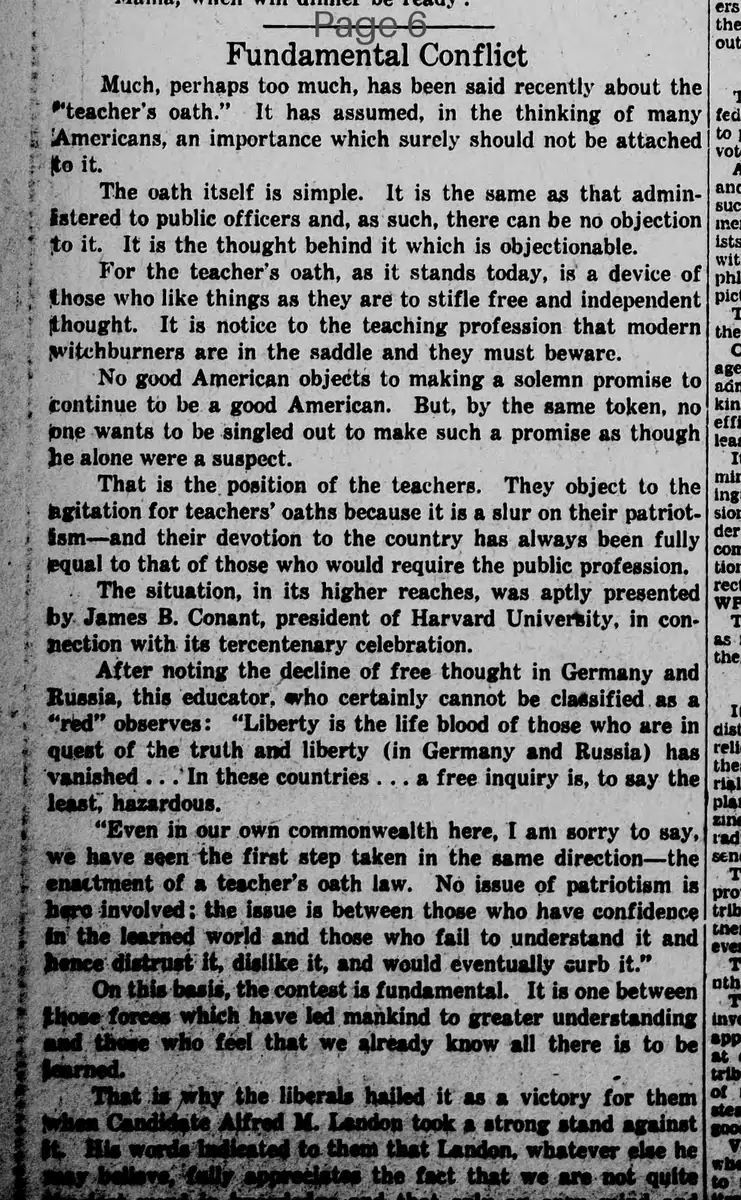
Fundamental Conflict
Much, perhaps too much, has been said recently about the "teacher's oath." It has assumed, in the thinking of many Americans, an importance which surely should not be attached to it.
The oath itself is simple. It is the same as that administered to public officers and, as such, there can be no objection to it. It is the thought behind it which is objectionable.
For the teacher's oath, as it stands today, is a device of those who like things as they are to stifle free and independent thought. It is notice to the teaching profession that modern witchburners are in the saddle and they must beware.
No good American objects to making a solemn promise to continue to be a good American. But, by the same token, no one wants to be singled out to make such a promise as though he alone were a suspect.
That is the position of the teachers. They object to the agitation for teachers' oaths because it is a slur on their patriotism—and their devotion to the country has always been fully equal to that of those who would require the public profession.
The situation, in its higher reaches, was aptly presented by James B. Conant, president of Harvard University, in connection with its tercentenary celebration.
After noting the decline of free thought in Germany and Russia, this educator, who certainly cannot be classified as a "red" observes: "Liberty is the life blood of those who are in quest of the truth and liberty (in Germany and Russia) has vanished . . . In these countries . . . a free inquiry is, to say the least, hazardous."
"Even in our own commonwealth here, I am sorry to say, we have seen the first step taken in the same direction—the enactment of a teacher's oath law. No issue of patriotism is here involved; the issue is between those who have confidence in the learned world and those who fail to understand it and hence distrust it, dislike it, and would eventually curb it."
On this basis, the contest is fundamental. It is one between those forces which have led mankind to greater understanding and those who feel that we already know all there is to be known.
That is why the liberals hailed it as a victory for them when Candidate Alfred M. Landon took a strong stand against it. His words indicated to them that Landon, whatever else he may be, retains the fact that we are not quite another European nation.
Much, perhaps too much, has been said recently about the "teacher's oath." It has assumed, in the thinking of many Americans, an importance which surely should not be attached to it.
The oath itself is simple. It is the same as that administered to public officers and, as such, there can be no objection to it. It is the thought behind it which is objectionable.
For the teacher's oath, as it stands today, is a device of those who like things as they are to stifle free and independent thought. It is notice to the teaching profession that modern witchburners are in the saddle and they must beware.
No good American objects to making a solemn promise to continue to be a good American. But, by the same token, no one wants to be singled out to make such a promise as though he alone were a suspect.
That is the position of the teachers. They object to the agitation for teachers' oaths because it is a slur on their patriotism—and their devotion to the country has always been fully equal to that of those who would require the public profession.
The situation, in its higher reaches, was aptly presented by James B. Conant, president of Harvard University, in connection with its tercentenary celebration.
After noting the decline of free thought in Germany and Russia, this educator, who certainly cannot be classified as a "red" observes: "Liberty is the life blood of those who are in quest of the truth and liberty (in Germany and Russia) has vanished . . . In these countries . . . a free inquiry is, to say the least, hazardous."
"Even in our own commonwealth here, I am sorry to say, we have seen the first step taken in the same direction—the enactment of a teacher's oath law. No issue of patriotism is here involved; the issue is between those who have confidence in the learned world and those who fail to understand it and hence distrust it, dislike it, and would eventually curb it."
On this basis, the contest is fundamental. It is one between those forces which have led mankind to greater understanding and those who feel that we already know all there is to be known.
That is why the liberals hailed it as a victory for them when Candidate Alfred M. Landon took a strong stand against it. His words indicated to them that Landon, whatever else he may be, retains the fact that we are not quite another European nation.
What sub-type of article is it?
Constitutional
Education
What keywords are associated?
Teacher's Oath
Free Thought
Patriotism
Witchburners
James B. Conant
Alfred M. Landon
Liberty
Education
What entities or persons were involved?
James B. Conant
Alfred M. Landon
Harvard University
Teachers
Editorial Details
Primary Topic
Opposition To Teacher's Oath
Stance / Tone
Critical Of Teacher's Oath As Stifling Free Thought
Key Figures
James B. Conant
Alfred M. Landon
Harvard University
Teachers
Key Arguments
The Teacher's Oath Is Simple But Objectionable As A Device To Stifle Free Thought.
It Serves As A Notice To Teachers That Modern Witchburners Are In Control.
Teachers Object To It As A Slur On Their Patriotism.
Free Inquiry Is Hazardous In Germany And Russia, And The Oath Is A First Step In That Direction In The Us.
The Issue Is Between Confidence In The Learned World And Those Who Distrust It.
The Contest Is Between Forces Advancing Understanding And Those Believing We Know All.
Liberals Hailed Landon's Stand Against It As A Victory.