Thank you for visiting SNEWPapers!
Sign up free
The Wilmingtonian, And Delaware Register
Wilmington, New Castle County, Delaware
What is this article about?
In September 1824, natives of Vavaoo, led by Chief Fenow, massacred the crew of the British whaler Elizabeth at Port Refuge, killing the captain, chief mate, and carpenter. Survivors escaped via gunfire from the tops and returned to Deptford, attributing the attack partly to crew imprudence.
Clipping
OCR Quality
Full Text
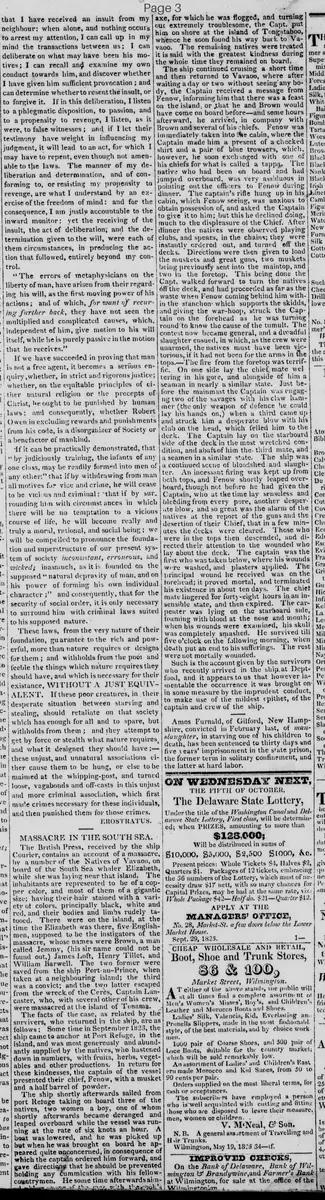
The British Press, received by the ship Courier, contains an account of a massacre, by a number of the Natives of Vavaoo, on board of the South Sea whaler Elizabeth, while she was laying near that island. The inhabitants are represented to be of a copper color, and most of them of a gigantic size; having their hair stained with a variety of colors, principally black, white and red, and their bodies and limbs rudely tattooed. There were on the island, at the time the Elizabeth was there, five Englishmen, supposed to be the instigators of the massacre, whose names were Brown, a man called Jimmy, (his sir name could not be found out,) James Loft, Henry Tillet, and William Barwell. The two former were saved from the ship Port-au-Prince, when taken at a neighbouring island; the third was a convict; and the two latter escaped from the wreck of the Ceres, Captain Lancaster, who, with several others of his crew, were massacred at the island of Tonama.
The facts of the case, as related by the survivors, who returned in the ship, are as follows: Some time in September 1824, the ship came to anchor at Port Refuge, in the island, and was most generously and abundantly supplied by the natives, who hastened down in numbers, with fruits, herbs, vegetables and other productions. In return for these kindnesses, the captain of the vessel presented their chief, Fenow, with a musket and a half barrel of powder.
The ship shortly afterwards sailed from Port Refuge taking on board three of the natives, two women and a boy, one of whom shortly afterwards became deranged and leaped overboard while the vessel was running at the rate of six knots an hour. A boat was lowered, and he was picked up but when he was brought on board he appeared quite unconcerned, in consequence of which the captain ordered him forward, and gave directions that he should be prevented holding any communication with his fellow-countrymen. He some time afterwards drank with the cook's axe, for which he was flogged, and turning out extremely troublesome, the Capt. put him on shore at the island of Tongataboo, whence he soon found his way back to Vavaoo. The remaining natives were treated it is said with the greatest kindness during the whole time they remained on board.
The ship continued cruising a short time and then returned to Vavaoo, where after waiting a day or two without seeing any body, the Captain received a message from Fenow, informing him that there was a feast on the island, or that he and Brown would have come on board before--and some hours afterward, he arrived, in company with Brown and several of his chiefs. Fenow was immediately taken into the cabin, where the Captain made him a present of a checked shirt and a pair of blue trowsers, which, however, he soon exchanged with one of his chiefs for what is called a tappa. The native who had been on board and had jumped overboard, was very assiduous in pointing out the officers to Fenow during dinner. The captain's rifle hung up in his cabin, which Fenow seeing, was anxious to obtain possession of, and asked the Captain to give it to him; but this he declined doing, much to the displeasure of the Chief. After dinner the natives were observed playing clubs, and spears, in the chains; they were instantly ordered out, and turned off the decks. Directions were then given to load the muskets and great guns, two muskets being previously sent into the maintop, and two in the foretop. This being done the Capt. walked forward to turn the natives off the deck. and had proceeded as far as the waist when Fenow coming behind him within the stanchion which supports the skidds, and giving the war-hoop, struck the Captain on the forehead as he was turning round to know the cause of the tumult. The contest now became general, and a dreadful slaughter ensued, in which, as the crew were unarmed, the natives must have been victorious, if it had not been for the arms in the tops.--The fire from the foretop was terrific. On one side lay the chief mate weltering in his gore, and alongside of him a seaman in nearly a similar state. Just before the mainmast the Captain was engaging two of the savages with his claw hammer (the only weapon of defence he could lay his hands on,) when a third came up and struck him a desperate blow with his club on the head, which felled him to the deck. The Captain lay on the starboard side of the deck in the most wretched condition, and abaft of him the third mate, and a seaman in a similar state. The ship was a continued scene of bloodshed and slaughter. An incessant firing was kept up from both tops, and Fenow shortly leaped overboard, though not before he had given the Captain, who at the time lay senseless and bleeding from every pore, another desperate blow, and so great was the alarm of the natives at the report of the guns and the desertion of their Chief. that in a few minutes the decks were cleared. Those who were in the tops then descended, and directed their attention to the wounded who lay about the deck. The captain was the first who was taken below, where his wounds were washed, and plasters applied. The principal wound he received was on the forehead; it proved mortal, and terminated his existence in about ten days. The chief mate lingered for forty-eight hours in an insensible state, and then expired. The carpenter was lying on the starboard side, foaming with blood at the nose and mouth; when his wounds were examined, his skull was completely smashed. He survived till five o'clock on the following morning, when death put an end to his sufferings. The rest were not mortally wounded.
Such is the account given by the survivors who recently arrived in the ship at Deptford, and it appears to us that however lamentable the occurrence it was brought on in some measure by the imprudent conduct, to make use of the mildest epithet, of the captain and crew of the ship.
What sub-type of article is it?
What keywords are associated?
What entities or persons were involved?
Where did it happen?
Foreign News Details
Primary Location
Vavaoo
Event Date
September 1824
Key Persons
Outcome
captain died after 10 days from forehead wound; chief mate expired after 48 hours; carpenter died next morning from smashed skull; other crew members wounded but survived; natives cleared the deck after gunfire and fenow leaped overboard.
Event Details
The British whaler Elizabeth anchored at Port Refuge, Vavaoo, in September 1824, and was supplied by locals. Captain gifted Chief Fenow a musket and powder. Ship took three natives aboard; one was flogged and put ashore at Tongataboo. Upon return to Vavaoo, Fenow, Brown, and chiefs boarded. After dinner, natives attacked, killing several crew with clubs and spears. Crew fired muskets from tops, repelling attackers. Survivors returned to Deptford.