Thank you for visiting SNEWPapers!
Sign up free
Story
June 30, 1878
The New Orleans Daily Democrat
New Orleans, Orleans County, Louisiana
What is this article about?
Excerpt from Dr. Clarke's book argues death is usually painless, illustrated by a terminally ill doctor's peaceful final hours using finger signals to deny suffering, bolstered by faith.
Clipping
OCR Quality
95%
Excellent
Full Text
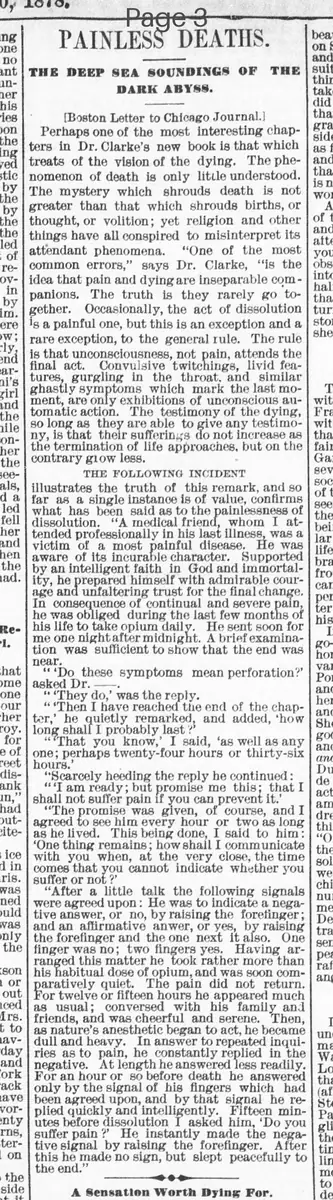
PAINLESS DEATHS.
THE DEEP SEA SOUNDINGS OF THE
DARK ABYSS.
[Boston Letter to Chicago Journal.]
Perhaps one of the most interesting chapters in Dr. Clarke's new book is that which treats of the vision of the dying. The phenomenon of death is only little understood. The mystery which shrouds death is not greater than that which shrouds births, or thought, or volition; yet religion and other things have all conspired to misinterpret its attendant phenomena. "One of the most common errors," says Dr. Clarke, "is the idea that pain and dying are inseparable companions. The truth is they rarely go together. Occasionally, the act of dissolution is a painful one, but this is an exception and a rare exception, to the general rule. The rule is that unconsciousness, not pain, attends the final act. Convulsive twitchings, livid features, gurgling in the throat, and similar ghastly symptoms which mark the last moment, are only exhibitions of unconscious automatic action. The testimony of the dying, so long as they are able to give any testimony, is that their sufferings do not increase as the termination of life approaches, but on the contrary grow less.
THE FOLLOWING INCIDENT
illustrates the truth of this remark, and so far as a single instance is of value, confirms what has been said as to the painlessness of dissolution. "A medical friend, whom I attended professionally in his last illness, was a victim of a most painful disease. He was aware of its incurable character. Supported by an intelligent faith in God and immortality, he prepared himself with admirable courage and unfaltering trust for the final change. In consequence of continual and severe pain, he was obliged during the last few months of his life to take opium daily. He sent soon for me one night after midnight. A brief examination was sufficient to show that the end was near.
"'Do these symptoms mean perforation?" asked Dr.
"They do," was the reply.
"Then I have reached the end of the chapter," he quietly remarked, and added, "how long shall I probably last?"
"That you know," I said, "as well as anyone; perhaps twenty-four hours or thirty-six hours."
"Scarcely heeding the reply he continued: "I am ready; but promise me this: that I shall not suffer pain if you can prevent it."
"The promise was given, of course, and I agreed to see him every hour or two as long as he lived. This being done, I said to him: "One thing remains; how shall I communicate with you when, at the very close, the time comes that you cannot indicate whether you suffer or not?"
"After a little talk the following signals were agreed upon: He was to indicate a negative answer, or no, by raising the forefinger; and an affirmative answer, or yes, by raising the forefinger and the one next it also. One finger was no; two fingers yes. Having arranged this matter he took rather more than his habitual dose of opium, and was soon comparatively quiet. The pain did not return. For twelve or fifteen hours he appeared much as usual; conversed with his family and friends, and was cheerful and serene. Then, as nature's anesthetic began to act, he became dull and heavy. In answer to repeated inquiries as to pain, he constantly replied in the negative. At length he answered less readily. For an hour or so before death he answered only by the signal of his fingers which had been agreed upon, and by that signal he replied quickly and intelligently. Fifteen minutes before dissolution I asked him, 'Do you suffer pain?' He instantly made the negative signal by raising the forefinger. After this he made no sign, but slept peacefully to the end."
THE DEEP SEA SOUNDINGS OF THE
DARK ABYSS.
[Boston Letter to Chicago Journal.]
Perhaps one of the most interesting chapters in Dr. Clarke's new book is that which treats of the vision of the dying. The phenomenon of death is only little understood. The mystery which shrouds death is not greater than that which shrouds births, or thought, or volition; yet religion and other things have all conspired to misinterpret its attendant phenomena. "One of the most common errors," says Dr. Clarke, "is the idea that pain and dying are inseparable companions. The truth is they rarely go together. Occasionally, the act of dissolution is a painful one, but this is an exception and a rare exception, to the general rule. The rule is that unconsciousness, not pain, attends the final act. Convulsive twitchings, livid features, gurgling in the throat, and similar ghastly symptoms which mark the last moment, are only exhibitions of unconscious automatic action. The testimony of the dying, so long as they are able to give any testimony, is that their sufferings do not increase as the termination of life approaches, but on the contrary grow less.
THE FOLLOWING INCIDENT
illustrates the truth of this remark, and so far as a single instance is of value, confirms what has been said as to the painlessness of dissolution. "A medical friend, whom I attended professionally in his last illness, was a victim of a most painful disease. He was aware of its incurable character. Supported by an intelligent faith in God and immortality, he prepared himself with admirable courage and unfaltering trust for the final change. In consequence of continual and severe pain, he was obliged during the last few months of his life to take opium daily. He sent soon for me one night after midnight. A brief examination was sufficient to show that the end was near.
"'Do these symptoms mean perforation?" asked Dr.
"They do," was the reply.
"Then I have reached the end of the chapter," he quietly remarked, and added, "how long shall I probably last?"
"That you know," I said, "as well as anyone; perhaps twenty-four hours or thirty-six hours."
"Scarcely heeding the reply he continued: "I am ready; but promise me this: that I shall not suffer pain if you can prevent it."
"The promise was given, of course, and I agreed to see him every hour or two as long as he lived. This being done, I said to him: "One thing remains; how shall I communicate with you when, at the very close, the time comes that you cannot indicate whether you suffer or not?"
"After a little talk the following signals were agreed upon: He was to indicate a negative answer, or no, by raising the forefinger; and an affirmative answer, or yes, by raising the forefinger and the one next it also. One finger was no; two fingers yes. Having arranged this matter he took rather more than his habitual dose of opium, and was soon comparatively quiet. The pain did not return. For twelve or fifteen hours he appeared much as usual; conversed with his family and friends, and was cheerful and serene. Then, as nature's anesthetic began to act, he became dull and heavy. In answer to repeated inquiries as to pain, he constantly replied in the negative. At length he answered less readily. For an hour or so before death he answered only by the signal of his fingers which had been agreed upon, and by that signal he replied quickly and intelligently. Fifteen minutes before dissolution I asked him, 'Do you suffer pain?' He instantly made the negative signal by raising the forefinger. After this he made no sign, but slept peacefully to the end."
What sub-type of article is it?
Medical Curiosity
Curiosity
Biography
What themes does it cover?
Providence Divine
Moral Virtue
Recovery
What keywords are associated?
Painless Death
Dying Signals
Opium Use
Medical Anecdote
Faith In Immortality
What entities or persons were involved?
Dr. Clarke
Medical Friend
Story Details
Key Persons
Dr. Clarke
Medical Friend
Story Details
Dr. Clarke's book explains that death is typically painless, with unconsciousness rather than suffering. An anecdote describes a dying doctor, in severe pain from an incurable disease, who uses opium and finger signals to communicate no pain in his final hours, supported by faith in God and immortality.