Thank you for visiting SNEWPapers!
Sign up free
The Daily Clarion
Jackson, Hinds County, Mississippi
What is this article about?
Bishop Campbell, a distinguished African Methodist Episcopal bishop, delivered an eloquent address at the Mississippi Capitol, advising freed Black citizens on moral conduct, voting wisely, racial harmony, and self-reliance in the post-slavery era. The event drew a large crowd and was highly praised.
Merged-components note: These sequential components form a single continuous story detailing the announcement and full coverage of Bishop Campbell's address on political and social matters.
Clipping
OCR Quality
Full Text
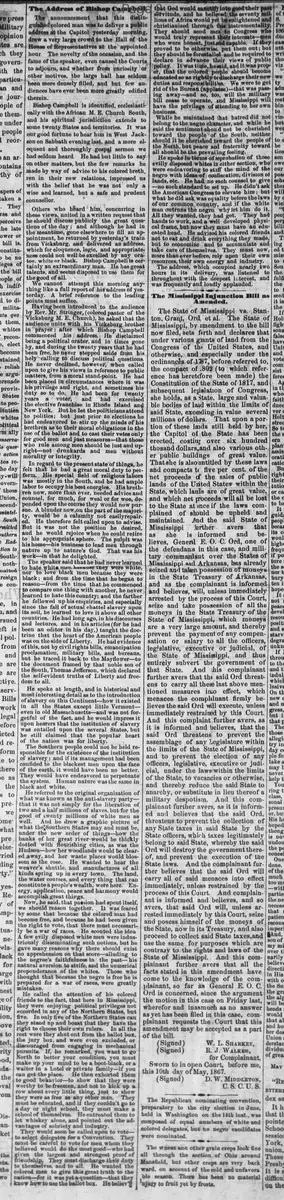
Bishop Campbell is identified, ecclesiastically with the African M. E. Church South, and his spiritual jurisdiction extends to some twenty States and territories. It was our good fortune to hear him in West Jackson on Sabbath evening last, and a more eloquent and thoroughly gospel sermon we had seldom heard. He had but little to say on other matters, but the few remarks he made by way of advice to his colored brethren in their new relations, impressed us with the belief that he was not only a wise and learned, but a safe and prudent counsellor.
Others who heard him, concurring in these views, united in a written request that he should discuss publicly 'the great questions of the day; and although he had in the meantime, gone elsewhere to fill an appointment, he returned by yesterday's train from Vicksburg, and delivered an address, which for eloquence, logic, and appropriateness could not well be excelled by any orator, white or black. Bishop Campbell is certainly an extraordinary man. He has great talents, and seems disposed to use them for the good of all.
We cannot attempt this morning anything like a full report of his address of yesterday. A brief reference to the leading points must suffice.
Having been introduced to the audience by Rev. Mr. Stringer, (colored pastor of the Vicksburg M. E. Church), he asked that the audience unite with his Vicksburg brother in prayer; after which Bishop Campbell commenced his address. He disclaimed being a political orator, and in times gone by, and during the twenty years that he had been free, he never stepped aside from his holy calling to discuss political questions. He never declined, however, when called upon to give his views in reference to public matters, from a moral stand-point. He had been placed in circumstances where it was his privilege and right, and sometimes his duty so to do. He had been for twenty years a voter, and had exercised the elective franchise in Rhode Island and New York. But he let the politicians attend to politics; but just prior to elections he had endeavored to stir up the minds of his brethren as to their moral obligations in the use of the ballot and to cast their votes only for good men and just measures—that those who rule among men should be just and upright—not drunkards and men without morality or integrity.
In regard to the present state of things, he felt that he had a great moral duty to perform. His special field of religious labors was mostly in the South, and he had ample labor to occupy his best energies. His brethren now, more than ever, needed advice and counsel, for much, for weal or for woe, depended upon the course they would now pursue. A blunder now, on the part of the majority, would be a calamity not easily repaired. He therefore felt called upon to advise. But it was not the position he desired, and he would rejoice when he could retire to his appropriate sphere. The pulpit was his home—his business to lead men through nature up to nature's God. That was his work—in that he delighted.
The speaker said that he had never learned to hate white men because they were white, nor to love black men because they were black; and from the time that he began to reason—from the time that he commenced to compare one thing with another, he never learned to hate this country; and the farther he followed up his enquiries, and especially since the fall of actual chattel slavery upon its soil, he learned to love it above all other countries. He had long ago, in his discourses and lectures, and in his articles (for he had been an editor in his day,) taught the doctrine that the heart of the American people was on the side of Liberty. He had evidence of this, not by civil rights bills, emancipation proclamation, military bills, and bureaus, but he traced it back to the Mayflower—to the document framed by that noble son of the South, Thomas Jefferson, which declared the self-evident truths of Liberty and freedom to all.
He spoke at length, and in historical and most interesting detail as to the introduction of slavery on this Continent—how it existed in all the States except little Vermont—even in old Massachusetts—and was not forgetful of the fact, and he would impress it upon hearers that the institution of slavery was entailed upon the several States, but he still claimed that the popular heart of the nation was for liberty.
The Southern people could not be held responsible for the existence of the institution of slavery; and if its management had been confided to the blackest men upon the face of the earth, it would have been no better. They would have endeavored to perpetuate the system. Human nature was the same in black and white.
He referred to the original organization of what was known as the anti-slavery party—that it was not simply for the liberation of two and a half millions of slaves, but for the good of twenty millions of white men as well. And he drew a graphic picture of what the Southern States may and must be, under the new order of things—how the banks of her great river would be thickly dotted with flourishing cities, as was the Hudson—how her woodlands would be cleared away, and her waste places would blossom as the rose. He wanted to hear the weaver's shuttle, and manufactures of all kinds spring up in every town. The land, the water courses, and every thing that can constitute a people's wealth, were here. Energy, application, peace and harmony would accomplish great things.
Now, he said, that passion had spent itself, we should reason together. It was feared by some that because the colored man had become free, and because he had been given the right to vote, that there must necessarily be a war of races. He scouted the idea. A few evilly disposed white men were industriously disseminating such notions, but he gave many reasons why there should exist no apprehension on that score—alluding to the negro's faithfulness in the past, his natural aversion to strife, and the numerical preponderance of the whites. Those who thought that because the negro is free he is prepared for a war of races, were greatly mistaken.
He called the attention of his colored friends to the fact, that here in Mississippi, they were enjoying political privileges not accorded in any of the Northern States, but five. In only five of the Northern States can they stand up and boast that they have the right to choose their own rulers. In all the rest were they shut out from the ballot box, the jury box, and were even excluded, or discouraged from engaging in mechanical pursuits. If, he remarked, you want to go North to better your condition, you must make up your mind to be a boot-black, or a waiter in a hotel or private family—if you can get the place. He then exhorted them to good behavior—to show that they were worthy to be freemen, and not to kick up a row about every little thing, just to show they were as free as any other man. They must be educated, and if they couldn't go to a day or night school, they must make a school of themselves. He entreated them to let whiskey alone, and pointed out the advantages of sobriety and industry.
They would soon be called upon to vote—to select delegates for a Convention. They must be careful to vote for men whom they believed would do the most good—who had given the largest and strongest proof of friendship. They must discharge their duty to themselves, and to all. He wanted the colored men to give this great truth to the nation—for it was yet a question—that they know how to use the ballot box. He believed they did.
While he maintained that hatred did not belong to the negro character, and while he said the sentiment should not be cherished toward the people of the South, neither should it be cherished toward the people of the North, but peace and fraternity toward all should be the prevailing feeling.
He spoke in terms of reprobation of those evilly disposed whites in either section, who were endeavoring to stuff the mind of the negro with ideas of confiscation, division of lands, etc. He had no such counsel to give—no such standard to set up. He didn't ask the American Congress to elevate him; but what he did ask was equality before the laws of our common country, and if the white man outruns the negro, why let him do it. All they wanted, they had got. They had hands to work, and a well developed physical frame, but now they must have an educated head. He advised his colored friends not to eat and drink everything they made, but to economize and to accumulate and take care of themselves. They must now, more than ever before, rely upon their own resources, their own energy and industry.
The address, which occupied nearly two hours in its delivery, was listened to throughout with the deepest interest, and was frequently and loudly applauded.
What sub-type of article is it?
What themes does it cover?
What keywords are associated?
What entities or persons were involved?
Where did it happen?
Story Details
Key Persons
Location
Hall Of The House Of Representatives, Capitol, Jackson, Mississippi
Story Details
Bishop Campbell, a prominent Black bishop, spoke at the Capitol on moral duties, voting for just leaders, rejecting racial hatred, historical context of slavery, future prosperity of the South, and exhorting freedmen to education, sobriety, industry, and self-reliance while seeking equality under the law.