Thank you for visiting SNEWPapers!
Sign up free
The New Hampshire Gazette And Historical Chronicle
Portsmouth, Greenland, Rockingham County, New Hampshire
What is this article about?
Petition from Massachusetts-Bay's Council and House of Representatives to British Parliament protesting the Sugar Act's duties on foreign sugars and molasses, which burden colonial trade, fisheries, and deprive rights like jury trials. Seeks relief and preservation of internal taxation privileges.
Clipping
OCR Quality
Full Text
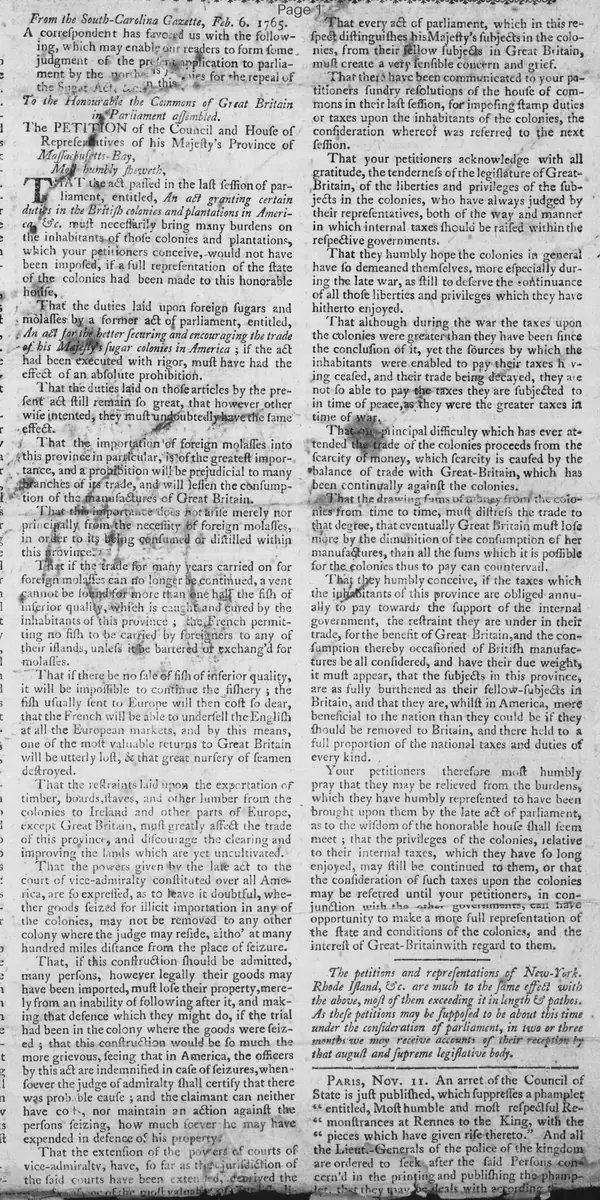
A correspondent has favored us with the following, which may enable our readers to form some judgment of the present application to parliament by their brethren for the repeal of the Sugar Act.
To the Honourable the Commons of Great Britain in Parliament assembled.
The PETITION of the Council and House of Representatives of his Majesty's Province of Massachusetts-Bay,
Most humbly sheweth.
That the act passed in the last session of parliament, entitled, An act granting certain duties in the British colonies and plantations in America, &c. must necessarily bring many burdens on the inhabitants of those colonies and plantations, which your petitioners conceive, would not have been imposed, if a full representation of the state of the colonies had been made to this honorable house,
That the duties laid upon foreign sugars and molasses by a former act of parliament, entitled, An act for the better securing and encouraging the trade of his Majesty's sugar colonies in America; if the act had been executed with rigor, must have had the effect of an absolute prohibition.
That the duties laid on those articles by the present act still remain so great, that however otherwise intended, they must undoubtedly have the same effect.
That the importation of foreign molasses into this province in particular, is of the greatest importance, and a prohibition will be prejudicial to many branches of its trade, and will lessen the consumption of the manufactures of Great Britain.
That this importance does not arise merely nor principally from the necessity of foreign molasses in order to its being consumed or distilled within this province.
That if the trade for many years carried on for foreign molasses can no longer be continued, a vent cannot be found for more than one half the fish of inferior quality, which is caught and cured by the inhabitants of this province: the French permitting no fish to be carried by foreigners to any of their islands, unless it be bartered or exchanged for molasses.
That if there be no sale of fish of inferior quality, it will be impossible to continue the fishery; the fish usually sent to Europe will then cost so dear, that the French will be able to undersell the English at all the European markets, and by this means, one of the most valuable returns to Great Britain will be utterly lost, & that great nursery of seamen destroyed.
That the restraints laid upon the exportation of timber, boards, staves, and other lumber from the colonies to Ireland and other parts of Europe, except Great Britain, must greatly affect the trade of this province, and discourage the clearing and improving the lands which are yet uncultivated.
That the powers given by the late act to the court of vice-admiralty constituted over all America, are so expressed, as to leave it doubtful, whether goods seized for illicit importation in any of the colonies, may not be removed to any other colony where the judge may reside, altho' at many hundred miles distance from the place of seizure.
That, if this construction should be admitted, many persons, however legally their goods may have been imported, must lose their property, merely from an inability of following after it, and making that defence which they might do, if the trial had been in the colony where the goods were seized; that this construction would be so much the more grievous, seeing that in America, the officers by this act are indemnified in case of seizures, whenever the judge of admiralty shall certify that there was probable cause; and the claimant can neither have costs, nor maintain an action against the persons seizing, how much soever he may have expended in defence of his property.
That the extension of the powers of courts of vice-admiralty, have, so far as the jurisdiction of the said courts have been extended, deprived the inhabitants of the colonies of trial by jury, and of the benefit of the common law.
That every act of parliament which in this respect distinguishes his Majesty's subjects in the colonies, from their fellow subjects in Great Britain, must create a very sensible concern and grief.
That there have been communicated to your petitioners sundry resolutions of the house of commons in their last session, for imposing stamp duties or taxes upon the inhabitants of the colonies, the consideration whereof was referred to the next session.
That your petitioners acknowledge with all gratitude, the tenderness of the legislature of Great-Britain, of the liberties and privileges of the subjects in the colonies, who have always judged by their representatives, both of the way and manner in which internal taxes should be raised within the respective governments.
That they humbly hope the colonies in general have so demeaned themselves, more especially during the late war, as still to deserve the continuance of all those liberties and privileges which they have hitherto enjoyed.
That although during the war the taxes upon the colonies were greater than they have been since the conclusion of it, yet the sources by which the inhabitants were enabled to pay their taxes having ceased, and their trade being decayed, they are not so able to pay the taxes they are subjected to in time of peace, as they were the greater taxes in time of war.
That the principal difficulty which has ever attended the trade of the colonies proceeds from the scarcity of money, which scarcity is caused by the balance of trade with Great-Britain, which has been continually against the colonies.
That the drawing sums of money from the colonies from time to time, must distress the trade to that degree, that eventually Great Britain must lose more by the diminution of the consumption of her manufactures, than all the sums which it is possible for the colonies thus to pay can countervail.
That they humbly conceive, if the taxes which the inhabitants of this province are obliged annually to pay towards the support of the internal government, the restraint they are under in their trade, for the benefit of Great-Britain, and the consumption thereby occasioned of British manufactures be all considered, and have their due weight, it must appear, that the subjects in this province, are as fully burthened as their fellow-subjects in Britain, and that they are, whilst in America, more beneficial to the nation than they could be if they should be removed to Britain, and there held to a full proportion of the national taxes and duties of every kind.
Your petitioners therefore most humbly pray that they may be relieved from the burthens which they have humbly represented to have been brought upon them by the late act of parliament, as to the wisdom of the honorable house shall seem meet; that the privileges of the colonies, relative to their internal taxes, which they have so long enjoyed, may still be continued to them, or that the consideration of such taxes upon the colonies may be referred until your petitioners, in conjunction with the other governments, can have opportunity to make a more full representation of the state and conditions of the colonies, and the interest of Great-Britain with regard to them.
The petitions and representations of New-York, Rhode Island, &c. are much to the same effect with the above, most of them exceeding it in length & pathos. As these petitions may be supposed to be about this time under the consideration of parliament, in two or three months we may receive accounts of their reception by that august and supreme legislative body.
What sub-type of article is it?
What themes does it cover?
What keywords are associated?
What entities or persons were involved?
Where did it happen?
Story Details
Key Persons
Location
Massachusetts Bay Province, British Colonies In America
Event Date
1765
Story Details
The petitioners argue that the Sugar Act imposes burdensome duties on foreign sugars and molasses, prohibiting trade vital to the colonial economy, particularly the fishery which relies on bartering fish for molasses with French islands. They highlight impacts on British manufactures, restraints on lumber exports, and admiralty court powers that deny jury trials and fair defense. They seek repeal of the act, preservation of colonial taxation rights by representatives, and further representation on proposed stamp duties.