Thank you for visiting SNEWPapers!
Sign up free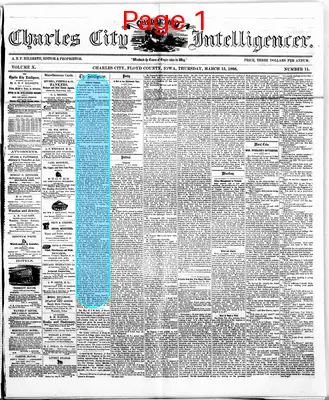
Charles City Intelligencer
Charles City, Floyd County, Iowa
What is this article about?
In Iowa, Representative Gaylord introduced House File No. 230 to aid orphans of soldiers who died in the Civil War. The bill mandates enumeration by assessors, county funding via a half-mill tax, and management by supervisors for maintenance and education, effective after publication in 1866.
Clipping

OCR Quality
Full Text
Soldiers' Orphans.
Representative Gaylord has introduced a bill in the House to provide for Soldiers' orphans, of which the following is a copy. It is a good bill and ought to pass:
HOUSE FILE NO. 230.]
[BY GAYLORD.
A BILL
FOR AN ACT TO PROVIDE FOR THE ORPHANS
OF THE SOLDIERS WHO PERISHED IN THE
SERVICE OF THE UNITED STATES DURING
The great Rebellion
Whereas, a cruel and desolating war with armed treason has visited our land, and left in its bloody wake the orphans of our brave and fallen defenders, whose heroic services and patriotic devotion to their imperiled government entitles their bereaved families to our gratitude and support; and whereas, these families are scattered throughout almost every county in this State, and can be provided for with a much less expense at home, under the immediate supervision of parents and guardians, than abroad amongst strangers, in large cities, where but comparatively few can be concentrated, and where the essential and industrial pursuits of life must be neglected; therefore,
Section 1. Be it enacted by the General Assembly of the State of Iowa, That the Assessor of each ward and township in this State, before the first Monday in June, A. D. 1866, and when he is making the assessment in each year thereafter for the term of ten years, shall take an enumeration of all the children of deceased soldiers who were in the military service of the government of the United States, in his ward or township, naming the company, regiment, battery, battalion or organization to which the deceased soldiers belonged, and make accurate return to the Board of Supervisors of his county, designating the name, age, and sex of all the children belonging to the family of the deceased, for which the Assessor shall receive the same compensation as for other services.
Sec. 2. It shall be the duty of the Board of Supervisors to revise said enumeration list of orphans from time to time, by adding thereto or striking therefrom as they may deem proper.
Sec. 3. It shall be the duty of the Clerk of the Board of Supervisors to furnish to the Assessors of the several townships in his county such blanks as may be necessary for taking the aforesaid enumeration.
Sec. 4. The Board of Supervisors of the several counties shall have control of the funds for the purposes mentioned in this act, and shall use the same for the maintenance and education of the orphans aforesaid, in such manner and in such sums as the exigencies of the case may demand, and for no other purpose.
Sec. 5. The Board of Supervisors shall levy a tax not to exceed one-half mill on the dollar, in any one year, on all the taxable property in their county, provided that there are any such orphans in their county needing such aid, and shall apply said fund in manner as hereinbefore directed.
Sec. 6. If the children of the deceased soldiers aforesaid have no natural or other guardian, or are neglected, the Board of Supervisors may appoint some suitable person in the township, whose duty it shall be to see that said children are cared for according to the spirit and intent of this act.
Sec. 7. The funds raised under the provisions of this act, shall be called the 'Soldiers' Orphan Fund,' and shall be levied, collected, and paid out in the same manner as other county funds.
Sec. 8. The provisions of this act shall not be so construed as to prevent the Supervisors of any county in this State from permitting the orphans, or any number thereof from their respective counties, to attend any Orphans' Home in this State, which Orphans Home shall receive from said county its proportion of the fund raised therein, according to the number of such orphans in the county; and any county which shall provide for its soldiers' orphans according to the provisions of this act, shall not be taxed by the State for the same purpose.
Sec. 9. This act being deemed of immediate importance by the Legislature, shall take effect and be in force from and after its publication in the Iowa State Register and Iowa Homestead, newspapers published at Des Moines, Iowa.
What sub-type of article is it?
What keywords are associated?
What entities or persons were involved?
Where did it happen?
Domestic News Details
Primary Location
Iowa
Event Date
1866
Key Persons
Event Details
Representative Gaylord introduced House File No. 230 in the Iowa House of Representatives to provide for the orphans of soldiers who perished during the Civil War. The bill requires assessors to enumerate such orphans starting before June 1866 for ten years, with county supervisors managing a 'Soldiers' Orphan Fund' raised by a tax not exceeding one-half mill on the dollar for their maintenance and education. Counties can send orphans to state homes but won't be state-taxed if providing locally.