Thank you for visiting SNEWPapers!
Sign up free
The Alexandria Herald
Alexandria, Virginia
What is this article about?
Governor Thomas M. Randolph's address to the Virginia legislature on December 2, 1822, discusses agricultural distress from drought and insects leading to emigration, widespread autumnal diseases, lack of medical institutions, infrastructure progress on James River and Monongalia projects, literary fund loans, support for volunteer corps, and reflections on his tenure.
Merged-components note: Merged continuation of the Governor's message across pages; relabeled to domestic_news for its political significance.
Clippings
1 of 2
OCR Quality
Full Text
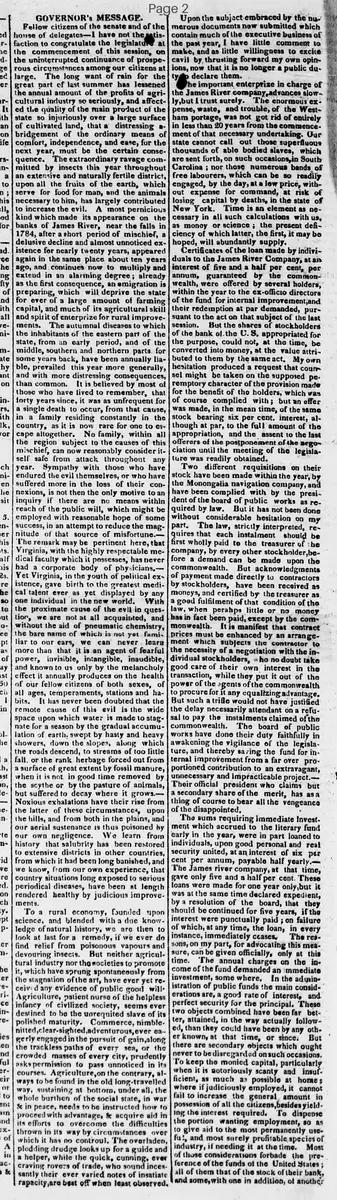
Fellow citizens of the senate and of the house of delegates—I have not the satisfaction to congratulate the legislature at the commencement of this session, on the uninterrupted continuance of prosperous circumstances among our citizens at large. The long want of rain for the great part of last summer has lessened the annual amount of the profits of agricultural industry so seriously, and affected the quality of the main product of the state so injuriously over a large surface of cultivated land, that a distressing abridgement of the ordinary means of comfort, independence, and ease, for the next year, must be the certain consequence. The extraordinary ravage committed by insects this year throughout an extensive and naturally fertile district, upon all the fruits of the earth, which serve for food for man, and the animals necessary to him, has largely contributed to increase the evil. A most pernicious kind which made its appearance on the banks of James River, near the falls in 1784, after a short period of mischief, a delusive decline and almost unnoticed existence for nearly twenty years, appeared again in the same place about ten years ago, and continues now to multiply and extend in an alarming degree; already as the first consequence, an emigration is preparing, which will deprive the state for ever of a large amount of farming capital, and much of its agricultural skill and spirit of enterprize for rural improvements. The autumnal diseases to which the inhabitants of the eastern part of the state, from an early period, and of the middle, southern and northern parts for some years back, have been annually liable, prevailed this year more generally, and with more distressing consequences, than common. It is believed by most of those who have lived to remember, that forty years since, it was as unfrequent for a single death to occur, from that cause, in a family residing constantly in the country, as it is now rare for one to escape altogether. No family, within all the region subject to the causes of this mischief, can now reasonably consider itself safe from attack throughout any year. Sympathy with those who have endured the evil themselves, or who have suffered more in the loss of their connexions, is not then the only motive to an inquiry if there are no means within reach of the public will, which might be employed with reasonable hope of some success, in an attempt to reduce the magnitude of that source of misfortune.—
The remark may be pertinent here, that Virginia, with the highly respectable medical faculty which it possesses, has never had a corporate body of physicians.— Yet Virginia, in the youth of political existence, gave birth to the greatest medical talent ever as yet displayed by any one individual in the new world. With the proximate cause of the evil in question, we are not at all acquainted, and without the aid of pneumatic chemistry, the bare name of which is not yet familiar to our ears, we can never learn more than that it is an agent of fearful power, invisible, intangible, inaudible, and known to us only by the melancholy effect it annually produces on the health of our fellow citizens of both sexes, of all ages, temperaments, stations and habits. It has never been doubted that the remote cause of this evil is the wide space upon which water is made to stagnate for a season by the gradual accumulation of earth, swept by hasty and heavy showers, down the slopes, along which the roads descend, to streams of too little fall, or the rank herbage forced out from a surface of great extent by fossil manure, when it is not, in good time removed by the scythe or by the pasture of animals, but suffered to decay where it grows.— Noxious exhalations have their rise from the latter of these circumstances, upon the hills, and from both in the plains, and our aerial sustenance is thus poisoned by our own negligence. We learn from history that salubrity has been restored to extensive districts in other countries, from which it had been long banished, and we know, from our own experience, that country situations long exposed to serious periodical diseases, have been at length rendered healthy by judicious improvements.
To a rural economy, founded upon science, and blended with a due knowledge of natural history, we are then to look at last for a remedy, if we ever do find relief from poisonous vapours and devouring insects. But neither agricultural industry nor the societies to promote it, which have sprung spontaneously from the stagnation of the art, have ever yet received any evidence of public good will— Agriculture, patient nurse of the helpless infancy of civilized society, seems ever destined to be the unrequited slave of its polished maturity. Commerce, nimble, united, clear-sighted, adventurous, ever eager engaged in the pursuit of gain, along the trackless paths of every sea, or the crowded masses of every city, prudently asks permission to pass unnoticed in its courses. Agriculture, on the contrary, always to be found in the old long-travelled way, sustaining at bottom, under all, the whole burthen of the social state, in war & in peace, needs to be instructed how to proceed with advantage, & acquire aid in its efforts to overcome the difficulties thrown in its way by circumstances over which it has no controul. The overladen, plodding drudge looks up for a guide and a helper, while the quick, cunning, ever craving rovers of trade, who sound incessantly their ever varied notes of insatiate rapacity, are best off when least observed.
Upon the subject embraced by the numerous documents now submitted which contain much of the executive business of the past year, I have little comment to make, and as little willingness to excite cavil by thrusting forward my own opinions, now that it is no longer a public duty to declare them.
The important enterprize in charge of the James River company advances slowly, but I trust surely. The enormous expense, waste, and trouble, of the Westham portage, was not got rid of entirely in less than 20 years from the commencement of that necessary undertaking. Our state cannot call out those superfluous thousands of able bodied slaves, which are sent forth, on such occasions, in South Carolina; nor those numerous bands of free labourers, which can be so readily engaged, by the day, at a low price, without expense for command, at risk of losing capital by deaths, in the state of New York. Time is an element as necessary in all such calculations with us, as money or science; the present deficiency of which latter, the first, it may be hoped, will abundantly supply.
Certificates of the loan made by individuals to the James River Company, at an interest of five and a half per cent, per annum, guaranteed by the commonwealth, were offered by several holders, within the year to the ex-officio directors of the fund for internal improvement, and their redemption at par demanded, pursuant to the act on that subject of the last session. But the shares of stock holders of the bank of the U.S. appropriated for the purpose, could not, at the time, be converted into money, at the value attributed to them by the same act. My own hesitation produced a request that counsel might be taken on the supposed peremptory character of the provision made for the benefit of the holders, which was of course complied with; but an offer was made, in the mean time, of the same stock bearing six per cent. interest, although at par, to the full amount of the appropriation, and the assent to the last offerers of the postponement of the negociation until the meeting of the legislature was readily obtained.
Two different requisitions on their stock have been made within the year, by the Monongalia navigation company, and have been complied with by the president of the board of public works as required by law. But it has not been done without considerable hesitation on my part. The law, strictly interpreted, requires that each instalment should be first wholly paid to the treasurer of the company, by every other stockholder, before a demand can be made upon the commonwealth. But acknowledgments of payment made directly to contractors by stockholders, have been received as moneys, and certified by the treasurer as a good fulfilment of that condition of the law, when perhaps little or no money has in fact been paid, except by the commonwealth. It is manifest that contract prices must be enhanced by an arrangement which subjects the contractor to the necessity of a negotiation with the individual stockholders, who no doubt take good care of their own interest in the transaction, while they put it out of the power of the agents of the commonwealth to procure for it any equalizing advantage. But such a trifle would not have justified the delay necessarily attendant on a refusal to pay the instalments claimed of the commonwealth. The board of public works have done their duty faithfully in awakening the vigilance of the legislature, and thereby saving the fund for internal improvement from a far over proportioned contribution to an extravagant, unnecessary and impracticable project.— Their official president who claims but a secondary share of the merit, has as a thing of course to bear all the vengeance of the disappointed.
The sums requiring immediate Investment which accrued to the literary fund early in the year, were in part loaned to individuals, upon good personal and real security united, at an interest of six per cent per annum, payable half yearly. The James river company, at that time, gave only five and a half per cent. These loans were made for one year only, but it was at the same time declared expedient, by a resolution of the board, that they should be continued for five years, if the interest were punctually paid; on failure of which, at any time, the loan, in every instance, immediately ceases.
The reasons, on my part, for advocating this measure, can be given officially, only at this time. The annual charges on the income of the fund demanded an immediate investment, some where. In the administration of public funds the main considerations are, a good rate of interest, and perfect security for the principal. These two objects combined have been far better, attained, in the way actually followed, than they could have been by any other known, at that time, or since: But there are secondary objects which ought never to be disregarded on such occasions. To keep the monied capital, particularly when it is notorously scanty and insufficient, as much as possible at home; where if judiciously employed, it cannot fail to increase the general, amount in possession of all the citizens, besides yielding the interest required. To dispense the portion wanting employment, so as to give aid to the most permanently useful, and most surely profitable species of industry, if needing it at the time. Most of those considerations forbade the preference of the funds of the United States; all of them that of the stock of their bank. and some, with one in addition, of another.
nature, extended the interdiction to the stock of our own banks. They are never called on for loans upon their stock held by the state, and their issues of an arbitrary character, to individuals, are the larger for it. Perhaps also, when a very large proportion is held by the state, the profit from the remainder is diminished to individual holders, as there is not then to the same extent, an imperious, unavoidable necessity to answer the call for a good income every year, and it is more apt to be disregarded when made by a few voices. As the banks are always ready to accommodate the James river company for the long period prescribed by law. to make loans to it from the literary fund, would have a tendency to reduce the quantity of money kept in circulation. That I had no selfish view in this decision is well known, for applicants, if able to comply with all the conditions required with the promptitude demanded of them, were preferred as they offered. I could even wish, that the evidence to prove my not having received any accommodation whatsoever, from these loans, in any manner whatever direct or indirect, was not quite so over-ample for that purpose, as it really is in fact.
In favor of the volunteer corps of the state, which it has been attempted to decry, I must be permitted before I enter again into the ranks of society, to give the parting testimony of an old companion and devoted friend. At Lexington, at Bennington and Saratoga, at King's Mountain and Guilford, and many other fields of glory than can be now recalled up, in our war for independence; at Baltimore and New Orleans, in that for navigation, the success of our arms, was either wholly, or in a great measure due to the gallantry of volunteers, who took the field for the occasion. In South America, at Madrid, even in Greece, we find them always an efficient, often an irresistible force. Can the bands of unfortunate wanderers who sell their liberty upon long and irrevocable contracts, and, in consequence look upon those they are hired to defend as equally their foes, be wisely preferred; or can they be safely employed, in numbers sufficiently great to oppose a formidable enemy? Can homesick, untrainable fathers, and their awkward untrained sons, forced by lot into the ranks together, be relied on with certainty, on occasions wherein instinct itself must be subdued, and annihilated & every avenue to the heart firmly closed by passion, grave, or gay, calm, or furious, as temperament may command? Can either be reasonably preferred to volunteers, ardent and active from youth, patient and brave from honor, persevering and unyielding from emulation, faithful to all the interests of society from ties of affection? That, indeed, is the cheap, the sure, the safe defence of nations.
Always keeping in view the possibility of such another disturbance as happened in this place in 1800, at New Orleans not long since, and at Charleston in South Carolina very recently, I have been constantly prepared in my mind to meet that event under the most formidable aspect imaginable could represent, or the various less serious combinations of the probable circumstances, which it could distinctly trace for my memory in an impressive and lasting picture. To disperse any such assemblage in the first moment, or to check any movements attempted by it at their commencement, by a prompt attack with two light field pieces, supported by a troop of cavalry, has been always the most favoured thought. I have accordingly encouraged the artillery company of this city, and have promoted the wish of the captain of the public guard to have his company also trained as artillery, because it could be moving onward while another was collecting to take its place. at its different stations of daily service. and while the cavalry were following after. I have been induced, by this consideration, to be somewhat prodigal in the usual order for powder to fire the national salutes, on the two great festivals of the year, because at no other time could the guns be used, in earnest, without an expense not reasonable for individuals to bear. Not doubting on the last fourth of July that there was still on hand a sufficiency of damaged powder for the purpose, as such a reservation had been required by advice of council when a large parcel, which very little more than paid charges of sale, was directed to be sold, I made my usual requisition upon the adjutant general. Fifty one cartridges were demanded for each company, that morning, noon and night, of the glorifying festival, might be duly saluted, and that neither side of our double hilled city might be wholly unhonoured. I found afterwards, when payment of the bill was called for, that it had been necessary to purchase good powder to meet the requisition, and that an expense of about $60 had been incurred for the purpose. Payment was refused by the council, and I am accordingly under the necessity of requesting that provision may be made for it by law. I sincerely respect the scrupulous conduct displayed on this occasion, and heartily rejoice that vigilance has again come into fashion. But I feel, at the same time, in common with other tax-payers, the hardship of having to contribute, from the now scanty fruits of industry, to make up the enormous loss sustained by the commonwealth, from the scandalous speculations committed, while these watchmen slept on their post, during a former period.
I have now only to take leave of the legislature and return, after a few days, to my former life of alternate labour and study in my favorite occupation of agriculture. I do not hesitate to aver, that it is not possible for any one of my predecessors to have been more deeply penetrated with gratitude for the favor received, or more sincerely elated with honest pride in the enjoyment of the honour conferred. It is true that I have not found the functions so exalted, or the office so dignifying, as I had expected from the theory of our constitution. But my political creed was ever honestly republican, and has become with time a matter of moral sentiment, not of interest or passion. I have therefore performed with alacrity all the duties assigned me, industriously conscientiously, boldly and impartially. It has been my good fortune to enjoy the blessing of uninterrupted health during the whole period of my service, and, most certainly, I have never, once in the time had any of my humble faculties impaired weakened or obscured by any cause whatsoever.
Twice only, in the three years, have I been absent from the seat of government, a few days longer than a week, at one time. Once only, I have failed to return with punctuality at the appointed hour. I have been so constantly accessible during the whole period, to all who had, or supposed they had, business with the chief magistrate, that I have rarely kept my seat at table during an ordinary meal without rising to attend some person requiring to see me. In council I have ever cheerfully performed an honest, faithful, and laborious part; reading aloud all communications and documents, investigating every subject with all the ability I had, and making the research requisite, with patience and sincere interest. Nor have I ever once repined, with selfish feelings, at the servitude to which time, the corrupter of all things, had reduced the office I held; nor of the contumely so often experienced, of inattention, or interruption by loud and unseasonable discourse, to which it was liable. Without any share of the authority of speaker, chairman or moderator and a natural aversion besides to every kind of unnecessary ceremonious restraint, I have no right to expect much better than what has happened; and no rule of conduct, but never to suffer myself to be uncivil, until it be necessary, to check the progress of incivility in others.
The charge of a design, or wish, on my part, to introduce change into the executive department, was certainly unjust. But outcry against innovation is an old way of disguising and perpetuating encroachments. I have insisted, that an unjustifiable misinterpretation of the constitution was made, when the casting vote was wrested from the governor. For now while a constitutional advice may be given by any three counsellors, if four be present, yet all power to act, in any way, at any time, may be denied, by four members of the executive body, to five, or by three to four, or two to three as the number may happen to stand at the meeting. I have maintained that the question of the governor's absence from the government, when no such intention had been intimated beforehand, nor regularly communicated by a dispatch, could not be properly decided ex parte, much less without taking any evidence but that of non-appearance at the moment; as proof of the fact. The governor being annually chosen and also impeachable, is directly responsible to the legislature, and may be presumed to know and duly to estimate, the consequences of neglect of duty. It cannot surely be constitutional, upon a supposition to the contrary and under the pretext of providing against such neglect to him, to transfer his functions to that branch of the executive, which, as a body, is scarcely responsible at all, and thereby to take from the hands of the immediate representatives of the people the only efficient check upon executive proceedings which had been provided.
I have declared that the possible violation of the sacred character of private correspondence, with which such a construction necessarily involves, was altogether inadmissible, and I have threatened to impeach the honor of such as should knowingly commit that act. But I have always allowed that the bearer of sealed communications, when such were brought by a private hand, had a right, understood to be imparted to him by the sender, to require them to be opened by another than the governor; and moreover that when such were laid upon the table in the council chamber, but not when taken from the post office, the requisition to open them immediately might fairly be implied. To conclude, if I have fallen into errors of opinion in these matters, I trust it has not been for want of proper modesty towards the public that they have become known. If errors, most certainly they have sprung from honest misconception, for I have ever held the constitution as a guide to sound politics, next in veneration to the holy decalogue, upon which our ancient system of morality is so solidly founded. My enthusiasm may have been excessive, my zeal perhaps indiscreet, but it is manifest, from my age, and the narrow views to which I am necessarily confined by the circumstances of my situation in private life, that I could not have been influenced by any selfish motive whatever.
My course may have been blunderings but the efforts I have made have ever been the best my powers could afford, and I trust the ends of those who sent me forth to it, have been sufficiently answered. Few I hope will refuse their parting approval. None I think can, in lasting sincerity, be better pleased with the clumsy floundering movements of unbridled arrogance overbearing in itself-applauding career, the free will judgment and prudence of others, and thrusting aside for a moment from their proper place, candour, truth, and every thing of an unselfish, unassuming and disinterested nature.
I have the pleasure, in performing perhaps my last, act of public life, to lay before the legislature the report on his late mission to Kentucky of our justly honored, able and trusty fellow citizen Benj. Watkins Leigh.
THOS. M. RANDOLPH.
Richmond, Va. Dec. 2, 1822.
What sub-type of article is it?
What keywords are associated?
What entities or persons were involved?
Where did it happen?
Domestic News Details
Primary Location
Richmond, Va.
Event Date
Dec. 2, 1822
Key Persons
Outcome
agricultural profits lessened by drought and insects leading to emigration; autumnal diseases more prevalent with increased deaths; slow progress on james river company; loans made from literary fund at 6% interest; support for volunteer corps emphasized; request for $60 reimbursement for powder.
Event Details
Governor Thomas M. Randolph delivers message to Virginia legislature addressing drought and insect damage to agriculture, rising autumnal diseases attributed to stagnant water and decaying vegetation, need for scientific rural economy, lack of public support for agriculture, progress and financial issues of James River and Monongalia navigation companies, literary fund investments, defense via volunteer corps, preparations against disturbances, and reflections on his gubernatorial tenure and constitutional interpretations.