Thank you for visiting SNEWPapers!
Sign up free
Story
February 19, 1940
Henderson Daily Dispatch
Henderson, Vance County, North Carolina
What is this article about?
Tobacco growers in the Henderson, North Carolina area are expected to support a proposed three-year crop control program despite reservations about quotas, viewing it as the only alternative to economic distress. Farmers and business leaders express reluctant approval, with suggestions to increase cotton acreage to offset losses.
Clipping
OCR Quality
75%
Good
Full Text
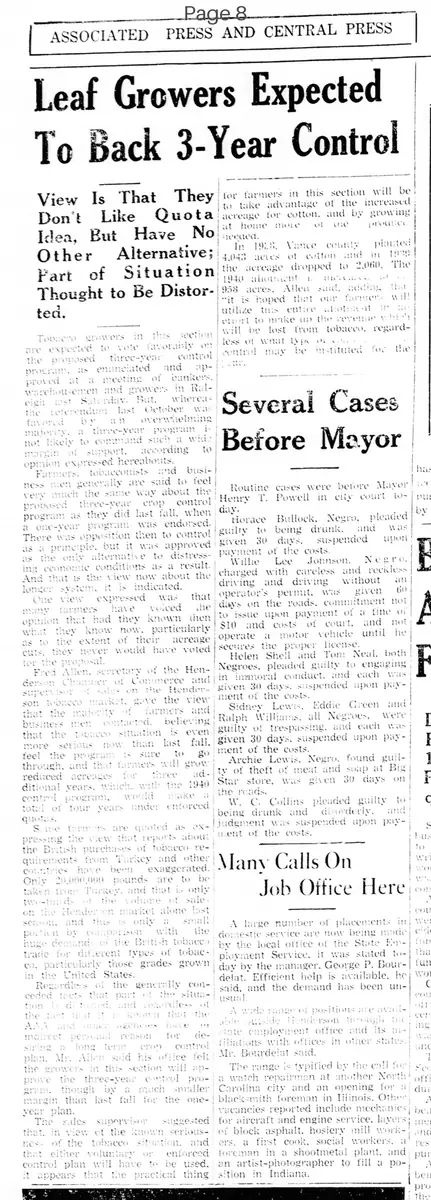
ASSOCIATED PRESS AND CENTRAL PRESS
Leaf Growers Expected To Back 3-Year Control
View Is That They Don't Like Quota Idea. But Have No Other Alternative; Part of Situation Thought to Be Distorted.
Tobacco growers in this section are expected to vote largely on the proposed three-year control program, as enunciated and approved at a meeting of bankers, warehousemen and growers in Raleigh last Saturday. But, whereas the referendum last October was favorable by a majority, a three-year program is not likely to command such a wide margin of support, according to opinion expressed hereabouts.
Farmers, tobacco men and business men generally are said to feel very much the same way about the proposed three-year crop control program as they did last fall, when a one-year program was endorsed. There was opposition then to control as a principle, but it was approved as the only alternative to distressing economic conditions as a result. And that is the view now about the longer system, it is indicated.
One view expressed was that many farmers have voiced the opinion that had they known then what they know now, particularly as to the extent of their acreage cuts, they never would have voted for the proposal.
Fred Allen, secretary of the Henderson Chamber of Commerce and supervisor of sales on the Henderson tobacco market, gave the view that the majority of farmers and business men contacted, believing that the tobacco situation is even more serious now than last fall, feel the program is sure to go through, and that farmers will grow reduced acreages for three additional years, which, with the 1939 control program, would make a total of four years under enforced quotas.
Some farmers are quoted as expressing the view that reports about the British purchases of tobacco requirements from Turkey and other countries have been exaggerated. Only 20,000 pounds are to be taken from Turkey, and that is only two-thirds of the value of sale on the Henderson market alone last season, and this is only a small point of comparison with the huge demand of the British tobacco trade for different types of tobacco, particularly those grades grown in the United States.
Regardless of the generally conceded fact that part of the situation is bad and details of the free list it is known that there are undue cases that may militate personal reason for desiring a short-term crop control plan, Mr. Allen said his office felt the growers in this section will approve the three-year control program, though by a much smaller margin than last fall for the one-year plan.
The sales supervisor suggested that, in view of the known seriousness of the tobacco situation, and that either voluntary or enforced control plan will have to be used, it appears that the practical thing
for farmers in this section will be to take advantage of the increased acreage for cotton, and by growing at home more of the products needed.
In 1939, Vance county planted 4,043 acres of cotton and in 1929 the acreage dropped to 2,060. The 1939 allotment is 958 acres, Allen said, adding that "it is hoped that our farmers will utilize this entire allotment in order to make up the income that will be lost from tobacco, regardless of what type of crop control may be instituted for the year."
Leaf Growers Expected To Back 3-Year Control
View Is That They Don't Like Quota Idea. But Have No Other Alternative; Part of Situation Thought to Be Distorted.
Tobacco growers in this section are expected to vote largely on the proposed three-year control program, as enunciated and approved at a meeting of bankers, warehousemen and growers in Raleigh last Saturday. But, whereas the referendum last October was favorable by a majority, a three-year program is not likely to command such a wide margin of support, according to opinion expressed hereabouts.
Farmers, tobacco men and business men generally are said to feel very much the same way about the proposed three-year crop control program as they did last fall, when a one-year program was endorsed. There was opposition then to control as a principle, but it was approved as the only alternative to distressing economic conditions as a result. And that is the view now about the longer system, it is indicated.
One view expressed was that many farmers have voiced the opinion that had they known then what they know now, particularly as to the extent of their acreage cuts, they never would have voted for the proposal.
Fred Allen, secretary of the Henderson Chamber of Commerce and supervisor of sales on the Henderson tobacco market, gave the view that the majority of farmers and business men contacted, believing that the tobacco situation is even more serious now than last fall, feel the program is sure to go through, and that farmers will grow reduced acreages for three additional years, which, with the 1939 control program, would make a total of four years under enforced quotas.
Some farmers are quoted as expressing the view that reports about the British purchases of tobacco requirements from Turkey and other countries have been exaggerated. Only 20,000 pounds are to be taken from Turkey, and that is only two-thirds of the value of sale on the Henderson market alone last season, and this is only a small point of comparison with the huge demand of the British tobacco trade for different types of tobacco, particularly those grades grown in the United States.
Regardless of the generally conceded fact that part of the situation is bad and details of the free list it is known that there are undue cases that may militate personal reason for desiring a short-term crop control plan, Mr. Allen said his office felt the growers in this section will approve the three-year control program, though by a much smaller margin than last fall for the one-year plan.
The sales supervisor suggested that, in view of the known seriousness of the tobacco situation, and that either voluntary or enforced control plan will have to be used, it appears that the practical thing
for farmers in this section will be to take advantage of the increased acreage for cotton, and by growing at home more of the products needed.
In 1939, Vance county planted 4,043 acres of cotton and in 1929 the acreage dropped to 2,060. The 1939 allotment is 958 acres, Allen said, adding that "it is hoped that our farmers will utilize this entire allotment in order to make up the income that will be lost from tobacco, regardless of what type of crop control may be instituted for the year."
What sub-type of article is it?
News Report
Agricultural Policy
What themes does it cover?
Misfortune
Survival
What keywords are associated?
Tobacco Control
Crop Quotas
Henderson Market
British Purchases
Cotton Acreage
What entities or persons were involved?
Fred Allen
Where did it happen?
Henderson, Vance County, North Carolina
Story Details
Key Persons
Fred Allen
Location
Henderson, Vance County, North Carolina
Event Date
1939
Story Details
Tobacco growers expected to back three-year control program despite quota opposition, as alternative to economic distress; shift to cotton suggested to offset losses.