Thank you for visiting SNEWPapers!
Sign up free
Story
July 29, 1875
The Valley Virginian
Clifton Forge, Staunton, Virginia
What is this article about?
H. V. Redfield's impressions of Staunton, Virginia, describe it as a bustling, historically rich town resembling Northern cities, with key institutions, railroads, and nearby mineral springs, correcting misconceptions about local railroads.
Clipping
OCR Quality
98%
Excellent
Full Text
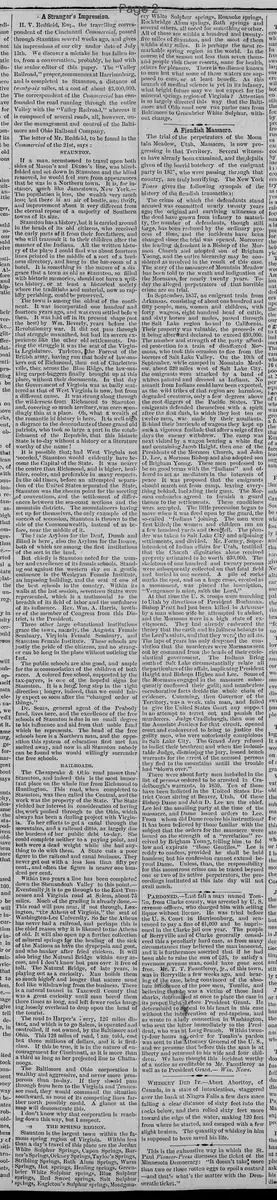
A Stranger's Impression.
H. V. Redfield, Esq., the travelling correspondent of the Cincinnati Commercial, passed through Staunton several weeks ago, and gives his impressions of our city under date of July 15th. We discover a mistake he has fallen into, from a conversation, probably, he had with the senior editor of this paper. The "Valley Railroad," proper, commences at Harrisonburg, and is completed to Staunton, a distance of twenty-six miles, at a cost of about $3,000,000. The correspondent of the Commercial has confounded the road running through the entire Valley with the "Valley Railroad," whereas it is composed of several roads, all, however, under the management and control of the Baltimore and Ohio Railroad Company.
The letter of Mr. Redfield, to be found in the Commercial of the 21st, says:
STAUNTON.
If a man, accustomed to travel upon both sides of Mason's and Dixon's line, was blindfolded and set down in Staunton and the blind removed, he would feel sure from appearances that he was in a Northern town. It is, for instance, much like Jamestown, New York. The population is less, the wealth very much less; but there is an air of bustle, and thrift, and improvement about it very different from the eternal repose of a majority of Southern towns of its size.
Staunton has a history, but it is carried around in the heads of its old citizens, who received the early parts of it from their forefathers, and who will transmit it to their children after the manner of the Indians. All the written history of the place I could find was about fourteen lines printed in the middle of a sort of a business directory, and hung in the bar-room of a hotel. It is something in the nature of a disgrace that a town as old as Staunton, so filled with historic memories, should not have a written history, or at least a historical society where the traditions and material, now so rapidly perishing, could be preserved.
The town is among the oldest of the continent. It was incorporated one hundred and fourteen years ago, and was even settled before then. It was laid off in its present shape (not the best) by Wm. Beverly, years before the Revolutionary war. It did not pass through that struggle unscathed, but had its severe experience like the other old settlements. During the struggle it was the seat of the Virginia Legislature. Tarleton, the Forrest of the British army, having run that body of law-makers out of Richmond, then out of Charlottesville, then across the Blue Ridge, the law-making carpet-baggers finally brought up at this place, without their documents. In that day the Government of Virginia was as badly scattered as that of West Virginia is now, but from a different cause. It was strung along through the wilderness from Richmond to Staunton and, covering so much territory, was correspondingly thin at a place. Oh, what a wealth of the romantic in history is here. It is well nigh a disgrace to the descendants of those grand old patriots, who took so large a part in the establishment of the Republic, that this historic State is to-day without a history or a literature worthy of the name!
It is possible that, had West Virginia not 'seceded,' Staunton would evidently have become the Capital of the State. It was nearer the centre than Richmond, and is higher, healthier, cooler, and preferable in many respects. In the old times, before an attempted separation of the United States separated the State, Staunton was the chosen point for the meeting of conventions, and the settlement of differences between the sea-coast sections and the mountain districts. The mountaineers having set up for themselves, the only example of the success of secession, Staunton is thrown to the side of the Commonwealth, instead of as before, near the middle of it.
The State Asylum for the Deaf, Dumb and Blind is here, also the Asylum for the Insane, both of which are among the first Institutions of the sort in the land.
But chiefly is Staunton noted for the number and excellence of its female schools. Standing out against the western sky on a gentle eminence is the Wesleyan Female Institute, an imposing building, and the seat of one of the best schools in the country. Within its walls at the last session, seventeen States were represented, which is a testimonial to the breadth of its field of labor and the usefulness of its influence. Rev. Wm. A. Harris, brother of the member of Congress from this District, is the President.
Three other large educational institutions grace the town, namely, the Augusta Female Seminary, Virginia Female Seminary, and Staunton Female Institute. These schools are justly the pride of the citizens, and no stranger can be long in the place without noticing the fact.
The public schools are also good, and ample for the accommodation of the children of both races. A colored free school, supported by the tax-payers, is one of the hopeful signs for Staunton. It is a long, long step in the right direction; longer, indeed, than we could fairly expect so soon after the "changed order of things."
D. Sears, general agent of the Peabody fund, lives here, and the excellence of the free schools of Staunton is due in no small degree to his influence and aid from that noble fund which he represents. The head of the free schools here is a Northern man, and the opposition this system of education first met has melted away, and now in all Staunton nobody can be found who would willingly surrender the free schools.
RAILROADS.
The Chesapeake & Ohio road passes through Staunton, and indeed this is the most important place on the whole line from Richmond to Huntington. This road, when completed to Staunton, was then called the Central, and the work was the property of the State. The State yielded her interest in consideration of having the work pushed through to the Ohio, which always has been a darling project with Virginia. To her efforts to get a canal through the mountains, and a railroad ditto, as largely due the burdens of her public debt to-day. She could complete neither to a paying point, and both were a dead weight while she had anything to do with them. A State cuts a poor figure in the railroad and canal business. They never get out with a less loss than fifty per cent., and often the figure is nearer one hundred per cent.
Within two years a line has been completed down the Shenandoah Valley to this point. Eventually it is to go through to the East Tennessee and Virginia road at Salem, about 75 miles. Much of the grading is already done. This road will pass near, if not through, Lexington, the "Athens of Virginia," the seat of Washington-Lee University. So far the Athens has never had a railroad, and perhaps this is the chief reason why it is likened to the Athens of old. It will also open up a further collection of mineral springs for the healing of the sick of the Nations as have the dyspepsia and gout, and who hanker after fried chicken. It will also bring the Natural Bridge within easy access, and I don't know but pass over it free of toll. The Natural Bridge, of late years, is playing out as a curiosity. Man builds them so much higher and longer that nature must feel like withdrawing from the business. There is a natural tunnel in Tazewell County that was a great curiosity until man bored them three times as long, and left fewer rocks hanging loosely overhead to drop upon the head of the tourist.
The road to Harper's Ferry, 126 miles distant, and which is to go Salem, is operated and controlled, if not owned, by the Baltimore and Ohio. This 126 miles of road, I am told, cost but three millions of dollars, and it is first-class. If this be true, it is in the nature of encouragement for Cincinnati, as it is more than a third as long as her projected line to Chattanooga.
The Baltimore and Ohio corporation is wealthy and aggressive, and never more prosperous than to-day. If they should pass through from here to the Virginia and Tennessee road, they would command the situation southward, as none of its competing lines farther north possibly could. A glance at the map will demonstrate this.
I don't know why that corporation is reaching down this way, but I suspect.
THE SPRING REGION.
Staunton is the largest town within the famous spring region of Virginia. Within less than a day's travel of this place are the Jordan White Sulphur Springs, Capon Springs, Burner's Springs, Orkney Springs, Taylor's Springs, Stribling Springs, Bath Alum Springs, Warm Springs, Hot Springs, Healing Springs, Greenbrier White Sulphur Springs, Blue Sulphur Springs, Red Sweet Springs, Salt Sulphur Springs, Eagleton's Sulphur Springs, Montgomery White Sulphur Springs, Roanoke Springs, Rockbridge Alum Springs, Bath Springs and several others, all noted for something or other.
All of these are within a hundred and twenty-five miles of Staunton, and the most of them within sixty miles. It is perhaps the most remarkable spring region in the world. In the course of the season not less than seven thousand people visit these resorts, some for health, others for pleasure. There is no disease known to man but what some of these waters are supposed to cure, or at least benefit. As this branch of medical science is yet in its infancy, what bright future may we not expect for the mineral springs region of Virginia? Attention is so largely directed this way that the Baltimore and Ohio road now run parlor cars from Baltimore to Greenbrier White Sulphur, without change.
H. V. Redfield, Esq., the travelling correspondent of the Cincinnati Commercial, passed through Staunton several weeks ago, and gives his impressions of our city under date of July 15th. We discover a mistake he has fallen into, from a conversation, probably, he had with the senior editor of this paper. The "Valley Railroad," proper, commences at Harrisonburg, and is completed to Staunton, a distance of twenty-six miles, at a cost of about $3,000,000. The correspondent of the Commercial has confounded the road running through the entire Valley with the "Valley Railroad," whereas it is composed of several roads, all, however, under the management and control of the Baltimore and Ohio Railroad Company.
The letter of Mr. Redfield, to be found in the Commercial of the 21st, says:
STAUNTON.
If a man, accustomed to travel upon both sides of Mason's and Dixon's line, was blindfolded and set down in Staunton and the blind removed, he would feel sure from appearances that he was in a Northern town. It is, for instance, much like Jamestown, New York. The population is less, the wealth very much less; but there is an air of bustle, and thrift, and improvement about it very different from the eternal repose of a majority of Southern towns of its size.
Staunton has a history, but it is carried around in the heads of its old citizens, who received the early parts of it from their forefathers, and who will transmit it to their children after the manner of the Indians. All the written history of the place I could find was about fourteen lines printed in the middle of a sort of a business directory, and hung in the bar-room of a hotel. It is something in the nature of a disgrace that a town as old as Staunton, so filled with historic memories, should not have a written history, or at least a historical society where the traditions and material, now so rapidly perishing, could be preserved.
The town is among the oldest of the continent. It was incorporated one hundred and fourteen years ago, and was even settled before then. It was laid off in its present shape (not the best) by Wm. Beverly, years before the Revolutionary war. It did not pass through that struggle unscathed, but had its severe experience like the other old settlements. During the struggle it was the seat of the Virginia Legislature. Tarleton, the Forrest of the British army, having run that body of law-makers out of Richmond, then out of Charlottesville, then across the Blue Ridge, the law-making carpet-baggers finally brought up at this place, without their documents. In that day the Government of Virginia was as badly scattered as that of West Virginia is now, but from a different cause. It was strung along through the wilderness from Richmond to Staunton and, covering so much territory, was correspondingly thin at a place. Oh, what a wealth of the romantic in history is here. It is well nigh a disgrace to the descendants of those grand old patriots, who took so large a part in the establishment of the Republic, that this historic State is to-day without a history or a literature worthy of the name!
It is possible that, had West Virginia not 'seceded,' Staunton would evidently have become the Capital of the State. It was nearer the centre than Richmond, and is higher, healthier, cooler, and preferable in many respects. In the old times, before an attempted separation of the United States separated the State, Staunton was the chosen point for the meeting of conventions, and the settlement of differences between the sea-coast sections and the mountain districts. The mountaineers having set up for themselves, the only example of the success of secession, Staunton is thrown to the side of the Commonwealth, instead of as before, near the middle of it.
The State Asylum for the Deaf, Dumb and Blind is here, also the Asylum for the Insane, both of which are among the first Institutions of the sort in the land.
But chiefly is Staunton noted for the number and excellence of its female schools. Standing out against the western sky on a gentle eminence is the Wesleyan Female Institute, an imposing building, and the seat of one of the best schools in the country. Within its walls at the last session, seventeen States were represented, which is a testimonial to the breadth of its field of labor and the usefulness of its influence. Rev. Wm. A. Harris, brother of the member of Congress from this District, is the President.
Three other large educational institutions grace the town, namely, the Augusta Female Seminary, Virginia Female Seminary, and Staunton Female Institute. These schools are justly the pride of the citizens, and no stranger can be long in the place without noticing the fact.
The public schools are also good, and ample for the accommodation of the children of both races. A colored free school, supported by the tax-payers, is one of the hopeful signs for Staunton. It is a long, long step in the right direction; longer, indeed, than we could fairly expect so soon after the "changed order of things."
D. Sears, general agent of the Peabody fund, lives here, and the excellence of the free schools of Staunton is due in no small degree to his influence and aid from that noble fund which he represents. The head of the free schools here is a Northern man, and the opposition this system of education first met has melted away, and now in all Staunton nobody can be found who would willingly surrender the free schools.
RAILROADS.
The Chesapeake & Ohio road passes through Staunton, and indeed this is the most important place on the whole line from Richmond to Huntington. This road, when completed to Staunton, was then called the Central, and the work was the property of the State. The State yielded her interest in consideration of having the work pushed through to the Ohio, which always has been a darling project with Virginia. To her efforts to get a canal through the mountains, and a railroad ditto, as largely due the burdens of her public debt to-day. She could complete neither to a paying point, and both were a dead weight while she had anything to do with them. A State cuts a poor figure in the railroad and canal business. They never get out with a less loss than fifty per cent., and often the figure is nearer one hundred per cent.
Within two years a line has been completed down the Shenandoah Valley to this point. Eventually it is to go through to the East Tennessee and Virginia road at Salem, about 75 miles. Much of the grading is already done. This road will pass near, if not through, Lexington, the "Athens of Virginia," the seat of Washington-Lee University. So far the Athens has never had a railroad, and perhaps this is the chief reason why it is likened to the Athens of old. It will also open up a further collection of mineral springs for the healing of the sick of the Nations as have the dyspepsia and gout, and who hanker after fried chicken. It will also bring the Natural Bridge within easy access, and I don't know but pass over it free of toll. The Natural Bridge, of late years, is playing out as a curiosity. Man builds them so much higher and longer that nature must feel like withdrawing from the business. There is a natural tunnel in Tazewell County that was a great curiosity until man bored them three times as long, and left fewer rocks hanging loosely overhead to drop upon the head of the tourist.
The road to Harper's Ferry, 126 miles distant, and which is to go Salem, is operated and controlled, if not owned, by the Baltimore and Ohio. This 126 miles of road, I am told, cost but three millions of dollars, and it is first-class. If this be true, it is in the nature of encouragement for Cincinnati, as it is more than a third as long as her projected line to Chattanooga.
The Baltimore and Ohio corporation is wealthy and aggressive, and never more prosperous than to-day. If they should pass through from here to the Virginia and Tennessee road, they would command the situation southward, as none of its competing lines farther north possibly could. A glance at the map will demonstrate this.
I don't know why that corporation is reaching down this way, but I suspect.
THE SPRING REGION.
Staunton is the largest town within the famous spring region of Virginia. Within less than a day's travel of this place are the Jordan White Sulphur Springs, Capon Springs, Burner's Springs, Orkney Springs, Taylor's Springs, Stribling Springs, Bath Alum Springs, Warm Springs, Hot Springs, Healing Springs, Greenbrier White Sulphur Springs, Blue Sulphur Springs, Red Sweet Springs, Salt Sulphur Springs, Eagleton's Sulphur Springs, Montgomery White Sulphur Springs, Roanoke Springs, Rockbridge Alum Springs, Bath Springs and several others, all noted for something or other.
All of these are within a hundred and twenty-five miles of Staunton, and the most of them within sixty miles. It is perhaps the most remarkable spring region in the world. In the course of the season not less than seven thousand people visit these resorts, some for health, others for pleasure. There is no disease known to man but what some of these waters are supposed to cure, or at least benefit. As this branch of medical science is yet in its infancy, what bright future may we not expect for the mineral springs region of Virginia? Attention is so largely directed this way that the Baltimore and Ohio road now run parlor cars from Baltimore to Greenbrier White Sulphur, without change.
What sub-type of article is it?
Historical Event
Journey
Curiosity
What themes does it cover?
Recovery
Nature
Triumph
What keywords are associated?
Staunton Virginia
Historical Town
Railroads
Female Schools
Mineral Springs
Post War Recovery
What entities or persons were involved?
H. V. Redfield
Wm. Beverly
Tarleton
Rev. Wm. A. Harris
D. Sears
Where did it happen?
Staunton, Virginia
Story Details
Key Persons
H. V. Redfield
Wm. Beverly
Tarleton
Rev. Wm. A. Harris
D. Sears
Location
Staunton, Virginia
Event Date
July 15th
Story Details
Travelling correspondent H. V. Redfield describes Staunton as a thriving, historically significant town with Revolutionary War ties, excellent schools and asylums, developing railroads under B&O control, and proximity to numerous mineral springs, contrasting it with typical Southern repose and noting post-war educational progress.