Thank you for visiting SNEWPapers!
Sign up free
Editorial
June 2, 1943
The Wilmington Morning Star
Wilmington, New Hanover County, North Carolina
What is this article about?
The editorial discusses how Allied air forces targeted German rail transport to disrupt Nazi mobility in occupied Europe, predicting this will hasten Hitler's collapse despite his defenses.
Clipping
OCR Quality
100%
Excellent
Full Text
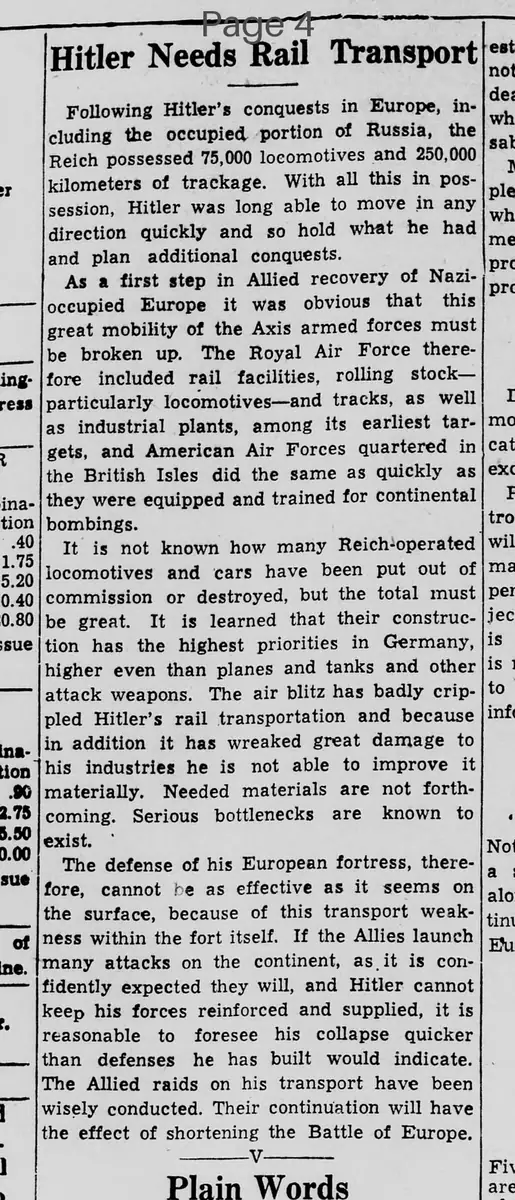
Hitler Needs Rail Transport
Following Hitler's conquests in Europe, including the occupied portion of Russia, the Reich possessed 75,000 locomotives and 250,000 kilometers of trackage. With all this in possession, Hitler was long able to move in any direction quickly and so hold what he had and plan additional conquests. As a first step in Allied recovery of Nazi-occupied Europe it was obvious that this great mobility of the Axis armed forces must be broken up. The Royal Air Force therefore included rail facilities, rolling stock— particularly locomotives—and tracks, as well as industrial plants, among its earliest targets, and American Air Forces quartered in the British Isles did the same as quickly as they were equipped and trained for continental bombings. It is not known how many Reich-operated locomotives and cars have been put out of commission or destroyed, but the total must be great. It is learned that their construction has the highest priorities in Germany, higher even than planes and tanks and other attack weapons. The air blitz has badly crippled Hitler's rail transportation and because in addition it has wreaked great damage to his industries he is not able to improve it materially. Needed materials are not forthcoming. Serious bottlenecks are known to exist. The defense of his European fortress, therefore, cannot be as effective as it seems on the surface, because of this transport weakness within the fort itself. If the Allies launch many attacks on the continent, as it is confidently expected they will, and Hitler cannot keep his forces reinforced and supplied, it is reasonable to foresee his collapse quicker than defenses he has built would indicate. The Allied raids on his transport have been wisely conducted. Their continuation will have the effect of shortening the Battle of Europe.
Following Hitler's conquests in Europe, including the occupied portion of Russia, the Reich possessed 75,000 locomotives and 250,000 kilometers of trackage. With all this in possession, Hitler was long able to move in any direction quickly and so hold what he had and plan additional conquests. As a first step in Allied recovery of Nazi-occupied Europe it was obvious that this great mobility of the Axis armed forces must be broken up. The Royal Air Force therefore included rail facilities, rolling stock— particularly locomotives—and tracks, as well as industrial plants, among its earliest targets, and American Air Forces quartered in the British Isles did the same as quickly as they were equipped and trained for continental bombings. It is not known how many Reich-operated locomotives and cars have been put out of commission or destroyed, but the total must be great. It is learned that their construction has the highest priorities in Germany, higher even than planes and tanks and other attack weapons. The air blitz has badly crippled Hitler's rail transportation and because in addition it has wreaked great damage to his industries he is not able to improve it materially. Needed materials are not forthcoming. Serious bottlenecks are known to exist. The defense of his European fortress, therefore, cannot be as effective as it seems on the surface, because of this transport weakness within the fort itself. If the Allies launch many attacks on the continent, as it is confidently expected they will, and Hitler cannot keep his forces reinforced and supplied, it is reasonable to foresee his collapse quicker than defenses he has built would indicate. The Allied raids on his transport have been wisely conducted. Their continuation will have the effect of shortening the Battle of Europe.
What sub-type of article is it?
Military Affairs
War Or Peace
What keywords are associated?
Hitler Rail Transport
Allied Bombing
Nazi Mobility
Transport Bottlenecks
Wwii Strategy
European Fortress
Axis Defenses
What entities or persons were involved?
Hitler
Reich
Royal Air Force
American Air Forces
Allies
Axis
Editorial Details
Primary Topic
Allied Bombing Of German Rail Transport To Weaken Nazi Defenses
Stance / Tone
Supportive Of Allied Strategy Predicting Quicker Nazi Collapse
Key Figures
Hitler
Reich
Royal Air Force
American Air Forces
Allies
Axis
Key Arguments
Hitler's Conquests Provided Vast Rail Resources For Mobility
Allied Air Forces Targeted Rail Facilities And Locomotives Early
German Rail Construction Has Highest Priority But Is Crippled
Transport Weaknesses Create Bottlenecks Hindering Defense
Continued Raids Will Shorten The Battle Of Europe