Thank you for visiting SNEWPapers!
Sign up free
Gazette Of The United States, & Philadelphia Daily Advertiser
Philadelphia, Philadelphia County, Pennsylvania
What is this article about?
Quakers in North Carolina defend against grand jury presentments accusing them of endangering the state by promoting slave emancipation, asserting their actions stem from religious and moral principles consistent with the Declaration of Independence and deny any malicious intent or forced emancipation.
Clipping
OCR Quality
Full Text
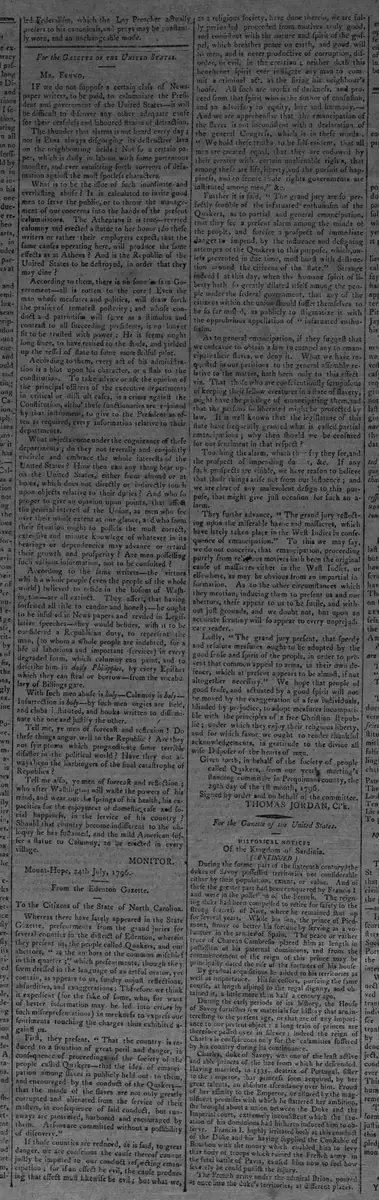
Mount-Hope, 24th July, 1796.
From the Edenton Gazette.
To the Citizens of the State of North Carolina.
Whereas there have lately appeared in the State Gazette, presentments from the grand juries for several counties in the district of Edenton, wherein they present us, the people called Quakers, and our abettors, "as the authors of the common mischief in this quarter;" which presentments, though they seem dressed in the language of an artful orator, yet contain, as appears to us, sundry unjust reflections, absurdities, and exaggerations: Therefore we think it expedient (for the sake of some, who, for want of better information may be led into errors by such misrepresentations) in meekness to express our sentiments touching the charges thus exhibited against us.
First, they present, "That the country is reduced to a situation of great peril and danger, in consequence of proceedings of the society of the people called Quakers—that the idea of emancipation among slaves is publicly held out to them, and encouraged by the conduct of the Quakers—that the minds of the slaves are not only greatly corrupted and alienated from the service of their masters, in consequence of said conduct, but runaways are protected, harbored and encouraged by them. Abductions are committed without a possibility of discovery."
If those counties are reduced, as is said, to great danger, we are conscious the cause thereof cannot justly be imputed to our conduct respecting emancipation; for if an effect be evil, the cause producing that effect must likewise be evil; but what we, as a religious society, have done therein, we are fully persuaded proceeded from motives truly good, and consistent with the nature and spirit of the gospel, which breathes peace on earth, and good will to men, and is never productive of corruption, disorder, or evil, in the creation; neither doth this beneficent spirit ever instigate any man to commit a criminal act, as the burning his neighbour's house. All such are works of darkness, and proceed from that spirit who is the author of confusion, and an adversary to equity, love and harmony.
And we are apprehensive that the emancipation of the slaves is not inconsistent with a declaration of the general Congress, which is in these words.
"We hold these truths to be self-evident, that all men are created equal, that they are endowed by their creator with certain unalienable rights, that among these are life, liberty, and the pursuit of happiness, and to secure those rights governments are instituted among men," &c.
Further it is said, "The grand jury are so perfectly sensible of the infatuated enthusiasm of the Quakers, as to partial and general emancipation, that they see a present alarm among the minds of the people, and foresee a prospect of immediate danger to impend, by the influence and designing attempts of the Quakers to this purpose, which, unless prevented in due time, must burst with destruction around the citizens of the state." Strange indeed! at this day, when the humane spirit of liberty hath so greatly dilated itself among the people under the federal government, that any of the citizens within the union should suffer themselves to be so far misled, as publicly to stigmatize it with the opprobrious appellation of "infatuated enthusiasm."
As to general emancipation, if they suggest that we endeavor to obtain a law to compel any to emancipate their slaves, we deny it. What we have requested in our petitions to the general assembly relative to the matter, hath been only to this effect viz. That those who are conscientiously scrupulous of keeping their fellow creatures in a state of slavery, might have the privilege of emancipating them, and that the persons so liberated might be protected by law. It is well known that the legislature of this state have frequently granted what is called partial emancipations; why then should we be censured for our sentiment in that respect?
Touching the alarm, which they say they see, and the prospect of impending danger, &c. If any such prospects are visible, we have reason to believe that those things arise not from our influence; and we are clear of any malevolent design to this purpose, that might give just occasion for such an alarm.
They further advance, "The grand jury reflecting upon the miserable havoc and massacres, which have lately taken place in the West Indies in consequence of emancipation." To this we may say, we do not conceive, that emancipation, proceeding purely from religious motives hath been the original cause of massacres either in the West Indies, or elsewhere, as may be obvious from an impartial information. As to the other circumstances which they mention, inducing them to present us and our abettors, these appear to us to be futile, and without just grounds, and we doubt not, but upon an accurate scrutiny will so appear to every unprejudiced careful reader.
Lastly, "The grand jury present, that speedy and resolute measures ought to be adopted by the good sense and spirit of the people, in order to prevent that common appeal to arms, in their own defence, which at present appears to be almost, if not altogether necessary." We hope that people of good sense, and actuated by a good spirit will not be moved by the exaggeration of a few individuals, blinded by prejudice, to adopt measures incompatible with the principles of a free Christian Republic; under which they enjoy their religious liberty, and for which favor we ought to render thankful acknowledgements, in gratitude to the divine all wise Disposer of the hearts of men.
Given forth, in behalf of the society of people called Quakers, from our yearly meeting's standing committee in Perquimans county, the 29th day of the 8th month, 1796.
Signed by order and on behalf of the committee.
THOMAS JORDAN, CLK.
What sub-type of article is it?
What themes does it cover?
What keywords are associated?
What entities or persons were involved?
Letter to Editor Details
Author
Thomas Jordan, Clk.
Recipient
To The Citizens Of The State Of North Carolina.
Main Argument
the quakers deny causing danger through emancipation efforts, asserting their actions are motivated by religious and moral principles aligned with the gospel and the declaration of independence, and they seek only the legal right to emancipate slaves voluntarily without compulsion.
Notable Details