Thank you for visiting SNEWPapers!
Sign up free
Editorial
January 29, 1941
Henderson Daily Dispatch
Henderson, Vance County, North Carolina
What is this article about?
Editorial opposes President Roosevelt's Lend-Lease bill for granting him unlimited powers to aid Britain, warning it would create dictatorship, undermine democracy, and let one man decide on war. Urges aid short of war with public input.
Clipping
OCR Quality
78%
Good
Full Text
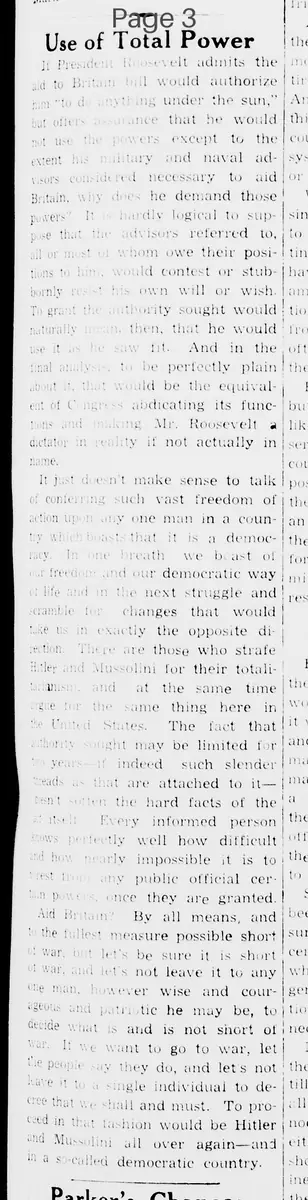
Use of Total Power
If President Roosevelt admits the aid to Britain bill would authorize him "to do anything under the sun," but offers assurance that he would not use powers except to the extent his military and naval advisors considered necessary to aid Britain. Why does he demand those powers? It is hardly logical to suppose that the advisors referred to, all or most of whom owe their positions to him, would contest or stubbornly resist his own will or wish.
To grant the authority sought would naturally then imply that he would use it if he saw fit. And in the final analysis to be perfectly plain about it, that would be the equivalent of Congress abdicating its functions and making Mr. Roosevelt a dictator in reality if not actually in name.
It just doesn't make sense to talk of consenting such vast freedom of action upon any one man in a country when that country is a democracy. In this blessed land we boast of freedom and our democratic way of life and in the next breath we struggle and cram it with changes that would take us in exactly the opposite direction. There are those who denounce Hitler and Mussolini for their totalitarianism and at the same time give the same thing here in United States. The fact that the authority though it may be limited for years—indeed such slender safeguards that are attached to it—cannot alter the hard facts of the situation. Every informed person knows full well how difficult and how nearly impossible it is to wrest from any public official once they are granted.
Aid Britain by all means, and to the fullest measure possible short of war, but let's be sure it is short of war, and do not leave it to any one man, however wise and courageous and patriotic he may be, to decide what is and is not short of war. If we want to go to war, let the people say they do, and let's not have it up to a single individual to decree that we shall and must. To proceed in that fashion would be Hitler and Mussolini all over again—and in a so-called democratic country.
If President Roosevelt admits the aid to Britain bill would authorize him "to do anything under the sun," but offers assurance that he would not use powers except to the extent his military and naval advisors considered necessary to aid Britain. Why does he demand those powers? It is hardly logical to suppose that the advisors referred to, all or most of whom owe their positions to him, would contest or stubbornly resist his own will or wish.
To grant the authority sought would naturally then imply that he would use it if he saw fit. And in the final analysis to be perfectly plain about it, that would be the equivalent of Congress abdicating its functions and making Mr. Roosevelt a dictator in reality if not actually in name.
It just doesn't make sense to talk of consenting such vast freedom of action upon any one man in a country when that country is a democracy. In this blessed land we boast of freedom and our democratic way of life and in the next breath we struggle and cram it with changes that would take us in exactly the opposite direction. There are those who denounce Hitler and Mussolini for their totalitarianism and at the same time give the same thing here in United States. The fact that the authority though it may be limited for years—indeed such slender safeguards that are attached to it—cannot alter the hard facts of the situation. Every informed person knows full well how difficult and how nearly impossible it is to wrest from any public official once they are granted.
Aid Britain by all means, and to the fullest measure possible short of war, but let's be sure it is short of war, and do not leave it to any one man, however wise and courageous and patriotic he may be, to decide what is and is not short of war. If we want to go to war, let the people say they do, and let's not have it up to a single individual to decree that we shall and must. To proceed in that fashion would be Hitler and Mussolini all over again—and in a so-called democratic country.
What sub-type of article is it?
Constitutional
War Or Peace
Foreign Affairs
What keywords are associated?
Presidential Powers
Lend Lease
Aid Britain
Dictatorship
Democracy
Roosevelt
War Decision
Totalitarianism
What entities or persons were involved?
President Roosevelt
Congress
Hitler
Mussolini
Editorial Details
Primary Topic
Opposition To Broad Presidential Powers For Aid To Britain
Stance / Tone
Strongly Against Granting Dictatorial Powers To Roosevelt
Key Figures
President Roosevelt
Congress
Hitler
Mussolini
Key Arguments
Presidential Advisors Unlikely To Resist Roosevelt's Will
Granting Broad Powers Equivalent To Congress Abdicating And Making Roosevelt A Dictator
Democracy Incompatible With Vast Freedom Of Action To One Man
Criticizes Hypocrisy In Denouncing Totalitarian Leaders While Enabling Similar Powers
Aid Britain Short Of War But Not Left To One Individual To Decide
War Decision Should Be By The People, Not A Single Person