Thank you for visiting SNEWPapers!
Sign up free
Literary
January 27, 1848
Litchfield Enquirer
Litchfield, Litchfield County, Connecticut
What is this article about?
A narrator recounts his romance with Kate Russell in the Old Colony. After a jealous quarrel, he leaves but returns on her wedding eve to another, reconciles with her, and they marry. The tale warns against delaying in love.
Clipping
OCR Quality
95%
Excellent
Full Text
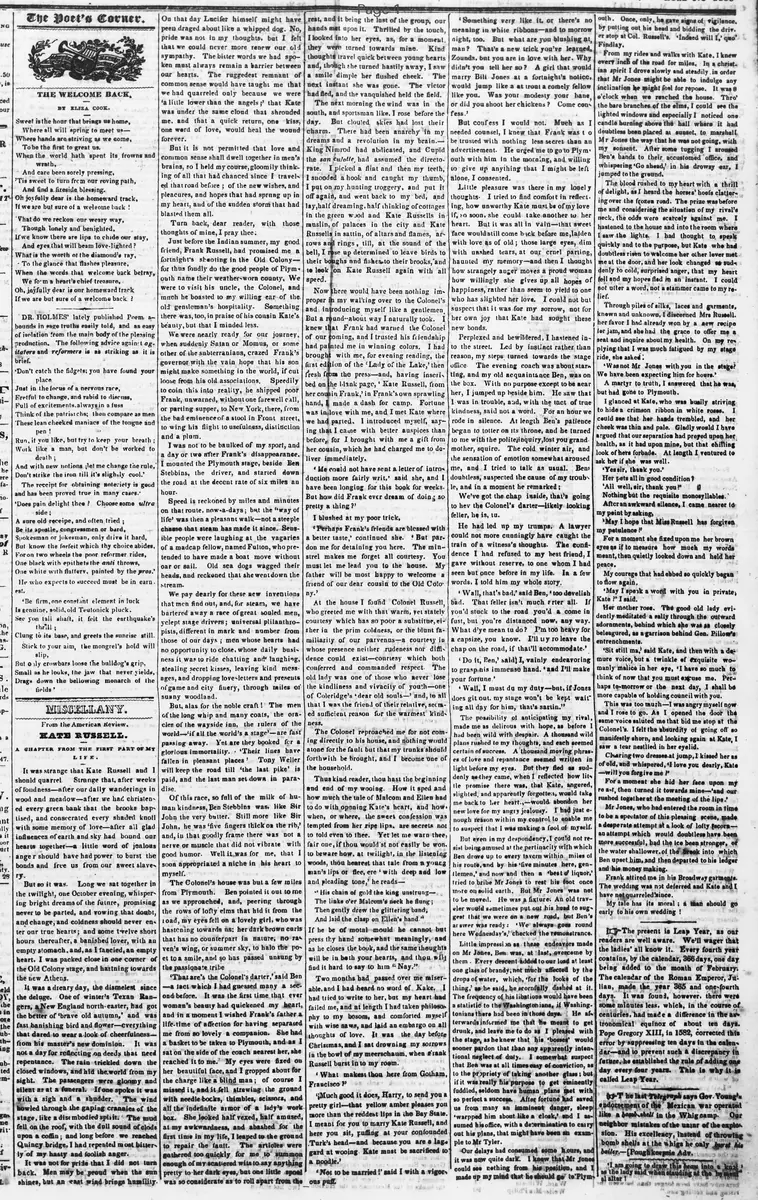
MISCELLANY.
From the American Review,
KATE ROSSELL.
CHAPTER FROM THE FIRST PART OF MY
LIFE.
It was strange that Kate Russell and I
should quarrel.
Strange that, after weeks
of fondness—after our daily wanderings in
wood and meadow—after we had christened
every green bank that the brooks baptized,
and consecrated every shaded knoll
with some memory of love—after all glad
influences of earth and sky had bound our
hearts together—a little word of jealous
anger should have had power to burst the
bonds and free us from our sweet slavery.
But so it was.
Long we sat together in
the twilight, one October evening, whispering
bright dreams of the future, promising
never to be parted, and vowing that doubt,
and change, and coldness should never enter
our true hearts; and some twelve short
hours thereafter, a banished lover, with an
empty stomach, and, as I fancied, an empty
heart, I was packed close in one corner of
the Old Colony stage, and hastening towards
the new Athens.
It was a dreary day, the dismalest since
the deluge. One of winter's Texan Rangers,
a New England north-easter, had got
the better of 'brave old autumn,' and was
fast banishing bird and flower—everything
that dared to wear a look of cheerfulness—
from his master's new dominion. It was
not a day for reflecting on deeds that need
repentance. The rain trickled down the
closed windows, and hid the world from my
sight. The passengers were gloomy and
silent as at a funeral. If one spoke it was
with a sigh and a shudder. The wind
howled through the gaping crannies of the
stage, like a disembodied spirit. The mud
fell on the roof, with the dull sound of clods
upon a coffin; and long before we reached
Quincy bridge, I had repented most bitterly
of my hasty and foolish anger.
It was not for pride that I did not turn
back. Men may be proud when the sun
shines, but an east wind brings humility.
On that day Lucifer himself might have
been dragged about like a whipped dog. No,
pride was not in my thoughts, but I felt
that we could never more renew our old
sympathy. The bitter words we had spoken
must always remain a barrier between
our hearts. The rudest remnant of
common sense would have taught me that
we had quarreled only because we were
a little lower than the angels; that Kate
was under the same cloud that shrouded
me, and that a quick return, one kiss,
one word of love, would heal the wound
forever.
But it is not permitted that love and
common sense shall dwell together in men's
brains, so I held my course, gloomily thinking
of all that had chanced since I traveled
that road before: of the new wishes, and
pleasures, and hopes that had sprung up in
my heart, and of the sudden storm that had
blasted them all.
Turn back, dear reader, with those
thoughts of mine, I pray thee:
Just before the Indian summer, my good
friend, Frank Russell, had promised me a
fortnight's shooting in the Old Colony—
for thus fondly do the good people of Plymouth
name their weather-worn county. We
were to visit his uncle, the Colonel, and
much he boasted to my willing ear of the
old gentleman's hospitality. Something
there was, too, in praise of his cousin Kate's
beauty, but that I minded less.
We were nearly ready for our journey,
when suddenly Satan or Momus, or some
other of the subterraneans, crazed Frank's
governor with the vain hope that his son
might make something in the world, if cut
loose from his old associations. Speedily
to coin this into reality, he shipped poor
Frank, unwarned, without one farewell call,
or parting supper, to New York, there, from
the bad eminence of a stool in Front street
to wing his flight to usefulness, distinction
and a plum.
I was not to be baulked of my sport, and
a day or two after Frank's disappearance,
mounted the Plymouth stage, beside Ben
Stebbins, the driver, and started down
the road at the decent rate of six miles an
hour.
Speed is reckoned by miles and minutes
on that route, now-a-days; but the 'way of
life' was then a pleasant walk—not a steeple
chase that steam has made it since. Sensible
people were laughing at the vagaries
of a madcap fellow, named Fulton, who pretended
to have made a boat move without
oar or sail. Old sea dogs wagged their
heads, and reckoned that she went down the
stream.
We pay dearly for these new inventions
that men find out, and, for steam, we have
bartered away a race of great souled men,
yclept stage drivers; universal philanthropists,
different in mark and number from
those of our days; men whose hearts had
no opportunity to close, whose daily business
it was to ride chatting and laughing,
stealing secret kisses, leaving kind messages,
and dropping love-letters and presents
of game and city finery, through miles of
sunny woodland.
But, alas for the noble craft! The men
of the long whip and many coats, the oracles
of the wayside inn, the rulers of the
world—'if all the world's a stage'—are fast
passing away. Yet are they booked for a
glorious immortality. 'Their lines have
fallen in pleasant places' Tony Weller
will keep the road till 'the last pike' is
paid, and the last man set down in paradise.
Of this race, so full of the milk of human
kindness, Ben Stebbins was, like Sir
John the very best. Still more like Sir
John, he was 'five fingers thick on the ribs,
and, in that goodly frame there was not a
nerve or muscle that did not vibrate with
good humor. Well it was for me, that I
soon appropriated a niche in his heart to
myself.
The Colonel's house was but a few miles
from Plymouth. Ben pointed it out to me
as we approached, and, peering through
the rows of lofty elms that hid it from the
road, my eyes fell on a lovely girl, who was
hastening towards us; her dark brown curls
that has no counterpart in nature, no rainbow's
wing, or summer sky, to halo the poet
to a smile, and so has passed unsung by
the passionate tribe
That's the Colonel's darter,' said Ben
—a fact which I had guessed many a second
before. It was the first time that ever
woman's beauty had quickened my heart,
and in a moment I wished Frank's father a
life-time of affection for having separated
me from so lovely a companion. She had
a basket to be taken to Plymouth, and as I
sat on the side of the coach nearest her, she
reached it to me. My eyes were fixed on
her beautiful face, and I groped about for
the charge like a blind man; of course I
missed it, and it fell strewing the ground
with needle books, thimbles, scissors, and
all the indefinite armor of a lady's work
box. She looked half vexed, half amused,
at my awkwardness, and abashed for the
first time in my life, I leaped to the ground
gathered too quickly for me to summon
to repair the fault. The articles were
enough of my scattered wits to say anything
pretty to her dark eyes, but one little spool
was so considerate as to roll apart from the
rest, and it being the last of the group, our
hands met upon it. Thrilled by the touch,
I looked into her eyes, as, for a moment,
they were turned towards mine. Kind
thoughts travel quick between young hearts
and, though she turned hastily away, I saw
a smile dimple her flushed cheek. The
next instant she was gone. The victor
had fled, and the vanquished held the field.
The next morning the wind was in the
south, and sportsman like, I rose before the
day. But clouded skies had lost their
charm. There had been anarchy in my
dreams and a revolution in my brain.—
King Nimrod had abdicated, and Cupid
the sans culotte, had assumed the directorate.
I picked a flint and then my teeth,
I snooded a hook and caught my thumb,
I put on my hunting toggery, and put it
off again, and went back to my bed, and
lay, half dreaming, half thinking of cottages
in the green wood and Kate Russells in
muslin, of palaces in the city and Kate
Russells in satin, of altars and flames, arrows
and rings, till, at the sound of the
bell, I rose up determined to leave birds to
their boughs and fishes to their brooks, 'and
to look on Kate Russell again with all
speed.
Now there would have been nothing improper
in my walking over to the Colonel's
and introducing myself like a gentleman.
But a round-about way I naturally took.
I knew that Frank had warned the Colonel
of our coming, and I trusted his friendship
had painted me in winning colors. I had
brought with me, for evening reading, the
first edition of the 'Lady of the Lake,' then
fresh from the press—and, having inscribed
on the blank page, 'Kate Russell, from
her cousin Frank,' in Frank's own sprawling
hand, I made a dash for camp. Fortune
was in love with me, and I met Kate where
we had parted, I introduced myself, saying
that I came with better auspices than
before, for I brought with me a gift from
her cousin, which he had charged me to deliver
immediately.
'He could not have sent a letter of introduction
more fairly writ,' said she, and I
have been longing for this book for weeks.
But how did Frank ever dream of doing so
pretty a thing?'
I blushed at my poor trick,
Perhaps Frank's friends are blessed with
a better taste,' continued she. 'But pardon
me for detaining you here. The minstrel
makes me forget all courtesy. You
must let me lead you to the house. My
father will be most happy to welcome a
friend of our dear cousin to the Old Colony.'
At the house I found Colonel Russell
who greeted me with that warm, yet stately
courtesy which has so poor a substitute, either
in the prim coldness, or the blunt familiarity
of our parvenus—a courtesy in
whose presence neither rudeness nor diffidence
could exist—courtesy which both
conferred and commanded respect. The
old lady was one of those who never lose
the kindliness and vivacity of youth—one
of Coleridge's 'dear old souls—' and, to all
that I was the friend of their relative, seemed
sufficient reason for the warmest kindness,
The Colonel reproached me for not coming
directly to his house, and nothing would
atone for the fault but that my trunks should
forthwith be brought, and I become one of
the household.
Thus kind reader, thou hast the beginning
and end of my wooing. How it sped and
how much the tale of Malcom and Ellen had
to do with opening Kate's heart, and how
when, or where, the sweet confession was
tempted from her ripe lips, are secrets not
to be told even to thee. Yet let me warn thee,
fair one, if thou would'st not easily be won,
to beware how, at twilight, in the listening
woods, thou hearest that tale from a young
man's lips or flee, ere with deep and low
and pleading tone, he reads—
"His chain of gold the king unstrung—
The links o'er Malcom's neck he flung;
Then gently drew the glittering band,
And laid the clasp on Ellen's hand."
If he be of mortal mould he cannot but
press thy hand somewhat meaningly, and
as he closes the book, and the same thoughts
will be in both your hearts, and thou wilt
find it hard to say to him "Nay."
Two months had passed over me miserable,
and I had heard no word of Kate. I
had tried to write to her, but my heart had
failed me, and at length I had taken philosophy
to my bosom, and comforted myself
with wise saws, and laid an embargo on all
thoughts of love. It was the day before
Christmas, and I sat drowning my sorrows
in the bowl of my meerschaum, when Frank
Russell burst in to my room.
What makest thou here from Gotham,
Francisco?
'Much good it does, Harry, to send you a
pretty girl—that yellow amber pleases you
more than the reddest lips in the Bay State.
I meant for you to marry Kate Russell, and
here you sit, puffing at your confounded
Turk's head—and because you are a laggard
at wooing, Kate must be sacrificed to
a noodle.'
Not to be married!' said I with a vigorous puff.
Something very like it, or there's no
meaning in white ribbons—and to morrow
night, too. But what are you blushing at
man? That's a new trick you've learned,
Zounds, but you are in love with her. Why
didn't you tell her so? A girl that would
marry Bill Jones at a fortnight's notice,
would jump like a trout at a comely fellow
like you. Was your modesty your bane
or did you shoot her chickens? Come confess.'
But confess I would not. Much as I
needed counsel, I knew that Frank was too
be trusted with nothing less secret than an
advertisement. He urged me to go to Plymouth
with him in the morning, and willing
to give up anything that I might be left
alone. I consented.
Little pleasure was there in my lonely
thoughts. I tried to find comfort in reflecting,
how unworthy Kate must be of my love
if, so soon, she could take another to her
heart. But it was all in vain—that sweet
face would still come back before me, laden
with love as of old; those large eyes, dim
with unshed tears, at our cruel parting,
haunted my memory—and then I thought
how strangely anger moves a proud woman
how willingly she gives up all hopes of
happiness, rather than seem to yield to one
who has slighted her love. I could not but
suspect that it was for my sorrow, not for
her own joy that Kate had sought these
new bonds.
Perplexed and bewildered, I hastened into
the street. Led by instinct rather than
reason, my steps turned towards the stage
office. The evening coach was about starting,
and my old acquaintance Ben, was on
the box. With no purpose except to be near
her, I jumped up beside him. He saw that
I was in trouble, and, with the tact of true
kindness, said not a word. For an hour we
rode in silence. At length Ben's patience
began to totter on its throne, and he turned
to me with the polite inquiry, 'Lost you grandmother,
squire.' The cold winter air, and
the sensation of motion somewhat aroused
me, and I tried to talk as usual. Ben's
doubtless, suspected the cause of my trouble,
and in a moment he remarked
We've got the chap inside, that's going
to hev the Colonel's darter—likely looking
feller, he is, tu.
He had led up my trumps. A lawyer
could not more cunningly have caught the
train of a witness's thoughts. The confidence
I had refused to my best friend, I
gave without reserve, to one whom I had
seen but once before in my life. In a few
words, I told him my whole story.
'Wall, that's bad, said Ben, 'too devilish
bad. That feller isn't much arter all. If
you'd stuck to the road you'd a come in
fust, but you're distanced now, any way.
What d'ye mean tu do? I'm too heavy for
a capsize, you know. I'll try to leave the
chap on the road, if that'll accommodate.'
'Do it, Ben, said I, vainly endeavoring
to grasp his immense hand. 'and I'll make
your fortune.'
Wall. I must du my duty—but, if Jones
does git out, my stage won't be kept waiting
all day for him, that's sartin.'
The possibility of anticipating my rival,
made me as delirious with hope, as before I
had been wild with despair. A thousand wild
plans rushed to my thoughts, and each seemed
certain of success. A thousand moving phrases
of love and repentance seemed written in
light before my eyes. But they fled as suddenly
as they came, when I reflected how little
promise there was, that Kate, angered,
slighted, and apparently forgotten, would take
me back to her heart.—would abandon her
new love for my angry jealousy. I had just enough
reason within my control to enable me
to suspect that I was making a fool of myself.
But even in my despondency, I could not resist
being amused at the pertinacity with which
Ben drove up to every tavern within miles of
his route, and by his 'five minutes here, gentlemen,'
and now and then a best liquor,
tried to bribe Mr. Jones to rest his foot once
more on solid earth. But Mr. Jones was not
to be moved. He was a fixture: An old traveler
would sometimes put out his head to suggest
that we were on a new road, but Ben's
answer was ready: 'We always goes round
here Wednesdays,' checked the remonstrance.
Little impression as these endeavors made
on Mr. Jones, Ben was, at last, overcome by
them. Every descent added to our load at least
one glass of brandy; not much affected by the
drops of water, which, 'for the looks of the
thing,' as he said, he scornfully dashed at it.
The frequency of his libations would have been
a statistic to the Washingtonians, if Washingtonians
there had been in those days. He afterwards
informed me that he meant to get
drunk, and leave me to do as I pleased with
the stage, as he knew that his 'bosses' would
sooner pardon that than any apparently intentional
neglect of duty. I somewhat suspect
that Ben was at all times easy of conviction, as
to the propriety of taking another glass; but
if it was really his purpose to get eminently
fuddled, seldom have human plans met with
so perfect a success. After fortune had saved
us from many an imminent danger, sleep
wrapped him about like a cloak,' and I assumed
his office, with a determination to carry
out his plans, that might have been an example
to Mr. Tyler.
Our delays had consumed some hours, and
it was now quite dark. I knew, that Mr. Jones
could see nothing from his position, and I
made up my mind that he should go to Plymouth.
Once, only, he gave signs of vigilance.
by putting out his head and bidding the driver
stop at Col. Russell's. 'Indeed will I,' quoth
Findlay.
From my rides and walks with Kate, I knew
every inch of the road for miles. In a Christian
spirit I drove slowly and steadily, in order
that Mr. Jones might be able to indulge any
inclination he might feel for repose. It was 8
o'clock when we reached the house. Thro'
the bare branches of the elms, I could see the
lighted windows and especially I noticed one
candle burning above the hall where it had
doubtless been placed at sunset, to marshal
Mr. Jones the way that he was not going, with
my consent. After some tugging I aroused
Ben's hands to their accustomed office, and
whispering 'Go ahead,' in his drowsy ear, I
jumped to the ground.
The blood rushed to my heart with a thrill
of delight, as I heard the horses' hoofs clattering
over the frozen road. The prize was before
me and considering the situation of my rival's
neck, the odds were scarcely against me. I
hastened to the house and into the room where
I saw the lights. I had thought to speak
quickly and to the purpose, but Kate who had.
doubtless risen to welcome her other lover met.
me at the door, and her look changed so suddenly
to cold, surprised anger, that my heart
fell and my hopes fled in an instant. I could
not utter a word, not a stammer came to my relief.
Through piles of silks, laces and garments,
known and unknown, I discerned Mrs. Russell.
her favor I had already won by a new recipe
for jam, and she had the grace to offer me a
seat and inquire about my health. On my responding
that I was much fatigued by my stage
ride, she asked:
'Was not Mr. Jones with you in the stage?
We have been expecting him for hours.'
A martyr to truth, I answered that he was,
but had gone to Plymouth.
I glanced at Kate, who was busily striving
to hide a crimson ribbon in white roses. I
could see that her hands trembled, and her
cheek was thin and pale. Gladly would I have
argued that our separation had preyed upon her
health, as it had upon mine, but that chilling
look of hers forbade. At length I ventured to
ask her if she was well.
'Yes sir, thank you.'
Her pets all in good condition?
'All well, sir, thank you?'
Nothing but the requisite monosyllables.
After an awkward silence, I came nearer to
my point by asking,
May I hope that Miss Russell has forgiven
my petulance?
For a moment she fixed upon me her brown
eyes as if to measure how much my words
meant, then quietly looked down and held her
peace.
My courage that had ebbed so quickly began
to flow again.
'May I speak a word with you in private
Kate?' I said.
Her mother rose. The good old lady evidently
meditated a sally through the outward
adornments, behind which she was so closely
beleaguered, as a garrison behind Gen. Pillow's
entrenchments.
'Sit still ma.' said Kate, and then with a demure
voice, but a twinkle of exquisite womanly
malice in her eye, 'I have so much to
think of now that you must excuse me, Perhaps
to-morrow or the next day, I shall be
more capable of holding council with you.'
This was too much—I was angry myself now
and I rose to go. As I opened the door the
same voice saluted me that bid me stop at the
Colonel's. I felt the absurdity of going off' so
manifestly shorn, and looking again at Kate, I
saw a tear nestled in her eyelid.
Clearing two dresses at a jump, I kissed her as
of old, and whispered, I love you dearly, Kate
—will you forgive me?'
For a moment she hid her face upon my
breast, then turned it towards mine—and our
lips rushed together at the meeting of the lips.
Mr. Jones, who had entered the room in time
to be a spectator of this pleasing scene, made
a desperate attempt at a look of lofty scorn—
an attempt which would doubtless have been
more successful, had the ice been stronger, or
the water shallower of the brook into which
Ben upset him, and then departed to his ledger
and his money making.
Frank attired me in his Broadway garments.
The wedding was not deferred and Kate and I
have not quarreled since.
My tale has its moral; a man should go
early to his own wedding!
From the American Review,
KATE ROSSELL.
CHAPTER FROM THE FIRST PART OF MY
LIFE.
It was strange that Kate Russell and I
should quarrel.
Strange that, after weeks
of fondness—after our daily wanderings in
wood and meadow—after we had christened
every green bank that the brooks baptized,
and consecrated every shaded knoll
with some memory of love—after all glad
influences of earth and sky had bound our
hearts together—a little word of jealous
anger should have had power to burst the
bonds and free us from our sweet slavery.
But so it was.
Long we sat together in
the twilight, one October evening, whispering
bright dreams of the future, promising
never to be parted, and vowing that doubt,
and change, and coldness should never enter
our true hearts; and some twelve short
hours thereafter, a banished lover, with an
empty stomach, and, as I fancied, an empty
heart, I was packed close in one corner of
the Old Colony stage, and hastening towards
the new Athens.
It was a dreary day, the dismalest since
the deluge. One of winter's Texan Rangers,
a New England north-easter, had got
the better of 'brave old autumn,' and was
fast banishing bird and flower—everything
that dared to wear a look of cheerfulness—
from his master's new dominion. It was
not a day for reflecting on deeds that need
repentance. The rain trickled down the
closed windows, and hid the world from my
sight. The passengers were gloomy and
silent as at a funeral. If one spoke it was
with a sigh and a shudder. The wind
howled through the gaping crannies of the
stage, like a disembodied spirit. The mud
fell on the roof, with the dull sound of clods
upon a coffin; and long before we reached
Quincy bridge, I had repented most bitterly
of my hasty and foolish anger.
It was not for pride that I did not turn
back. Men may be proud when the sun
shines, but an east wind brings humility.
On that day Lucifer himself might have
been dragged about like a whipped dog. No,
pride was not in my thoughts, but I felt
that we could never more renew our old
sympathy. The bitter words we had spoken
must always remain a barrier between
our hearts. The rudest remnant of
common sense would have taught me that
we had quarreled only because we were
a little lower than the angels; that Kate
was under the same cloud that shrouded
me, and that a quick return, one kiss,
one word of love, would heal the wound
forever.
But it is not permitted that love and
common sense shall dwell together in men's
brains, so I held my course, gloomily thinking
of all that had chanced since I traveled
that road before: of the new wishes, and
pleasures, and hopes that had sprung up in
my heart, and of the sudden storm that had
blasted them all.
Turn back, dear reader, with those
thoughts of mine, I pray thee:
Just before the Indian summer, my good
friend, Frank Russell, had promised me a
fortnight's shooting in the Old Colony—
for thus fondly do the good people of Plymouth
name their weather-worn county. We
were to visit his uncle, the Colonel, and
much he boasted to my willing ear of the
old gentleman's hospitality. Something
there was, too, in praise of his cousin Kate's
beauty, but that I minded less.
We were nearly ready for our journey,
when suddenly Satan or Momus, or some
other of the subterraneans, crazed Frank's
governor with the vain hope that his son
might make something in the world, if cut
loose from his old associations. Speedily
to coin this into reality, he shipped poor
Frank, unwarned, without one farewell call,
or parting supper, to New York, there, from
the bad eminence of a stool in Front street
to wing his flight to usefulness, distinction
and a plum.
I was not to be baulked of my sport, and
a day or two after Frank's disappearance,
mounted the Plymouth stage, beside Ben
Stebbins, the driver, and started down
the road at the decent rate of six miles an
hour.
Speed is reckoned by miles and minutes
on that route, now-a-days; but the 'way of
life' was then a pleasant walk—not a steeple
chase that steam has made it since. Sensible
people were laughing at the vagaries
of a madcap fellow, named Fulton, who pretended
to have made a boat move without
oar or sail. Old sea dogs wagged their
heads, and reckoned that she went down the
stream.
We pay dearly for these new inventions
that men find out, and, for steam, we have
bartered away a race of great souled men,
yclept stage drivers; universal philanthropists,
different in mark and number from
those of our days; men whose hearts had
no opportunity to close, whose daily business
it was to ride chatting and laughing,
stealing secret kisses, leaving kind messages,
and dropping love-letters and presents
of game and city finery, through miles of
sunny woodland.
But, alas for the noble craft! The men
of the long whip and many coats, the oracles
of the wayside inn, the rulers of the
world—'if all the world's a stage'—are fast
passing away. Yet are they booked for a
glorious immortality. 'Their lines have
fallen in pleasant places' Tony Weller
will keep the road till 'the last pike' is
paid, and the last man set down in paradise.
Of this race, so full of the milk of human
kindness, Ben Stebbins was, like Sir
John the very best. Still more like Sir
John, he was 'five fingers thick on the ribs,
and, in that goodly frame there was not a
nerve or muscle that did not vibrate with
good humor. Well it was for me, that I
soon appropriated a niche in his heart to
myself.
The Colonel's house was but a few miles
from Plymouth. Ben pointed it out to me
as we approached, and, peering through
the rows of lofty elms that hid it from the
road, my eyes fell on a lovely girl, who was
hastening towards us; her dark brown curls
that has no counterpart in nature, no rainbow's
wing, or summer sky, to halo the poet
to a smile, and so has passed unsung by
the passionate tribe
That's the Colonel's darter,' said Ben
—a fact which I had guessed many a second
before. It was the first time that ever
woman's beauty had quickened my heart,
and in a moment I wished Frank's father a
life-time of affection for having separated
me from so lovely a companion. She had
a basket to be taken to Plymouth, and as I
sat on the side of the coach nearest her, she
reached it to me. My eyes were fixed on
her beautiful face, and I groped about for
the charge like a blind man; of course I
missed it, and it fell strewing the ground
with needle books, thimbles, scissors, and
all the indefinite armor of a lady's work
box. She looked half vexed, half amused,
at my awkwardness, and abashed for the
first time in my life, I leaped to the ground
gathered too quickly for me to summon
to repair the fault. The articles were
enough of my scattered wits to say anything
pretty to her dark eyes, but one little spool
was so considerate as to roll apart from the
rest, and it being the last of the group, our
hands met upon it. Thrilled by the touch,
I looked into her eyes, as, for a moment,
they were turned towards mine. Kind
thoughts travel quick between young hearts
and, though she turned hastily away, I saw
a smile dimple her flushed cheek. The
next instant she was gone. The victor
had fled, and the vanquished held the field.
The next morning the wind was in the
south, and sportsman like, I rose before the
day. But clouded skies had lost their
charm. There had been anarchy in my
dreams and a revolution in my brain.—
King Nimrod had abdicated, and Cupid
the sans culotte, had assumed the directorate.
I picked a flint and then my teeth,
I snooded a hook and caught my thumb,
I put on my hunting toggery, and put it
off again, and went back to my bed, and
lay, half dreaming, half thinking of cottages
in the green wood and Kate Russells in
muslin, of palaces in the city and Kate
Russells in satin, of altars and flames, arrows
and rings, till, at the sound of the
bell, I rose up determined to leave birds to
their boughs and fishes to their brooks, 'and
to look on Kate Russell again with all
speed.
Now there would have been nothing improper
in my walking over to the Colonel's
and introducing myself like a gentleman.
But a round-about way I naturally took.
I knew that Frank had warned the Colonel
of our coming, and I trusted his friendship
had painted me in winning colors. I had
brought with me, for evening reading, the
first edition of the 'Lady of the Lake,' then
fresh from the press—and, having inscribed
on the blank page, 'Kate Russell, from
her cousin Frank,' in Frank's own sprawling
hand, I made a dash for camp. Fortune
was in love with me, and I met Kate where
we had parted, I introduced myself, saying
that I came with better auspices than
before, for I brought with me a gift from
her cousin, which he had charged me to deliver
immediately.
'He could not have sent a letter of introduction
more fairly writ,' said she, and I
have been longing for this book for weeks.
But how did Frank ever dream of doing so
pretty a thing?'
I blushed at my poor trick,
Perhaps Frank's friends are blessed with
a better taste,' continued she. 'But pardon
me for detaining you here. The minstrel
makes me forget all courtesy. You
must let me lead you to the house. My
father will be most happy to welcome a
friend of our dear cousin to the Old Colony.'
At the house I found Colonel Russell
who greeted me with that warm, yet stately
courtesy which has so poor a substitute, either
in the prim coldness, or the blunt familiarity
of our parvenus—a courtesy in
whose presence neither rudeness nor diffidence
could exist—courtesy which both
conferred and commanded respect. The
old lady was one of those who never lose
the kindliness and vivacity of youth—one
of Coleridge's 'dear old souls—' and, to all
that I was the friend of their relative, seemed
sufficient reason for the warmest kindness,
The Colonel reproached me for not coming
directly to his house, and nothing would
atone for the fault but that my trunks should
forthwith be brought, and I become one of
the household.
Thus kind reader, thou hast the beginning
and end of my wooing. How it sped and
how much the tale of Malcom and Ellen had
to do with opening Kate's heart, and how
when, or where, the sweet confession was
tempted from her ripe lips, are secrets not
to be told even to thee. Yet let me warn thee,
fair one, if thou would'st not easily be won,
to beware how, at twilight, in the listening
woods, thou hearest that tale from a young
man's lips or flee, ere with deep and low
and pleading tone, he reads—
"His chain of gold the king unstrung—
The links o'er Malcom's neck he flung;
Then gently drew the glittering band,
And laid the clasp on Ellen's hand."
If he be of mortal mould he cannot but
press thy hand somewhat meaningly, and
as he closes the book, and the same thoughts
will be in both your hearts, and thou wilt
find it hard to say to him "Nay."
Two months had passed over me miserable,
and I had heard no word of Kate. I
had tried to write to her, but my heart had
failed me, and at length I had taken philosophy
to my bosom, and comforted myself
with wise saws, and laid an embargo on all
thoughts of love. It was the day before
Christmas, and I sat drowning my sorrows
in the bowl of my meerschaum, when Frank
Russell burst in to my room.
What makest thou here from Gotham,
Francisco?
'Much good it does, Harry, to send you a
pretty girl—that yellow amber pleases you
more than the reddest lips in the Bay State.
I meant for you to marry Kate Russell, and
here you sit, puffing at your confounded
Turk's head—and because you are a laggard
at wooing, Kate must be sacrificed to
a noodle.'
Not to be married!' said I with a vigorous puff.
Something very like it, or there's no
meaning in white ribbons—and to morrow
night, too. But what are you blushing at
man? That's a new trick you've learned,
Zounds, but you are in love with her. Why
didn't you tell her so? A girl that would
marry Bill Jones at a fortnight's notice,
would jump like a trout at a comely fellow
like you. Was your modesty your bane
or did you shoot her chickens? Come confess.'
But confess I would not. Much as I
needed counsel, I knew that Frank was too
be trusted with nothing less secret than an
advertisement. He urged me to go to Plymouth
with him in the morning, and willing
to give up anything that I might be left
alone. I consented.
Little pleasure was there in my lonely
thoughts. I tried to find comfort in reflecting,
how unworthy Kate must be of my love
if, so soon, she could take another to her
heart. But it was all in vain—that sweet
face would still come back before me, laden
with love as of old; those large eyes, dim
with unshed tears, at our cruel parting,
haunted my memory—and then I thought
how strangely anger moves a proud woman
how willingly she gives up all hopes of
happiness, rather than seem to yield to one
who has slighted her love. I could not but
suspect that it was for my sorrow, not for
her own joy that Kate had sought these
new bonds.
Perplexed and bewildered, I hastened into
the street. Led by instinct rather than
reason, my steps turned towards the stage
office. The evening coach was about starting,
and my old acquaintance Ben, was on
the box. With no purpose except to be near
her, I jumped up beside him. He saw that
I was in trouble, and, with the tact of true
kindness, said not a word. For an hour we
rode in silence. At length Ben's patience
began to totter on its throne, and he turned
to me with the polite inquiry, 'Lost you grandmother,
squire.' The cold winter air, and
the sensation of motion somewhat aroused
me, and I tried to talk as usual. Ben's
doubtless, suspected the cause of my trouble,
and in a moment he remarked
We've got the chap inside, that's going
to hev the Colonel's darter—likely looking
feller, he is, tu.
He had led up my trumps. A lawyer
could not more cunningly have caught the
train of a witness's thoughts. The confidence
I had refused to my best friend, I
gave without reserve, to one whom I had
seen but once before in my life. In a few
words, I told him my whole story.
'Wall, that's bad, said Ben, 'too devilish
bad. That feller isn't much arter all. If
you'd stuck to the road you'd a come in
fust, but you're distanced now, any way.
What d'ye mean tu do? I'm too heavy for
a capsize, you know. I'll try to leave the
chap on the road, if that'll accommodate.'
'Do it, Ben, said I, vainly endeavoring
to grasp his immense hand. 'and I'll make
your fortune.'
Wall. I must du my duty—but, if Jones
does git out, my stage won't be kept waiting
all day for him, that's sartin.'
The possibility of anticipating my rival,
made me as delirious with hope, as before I
had been wild with despair. A thousand wild
plans rushed to my thoughts, and each seemed
certain of success. A thousand moving phrases
of love and repentance seemed written in
light before my eyes. But they fled as suddenly
as they came, when I reflected how little
promise there was, that Kate, angered,
slighted, and apparently forgotten, would take
me back to her heart.—would abandon her
new love for my angry jealousy. I had just enough
reason within my control to enable me
to suspect that I was making a fool of myself.
But even in my despondency, I could not resist
being amused at the pertinacity with which
Ben drove up to every tavern within miles of
his route, and by his 'five minutes here, gentlemen,'
and now and then a best liquor,
tried to bribe Mr. Jones to rest his foot once
more on solid earth. But Mr. Jones was not
to be moved. He was a fixture: An old traveler
would sometimes put out his head to suggest
that we were on a new road, but Ben's
answer was ready: 'We always goes round
here Wednesdays,' checked the remonstrance.
Little impression as these endeavors made
on Mr. Jones, Ben was, at last, overcome by
them. Every descent added to our load at least
one glass of brandy; not much affected by the
drops of water, which, 'for the looks of the
thing,' as he said, he scornfully dashed at it.
The frequency of his libations would have been
a statistic to the Washingtonians, if Washingtonians
there had been in those days. He afterwards
informed me that he meant to get
drunk, and leave me to do as I pleased with
the stage, as he knew that his 'bosses' would
sooner pardon that than any apparently intentional
neglect of duty. I somewhat suspect
that Ben was at all times easy of conviction, as
to the propriety of taking another glass; but
if it was really his purpose to get eminently
fuddled, seldom have human plans met with
so perfect a success. After fortune had saved
us from many an imminent danger, sleep
wrapped him about like a cloak,' and I assumed
his office, with a determination to carry
out his plans, that might have been an example
to Mr. Tyler.
Our delays had consumed some hours, and
it was now quite dark. I knew, that Mr. Jones
could see nothing from his position, and I
made up my mind that he should go to Plymouth.
Once, only, he gave signs of vigilance.
by putting out his head and bidding the driver
stop at Col. Russell's. 'Indeed will I,' quoth
Findlay.
From my rides and walks with Kate, I knew
every inch of the road for miles. In a Christian
spirit I drove slowly and steadily, in order
that Mr. Jones might be able to indulge any
inclination he might feel for repose. It was 8
o'clock when we reached the house. Thro'
the bare branches of the elms, I could see the
lighted windows and especially I noticed one
candle burning above the hall where it had
doubtless been placed at sunset, to marshal
Mr. Jones the way that he was not going, with
my consent. After some tugging I aroused
Ben's hands to their accustomed office, and
whispering 'Go ahead,' in his drowsy ear, I
jumped to the ground.
The blood rushed to my heart with a thrill
of delight, as I heard the horses' hoofs clattering
over the frozen road. The prize was before
me and considering the situation of my rival's
neck, the odds were scarcely against me. I
hastened to the house and into the room where
I saw the lights. I had thought to speak
quickly and to the purpose, but Kate who had.
doubtless risen to welcome her other lover met.
me at the door, and her look changed so suddenly
to cold, surprised anger, that my heart
fell and my hopes fled in an instant. I could
not utter a word, not a stammer came to my relief.
Through piles of silks, laces and garments,
known and unknown, I discerned Mrs. Russell.
her favor I had already won by a new recipe
for jam, and she had the grace to offer me a
seat and inquire about my health. On my responding
that I was much fatigued by my stage
ride, she asked:
'Was not Mr. Jones with you in the stage?
We have been expecting him for hours.'
A martyr to truth, I answered that he was,
but had gone to Plymouth.
I glanced at Kate, who was busily striving
to hide a crimson ribbon in white roses. I
could see that her hands trembled, and her
cheek was thin and pale. Gladly would I have
argued that our separation had preyed upon her
health, as it had upon mine, but that chilling
look of hers forbade. At length I ventured to
ask her if she was well.
'Yes sir, thank you.'
Her pets all in good condition?
'All well, sir, thank you?'
Nothing but the requisite monosyllables.
After an awkward silence, I came nearer to
my point by asking,
May I hope that Miss Russell has forgiven
my petulance?
For a moment she fixed upon me her brown
eyes as if to measure how much my words
meant, then quietly looked down and held her
peace.
My courage that had ebbed so quickly began
to flow again.
'May I speak a word with you in private
Kate?' I said.
Her mother rose. The good old lady evidently
meditated a sally through the outward
adornments, behind which she was so closely
beleaguered, as a garrison behind Gen. Pillow's
entrenchments.
'Sit still ma.' said Kate, and then with a demure
voice, but a twinkle of exquisite womanly
malice in her eye, 'I have so much to
think of now that you must excuse me, Perhaps
to-morrow or the next day, I shall be
more capable of holding council with you.'
This was too much—I was angry myself now
and I rose to go. As I opened the door the
same voice saluted me that bid me stop at the
Colonel's. I felt the absurdity of going off' so
manifestly shorn, and looking again at Kate, I
saw a tear nestled in her eyelid.
Clearing two dresses at a jump, I kissed her as
of old, and whispered, I love you dearly, Kate
—will you forgive me?'
For a moment she hid her face upon my
breast, then turned it towards mine—and our
lips rushed together at the meeting of the lips.
Mr. Jones, who had entered the room in time
to be a spectator of this pleasing scene, made
a desperate attempt at a look of lofty scorn—
an attempt which would doubtless have been
more successful, had the ice been stronger, or
the water shallower of the brook into which
Ben upset him, and then departed to his ledger
and his money making.
Frank attired me in his Broadway garments.
The wedding was not deferred and Kate and I
have not quarreled since.
My tale has its moral; a man should go
early to his own wedding!
What sub-type of article is it?
Prose Fiction
What themes does it cover?
Love Romance
Moral Virtue
What keywords are associated?
Romance
Quarrel
Reconciliation
Wedding
Stagecoach
Old Colony
Kate Russell
What entities or persons were involved?
From The American Review
Literary Details
Title
Kate Rossell. Chapter From The First Part Of My Life.
Author
From The American Review
Key Lines
It Was Strange That Kate Russell And I Should Quarrel.
"His Chain Of Gold The King Unstrung— The Links O'er Malcom's Neck He Flung; Then Gently Drew The Glittering Band, And Laid The Clasp On Ellen's Hand."
My Tale Has Its Moral; A Man Should Go Early To His Own Wedding!