Thank you for visiting SNEWPapers!
Sign up free
Story
January 20, 1877
The White Pine News
East Ely, Treasure City, Taylor, Ely, White Pine County, Nevada
What is this article about?
Paris inventor develops telegraph portrait transmission; police test it by sending images between Paris and Lyons, enabling arrest of absconding clerk with stolen money.
Clipping
OCR Quality
98%
Excellent
Full Text
SENDING PORTRAIT BY TELEGRAPH.—
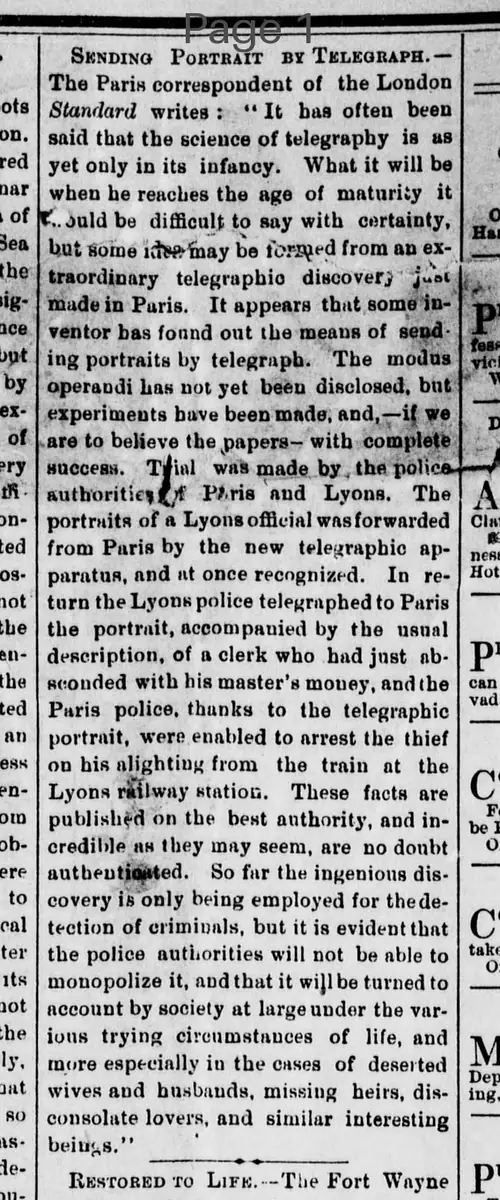
The Paris correspondent of the London Standard writes: 'It has often been said that the science of telegraphy is as yet only in its infancy. What it will be when it reaches the age of maturity it would be difficult to say with certainty, but some idea may be formed from an extraordinary telegraphic discovery just made in Paris. It appears that some inventor has found out the means of sending portraits by telegraph. The modus operandi has not yet been disclosed, but experiments have been made, and, if we are to believe the papers, with complete success. Trial was made by the police authorities of Paris and Lyons. The portrait of a Lyons official was forwarded from Paris by the new telegraphic apparatus, and at once recognized. In return the Lyons police telegraphed to Paris the portrait, accompanied by the usual description, of a clerk who had just absconded with his master's money, and the Paris police, thanks to the telegraphic portrait, were enabled to arrest the thief on his alighting from the train at the Lyons railway station. These facts are published on the best authority, and incredible as they may seem, are no doubt authenticated. So far the ingenious discovery is only being employed for the detection of criminals, but it is evident that the police authorities will not be able to monopolize it, and that it will be turned to account by society at large under the various trying circumstances of life, and more especially in the cases of deserted wives and husbands, missing heirs, disconsolate lovers, and similar interesting beings.'
The Paris correspondent of the London Standard writes: 'It has often been said that the science of telegraphy is as yet only in its infancy. What it will be when it reaches the age of maturity it would be difficult to say with certainty, but some idea may be formed from an extraordinary telegraphic discovery just made in Paris. It appears that some inventor has found out the means of sending portraits by telegraph. The modus operandi has not yet been disclosed, but experiments have been made, and, if we are to believe the papers, with complete success. Trial was made by the police authorities of Paris and Lyons. The portrait of a Lyons official was forwarded from Paris by the new telegraphic apparatus, and at once recognized. In return the Lyons police telegraphed to Paris the portrait, accompanied by the usual description, of a clerk who had just absconded with his master's money, and the Paris police, thanks to the telegraphic portrait, were enabled to arrest the thief on his alighting from the train at the Lyons railway station. These facts are published on the best authority, and incredible as they may seem, are no doubt authenticated. So far the ingenious discovery is only being employed for the detection of criminals, but it is evident that the police authorities will not be able to monopolize it, and that it will be turned to account by society at large under the various trying circumstances of life, and more especially in the cases of deserted wives and husbands, missing heirs, disconsolate lovers, and similar interesting beings.'
What sub-type of article is it?
Curiosity
Extraordinary Event
Crime Story
What themes does it cover?
Justice
Crime Punishment
Deception
What keywords are associated?
Telegraph Portrait
Invention
Police Arrest
Crime Detection
Paris Lyons
What entities or persons were involved?
Lyons Official
Clerk
Thief
Where did it happen?
Paris, Lyons
Story Details
Key Persons
Lyons Official
Clerk
Thief
Location
Paris, Lyons
Story Details
Inventor enables sending portraits by telegraph; Paris-Lyons police test identifies official and arrests absconding clerk upon train arrival using transmitted portrait and description.