Thank you for visiting SNEWPapers!
Sign up free
Literary
January 30, 1884
The Fairfield News And Herald
Winnsboro, Fairfield County, South Carolina
What is this article about?
Beatrice Latham falls deeply in love with Lt. Robert Headley during a brief courtship before he sails to India. Amidst the Afghan war, their letters sustain her hope until his return. Devastated to learn he married another upon landing, she suffers profound betrayal but gradually recovers, while Headley regrets his weakness. Connie weds Capt. Erskine.
Clipping
OCR Quality
98%
Excellent
Full Text
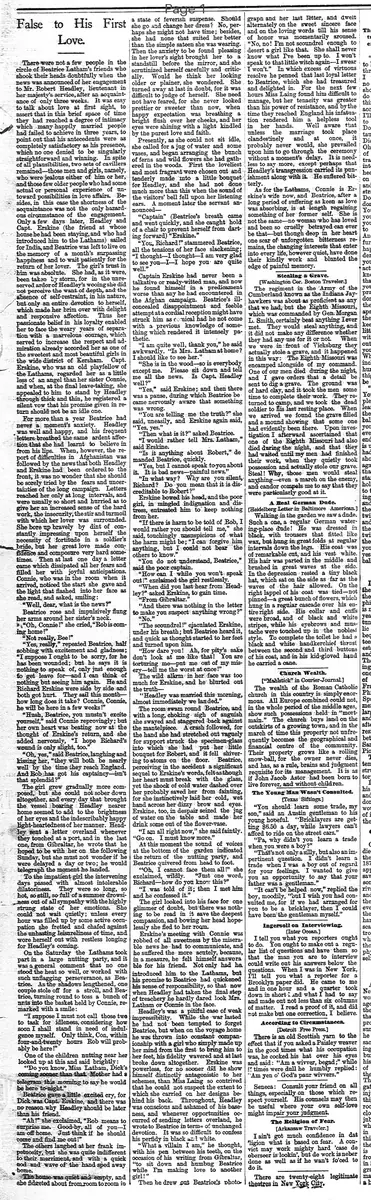
False to His First Love.
There were not a few people in the circle of Beatrice Latham's friends who shook their heads doubtfully when the news was announced of her engagement to Mr. Robert Headley, lieutenant in her majesty's service, after an acquaintance of only three weeks. It was easy to talk about love at first sight, to assert that in this brief space of time they had reached a degree of intimacy which many happily married people had failed to achieve in three years, to point out that his antecedents were as completely satisfactory as his presence, which no one denied to be singularly straightforward and winning. In spite of all plausibilities, two sets of cavillers remained—those men and girls, namely, who were jealous either of him or her, and those few older people who had some actual or personal experience of untoward possibilities in love affairs. Besides, in this case the shortness of the acquaintance was not the only hazardous circumstance of the engagement. Only a few days later, Headley and Capt. Erskine (the friend at whose house he had been staying, and who had introduced him to the Lathams) sailed for India and Beatrice was left to live on the memory of a month's surpassing happiness and to wait patiently for the return of her lover. The girl's trust in him was absolute. She had, as it were, been taken by storm, for in the unreserved ardor of Headley's wooing she did not perceive the want of depth, and the absence of self-restraint, in his nature, but only an entire devotion to herself, which made her brim over with delight and responsive affection. Thus her passionate belief in his loyalty enabled her to face the weary years of separation with a marvelous courage, which served to increase the respect and admiration already accorded her as one of the sweetest and most beautiful girls in the wide district of Kersham. Capt. Erskine, who was an old playfellow of the Lathams, regarded her as a little less of an angel than her sister Connie, and when, at the final leave-taking, she appealed to him to stand by Headley through thick and thin, he registered a silent vow that his promise given in return should not be an idle one.
For more than a year Beatrice had never a moment's anxiety. Headley was well and happy, and his frequent letters breathed the same ardent affection that she had learnt to believe in from his lips. When, however, the report of difficulties in Afghanistan was followed by the news that both Headley and Erskine had been ordered to the front, it was no wonder that she should be sorely tried by the fears and uncertainties of the long campaign. Letters reached her only at long intervals, and were usually so short and hurried as to give her an increased sense of the hard work, the insecurity, the stir and turmoil with which her lover was surrounded. She bore up bravely by dint of constantly impressing upon herself the necessity of fortitude in a soldier's bride, but her great love made confidence and composure very hard sometimes. Then at last one day a letter came which dissipated all her fears and filled her with joyful anticipations. Connie, who was in the room when it arrived, noticed the start she gave and the light that flashed into her face as she read, and asked, smiling:
"Well, dear, what is the news?"
Beatrice rose and impulsively flung her arms around her sister's neck. "Oh, Connie!" she cried, "Rob is coming home!"
"Not really, Bee!"
"Yes, really," repeated Beatrice, half sobbing with excitement and gladness; "I suppose I ought to be sorry, for he has been wounded; but he says it is nothing to speak of, only just enough to get leave for, and I can think of nothing but seeing him again. He and Richard Erskine were side by side and both got hurt. They sail this month—how long does it take? Connie, Connie, he will be here in a few weeks!"
"Hush, Beatrice, you mustn't excite yourself," said Connie reprovingly; but her own heart was beating now at the thought of Erskine's return, and she added nervously, "I hope Richard's wound is only slight, too."
"Oh, yes," said Beatrice, laughing and kissing her, "they will both be nearly well by the time they reach England. And Rob has got his captaincy—isn't that splendid?"
The girl grew gradually more composed, but she could not sober down altogether, and every day that brought the vessel bearing Headley nearer home seemed to add to the brightness of her eyes and the indescribably happy light-heartedness of her manner. Headley sent a letter overland whenever they touched at a port, and in the last one, from Gibraltar, he wrote that he hoped to be with her on the following Sunday, but she must not wonder if he were delayed a day or two; he would telegraph the moment he landed.
To the impatient girl the intervening days passed with almost intolerable dilatoriness. They were so long, so hot, so still, so full of a summer drowsiness out of all sympathy with the highly strung state of her emotions. She could not wait quietly; unless every hour was filled up by some active occupation she fretted and chafed against the unhasting leisureliness of time, and wore herself out with restless longing for Headley's coming.
On the Saturday the Lathams took part in a large nutting party, and it was a general comment that no one stood the heat so well, or worked with such unflagging perseverance, as Beatrice. As the shadows lengthened, one couple stole off for a stroll, and Beatrice, turning round to toss a bunch of nuts into the basket held by Connie, remarked with a smile:
"I suppose I must not call those two to task for idleness, considering how soon I shall stand in need of indulgence myself. Only think, Con, within four-and-twenty hours Rob will probably be here!"
One of the children nutting near her looked up at this and said brightly:
"Do you know, Miss Latham, Dick's coming sooner than that? Mother had a telegram this morning to say he would be here to-night."
Beatrice gave a little excited cry, for Dick was Capt. Erskine, and there was no reason why Headley should be later than his friend.
"Ah!" she exclaimed, "Rob means to surprise me.—Good-by, all of you—I am off home. Just think if he should come and find me out!"
The others laughed at her frank impetuosity, but she was quite indifferent to their merriment, and with a quick nod and wave of the hand sped away home.
The house was quiet and empty, and she fidgeted about from room to room in a state of feverish suspense. Should she go and change her dress? No, perhaps she might not have time: besides she had none that suited her better than the simple sateen she was wearing. Then the anxiety to be found pleasing in her lover's sight brought her to a standstill before the mirror, and she scrutinized herself carefully and critically. Would he think her looking older or plainer, she wondered. She turned away at last in doubt, for it was difficult to judge of herself. She need not have feared, for she never looked prettier or sweeter than now, when happy expectation was breathing a bright flush over her cheeks, and her eyes were shining with a light kindled by the purest love and faith.
Presently, as she could not sit idle, she called for a jug of water and some vases, and began arranging the bunch of ferns and wild flowers she had gathered in the woods. First the loveliest and most fragrant were chosen out and tenderly made into a little bouquet for Headley, and she had not done much more than this when the sound of the visitors' bell fell upon her listening ears. A moment later the servant announced—
"Captain" (Beatrice's breath came and went quickly, and she caught hold of a chair to prevent herself from darting forward) "Erskine."
"You, Richard!" stammered Beatrice, all the tensions of her face slackening: "I thought—I thought—I am very glad to see you—I—I hope you are quite well."
Captain Erskine had never been a talkative or ready-witted man, and now he found himself in a predicament worse than any he had encountered in the Afghan campaign. Beatrice's ill-concealed disappointment and feeble attempt at a cordial reception might have struck him as comical had he not come with a previous knowledge of something which rendered it intensely pathetic.
"I am quite well, thank you," he said awkwardly. "Is Mrs. Latham at home? I should like to see her."
"She is in the wood—so is everybody except me. Please sit down and tell me all the news. Is Capt. Headley well?"
"Yes," said Erskine; and then there was a pause, during which Beatrice became nervously aware that something was wrong.
"You are telling me the truth?" she said, uneasily, and Erskine again said "Yes, yes."
"Then what is it?" asked Beatrice.
"I would rather tell Mrs. Latham," said Erskine.
"Is it anything about Robert," demanded Beatrice, quickly.
"Yes, but I cannot speak to you about it. It is bad news—painful news."
"In what way? Why are you silent, Richard? Do you mean that it is discreditable to Robert?"
Erskine bowed his head, and the poor girl, in mingled indignation and distress, entreated him to keep nothing from her.
"If there is harm to be told of Rob, I would rather you should tell me," she said, touchingly unsuspicious of what the harm might be; "I can forgive him anything, but I could not bear the others to know."
"You do not understand, Beatrice," said the poor captain.
"How can I while you won't speak out!" exclaimed the girl restlessly. "When did you last hear from Headley?" asked Erskine, to gain time.
"From Gibraltar."
"And there was nothing in the letter to make you suspect anything wrong?"
"No."
"The scoundrel!" ejaculated Erskine under his breath; but Beatrice heard it, and quick as thought started to her feet and turned upon him.
"How dare you! Ah, for pity's sake don't look at me like that! You are torturing me—put me out of my misery—tell me the worst at once!"
The wild glare in her face was too much for Erskine, and he blurted out the truth—
"Headley was married this morning, almost immediately we landed."
The room swam round Beatrice, and with a long, choking sigh of anguish she swayed and staggered back against the mantelpiece. A crash followed, for the hand she had stretched out vaguely for support struck the specimen-glass into which she had put her little bouquet for Robert, and it fell shivering to atoms on the floor. Beatrice, perceiving in the accident a significant sequel to Erskine's words, felt as though her heart must break with the glass, yet the shock of cold water dashed over her probably saved her from fainting, for she instinctively laid her cold, wet hand across her dizzy brow and eyes. Erskine, too, in despair seized the jug of water on the table and made her drink some out of the flower-vase.
"I am all right now," she said faintly. "Go on. I must know more."
At this moment the sound of voices at the bottom of the garden indicated the return of the nutting party, and Beatrice quivered from head to foot.
"Oh, I cannot face them all!" she exclaimed, wildly. "Just one word, Richard—how do you know this?"
"I was told of it; then I met him and he confessed it."
The girl looked into his face for one glimmer of doubt, but there was nothing to be read in it save the deepest compassion, and—bowing her head hopelessly she fled to her room.
Erskine's meeting with Connie was robbed of all sweetness by the miserable news he had to communicate, and he suffered the more acutely, because, in a measure, he felt himself answerable for his friend. Not only had he introduced him to the Lathams, but his promise to Beatrice had quickened his sense of responsibility, so that now when Headley had taken the final step of treachery he hardly dared look Mrs. Latham or Connie in the face.
Headley's was a pitiful case of weak impressibility. While the war lasted he had not been tempted to forget Beatrice, but when on the voyage home he was thrown into constant companionship with a girl who simply made up her mind from the first to bring him to her feet, his fidelity wavered and at last broke down altogether. Erskine was powerless, for no sooner did he show himself distinctly antagonistic to her schemes, than Miss Laing so contrived that he could not suspect the extent to which she carried on her designs behind his back. Throughout, Headley was conscious and ashamed of his baseness, and whenever opportunities occurred of sending letters overland, he wrote to Beatrice in terms of unchanged devotion. It was so difficult to confess his perfidy in black and white.
"What a villain I am," he thought with his pen between his teeth, on the occasion of his writing from Gibraltar, "to sit down and humbug Beatrice while I'm making love to another girl!"
Then he drew out Beatrice's photograph and her last letter, and dwelt alternately on the sweet sincere face and on the loving words till his sense of honor was momentarily aroused.
"No, no! I'm not scoundrel enough to desert a girl like that. She shall never know what I've been up to. I won't speak to that little witch again—I swear I won't." In which excess of virtuous resolve he penned that last loyal letter to Beatrice, which she had treasured and delighted in. For the next few hours Miss Laing found him difficult to manage, but her tenacity was greater than his power of resistance, and by the time they reached England his infatuation rendered him a helpless tool in her hands.
Well aware that unless the marriage took place clandestinely and at once, it probably never would, she prevailed upon him to go through the ceremony without a moment's delay. It is needless to say more, except perhaps that Headley's transgression carried its punishment along with it. He suffered bitterly.
As for the Lathams, Connie is Erskine's wife now, and Beatrice, after a long period of suffering as keen as love was absorbing, is at length regaining something of her former self. She is not the same—no woman who has loved and been so cruelly betrayed can ever be that—but though deep in her heart one scar of unforgotten bitterness remains, the changing interests that enter into every life, however quiet, have done their kindly work and blunted the edge of painful memory.
There were not a few people in the circle of Beatrice Latham's friends who shook their heads doubtfully when the news was announced of her engagement to Mr. Robert Headley, lieutenant in her majesty's service, after an acquaintance of only three weeks. It was easy to talk about love at first sight, to assert that in this brief space of time they had reached a degree of intimacy which many happily married people had failed to achieve in three years, to point out that his antecedents were as completely satisfactory as his presence, which no one denied to be singularly straightforward and winning. In spite of all plausibilities, two sets of cavillers remained—those men and girls, namely, who were jealous either of him or her, and those few older people who had some actual or personal experience of untoward possibilities in love affairs. Besides, in this case the shortness of the acquaintance was not the only hazardous circumstance of the engagement. Only a few days later, Headley and Capt. Erskine (the friend at whose house he had been staying, and who had introduced him to the Lathams) sailed for India and Beatrice was left to live on the memory of a month's surpassing happiness and to wait patiently for the return of her lover. The girl's trust in him was absolute. She had, as it were, been taken by storm, for in the unreserved ardor of Headley's wooing she did not perceive the want of depth, and the absence of self-restraint, in his nature, but only an entire devotion to herself, which made her brim over with delight and responsive affection. Thus her passionate belief in his loyalty enabled her to face the weary years of separation with a marvelous courage, which served to increase the respect and admiration already accorded her as one of the sweetest and most beautiful girls in the wide district of Kersham. Capt. Erskine, who was an old playfellow of the Lathams, regarded her as a little less of an angel than her sister Connie, and when, at the final leave-taking, she appealed to him to stand by Headley through thick and thin, he registered a silent vow that his promise given in return should not be an idle one.
For more than a year Beatrice had never a moment's anxiety. Headley was well and happy, and his frequent letters breathed the same ardent affection that she had learnt to believe in from his lips. When, however, the report of difficulties in Afghanistan was followed by the news that both Headley and Erskine had been ordered to the front, it was no wonder that she should be sorely tried by the fears and uncertainties of the long campaign. Letters reached her only at long intervals, and were usually so short and hurried as to give her an increased sense of the hard work, the insecurity, the stir and turmoil with which her lover was surrounded. She bore up bravely by dint of constantly impressing upon herself the necessity of fortitude in a soldier's bride, but her great love made confidence and composure very hard sometimes. Then at last one day a letter came which dissipated all her fears and filled her with joyful anticipations. Connie, who was in the room when it arrived, noticed the start she gave and the light that flashed into her face as she read, and asked, smiling:
"Well, dear, what is the news?"
Beatrice rose and impulsively flung her arms around her sister's neck. "Oh, Connie!" she cried, "Rob is coming home!"
"Not really, Bee!"
"Yes, really," repeated Beatrice, half sobbing with excitement and gladness; "I suppose I ought to be sorry, for he has been wounded; but he says it is nothing to speak of, only just enough to get leave for, and I can think of nothing but seeing him again. He and Richard Erskine were side by side and both got hurt. They sail this month—how long does it take? Connie, Connie, he will be here in a few weeks!"
"Hush, Beatrice, you mustn't excite yourself," said Connie reprovingly; but her own heart was beating now at the thought of Erskine's return, and she added nervously, "I hope Richard's wound is only slight, too."
"Oh, yes," said Beatrice, laughing and kissing her, "they will both be nearly well by the time they reach England. And Rob has got his captaincy—isn't that splendid?"
The girl grew gradually more composed, but she could not sober down altogether, and every day that brought the vessel bearing Headley nearer home seemed to add to the brightness of her eyes and the indescribably happy light-heartedness of her manner. Headley sent a letter overland whenever they touched at a port, and in the last one, from Gibraltar, he wrote that he hoped to be with her on the following Sunday, but she must not wonder if he were delayed a day or two; he would telegraph the moment he landed.
To the impatient girl the intervening days passed with almost intolerable dilatoriness. They were so long, so hot, so still, so full of a summer drowsiness out of all sympathy with the highly strung state of her emotions. She could not wait quietly; unless every hour was filled up by some active occupation she fretted and chafed against the unhasting leisureliness of time, and wore herself out with restless longing for Headley's coming.
On the Saturday the Lathams took part in a large nutting party, and it was a general comment that no one stood the heat so well, or worked with such unflagging perseverance, as Beatrice. As the shadows lengthened, one couple stole off for a stroll, and Beatrice, turning round to toss a bunch of nuts into the basket held by Connie, remarked with a smile:
"I suppose I must not call those two to task for idleness, considering how soon I shall stand in need of indulgence myself. Only think, Con, within four-and-twenty hours Rob will probably be here!"
One of the children nutting near her looked up at this and said brightly:
"Do you know, Miss Latham, Dick's coming sooner than that? Mother had a telegram this morning to say he would be here to-night."
Beatrice gave a little excited cry, for Dick was Capt. Erskine, and there was no reason why Headley should be later than his friend.
"Ah!" she exclaimed, "Rob means to surprise me.—Good-by, all of you—I am off home. Just think if he should come and find me out!"
The others laughed at her frank impetuosity, but she was quite indifferent to their merriment, and with a quick nod and wave of the hand sped away home.
The house was quiet and empty, and she fidgeted about from room to room in a state of feverish suspense. Should she go and change her dress? No, perhaps she might not have time: besides she had none that suited her better than the simple sateen she was wearing. Then the anxiety to be found pleasing in her lover's sight brought her to a standstill before the mirror, and she scrutinized herself carefully and critically. Would he think her looking older or plainer, she wondered. She turned away at last in doubt, for it was difficult to judge of herself. She need not have feared, for she never looked prettier or sweeter than now, when happy expectation was breathing a bright flush over her cheeks, and her eyes were shining with a light kindled by the purest love and faith.
Presently, as she could not sit idle, she called for a jug of water and some vases, and began arranging the bunch of ferns and wild flowers she had gathered in the woods. First the loveliest and most fragrant were chosen out and tenderly made into a little bouquet for Headley, and she had not done much more than this when the sound of the visitors' bell fell upon her listening ears. A moment later the servant announced—
"Captain" (Beatrice's breath came and went quickly, and she caught hold of a chair to prevent herself from darting forward) "Erskine."
"You, Richard!" stammered Beatrice, all the tensions of her face slackening: "I thought—I thought—I am very glad to see you—I—I hope you are quite well."
Captain Erskine had never been a talkative or ready-witted man, and now he found himself in a predicament worse than any he had encountered in the Afghan campaign. Beatrice's ill-concealed disappointment and feeble attempt at a cordial reception might have struck him as comical had he not come with a previous knowledge of something which rendered it intensely pathetic.
"I am quite well, thank you," he said awkwardly. "Is Mrs. Latham at home? I should like to see her."
"She is in the wood—so is everybody except me. Please sit down and tell me all the news. Is Capt. Headley well?"
"Yes," said Erskine; and then there was a pause, during which Beatrice became nervously aware that something was wrong.
"You are telling me the truth?" she said, uneasily, and Erskine again said "Yes, yes."
"Then what is it?" asked Beatrice.
"I would rather tell Mrs. Latham," said Erskine.
"Is it anything about Robert," demanded Beatrice, quickly.
"Yes, but I cannot speak to you about it. It is bad news—painful news."
"In what way? Why are you silent, Richard? Do you mean that it is discreditable to Robert?"
Erskine bowed his head, and the poor girl, in mingled indignation and distress, entreated him to keep nothing from her.
"If there is harm to be told of Rob, I would rather you should tell me," she said, touchingly unsuspicious of what the harm might be; "I can forgive him anything, but I could not bear the others to know."
"You do not understand, Beatrice," said the poor captain.
"How can I while you won't speak out!" exclaimed the girl restlessly. "When did you last hear from Headley?" asked Erskine, to gain time.
"From Gibraltar."
"And there was nothing in the letter to make you suspect anything wrong?"
"No."
"The scoundrel!" ejaculated Erskine under his breath; but Beatrice heard it, and quick as thought started to her feet and turned upon him.
"How dare you! Ah, for pity's sake don't look at me like that! You are torturing me—put me out of my misery—tell me the worst at once!"
The wild glare in her face was too much for Erskine, and he blurted out the truth—
"Headley was married this morning, almost immediately we landed."
The room swam round Beatrice, and with a long, choking sigh of anguish she swayed and staggered back against the mantelpiece. A crash followed, for the hand she had stretched out vaguely for support struck the specimen-glass into which she had put her little bouquet for Robert, and it fell shivering to atoms on the floor. Beatrice, perceiving in the accident a significant sequel to Erskine's words, felt as though her heart must break with the glass, yet the shock of cold water dashed over her probably saved her from fainting, for she instinctively laid her cold, wet hand across her dizzy brow and eyes. Erskine, too, in despair seized the jug of water on the table and made her drink some out of the flower-vase.
"I am all right now," she said faintly. "Go on. I must know more."
At this moment the sound of voices at the bottom of the garden indicated the return of the nutting party, and Beatrice quivered from head to foot.
"Oh, I cannot face them all!" she exclaimed, wildly. "Just one word, Richard—how do you know this?"
"I was told of it; then I met him and he confessed it."
The girl looked into his face for one glimmer of doubt, but there was nothing to be read in it save the deepest compassion, and—bowing her head hopelessly she fled to her room.
Erskine's meeting with Connie was robbed of all sweetness by the miserable news he had to communicate, and he suffered the more acutely, because, in a measure, he felt himself answerable for his friend. Not only had he introduced him to the Lathams, but his promise to Beatrice had quickened his sense of responsibility, so that now when Headley had taken the final step of treachery he hardly dared look Mrs. Latham or Connie in the face.
Headley's was a pitiful case of weak impressibility. While the war lasted he had not been tempted to forget Beatrice, but when on the voyage home he was thrown into constant companionship with a girl who simply made up her mind from the first to bring him to her feet, his fidelity wavered and at last broke down altogether. Erskine was powerless, for no sooner did he show himself distinctly antagonistic to her schemes, than Miss Laing so contrived that he could not suspect the extent to which she carried on her designs behind his back. Throughout, Headley was conscious and ashamed of his baseness, and whenever opportunities occurred of sending letters overland, he wrote to Beatrice in terms of unchanged devotion. It was so difficult to confess his perfidy in black and white.
"What a villain I am," he thought with his pen between his teeth, on the occasion of his writing from Gibraltar, "to sit down and humbug Beatrice while I'm making love to another girl!"
Then he drew out Beatrice's photograph and her last letter, and dwelt alternately on the sweet sincere face and on the loving words till his sense of honor was momentarily aroused.
"No, no! I'm not scoundrel enough to desert a girl like that. She shall never know what I've been up to. I won't speak to that little witch again—I swear I won't." In which excess of virtuous resolve he penned that last loyal letter to Beatrice, which she had treasured and delighted in. For the next few hours Miss Laing found him difficult to manage, but her tenacity was greater than his power of resistance, and by the time they reached England his infatuation rendered him a helpless tool in her hands.
Well aware that unless the marriage took place clandestinely and at once, it probably never would, she prevailed upon him to go through the ceremony without a moment's delay. It is needless to say more, except perhaps that Headley's transgression carried its punishment along with it. He suffered bitterly.
As for the Lathams, Connie is Erskine's wife now, and Beatrice, after a long period of suffering as keen as love was absorbing, is at length regaining something of her former self. She is not the same—no woman who has loved and been so cruelly betrayed can ever be that—but though deep in her heart one scar of unforgotten bitterness remains, the changing interests that enter into every life, however quiet, have done their kindly work and blunted the edge of painful memory.
What sub-type of article is it?
Prose Fiction
What themes does it cover?
Love Romance
Moral Virtue
War Peace
What keywords are associated?
Romantic Betrayal
Infidelity
Wartime Separation
Soldier's Love
False Fidelity
Literary Details
Title
False To His First Love.
Key Lines
"Headley Was Married This Morning, Almost Immediately We Landed."
"What A Villain I Am," He Thought With His Pen Between His Teeth, On The Occasion Of His Writing From Gibraltar, "To Sit Down And Humbug Beatrice While I'm Making Love To Another Girl!"
She Is Not The Same—No Woman Who Has Loved And Been So Cruelly Betrayed Can Ever Be That—But Though Deep In Her Heart One Scar Of Unforgotten Bitterness Remains...