Thank you for visiting SNEWPapers!
Sign up free
The New Hampshire Gazette And General Advertiser
Portsmouth, Rockingham County, New Hampshire
What is this article about?
In Paris, the recent popular unrest during the French Revolution has subsided, leading to moderated debates in the National Assembly. Lafayette cleverly neutralizes agitator Marquis de St. Huruge by appointing him to lead a patrol, then has him arrested for inciting tumults.
Clipping
OCR Quality
Full Text
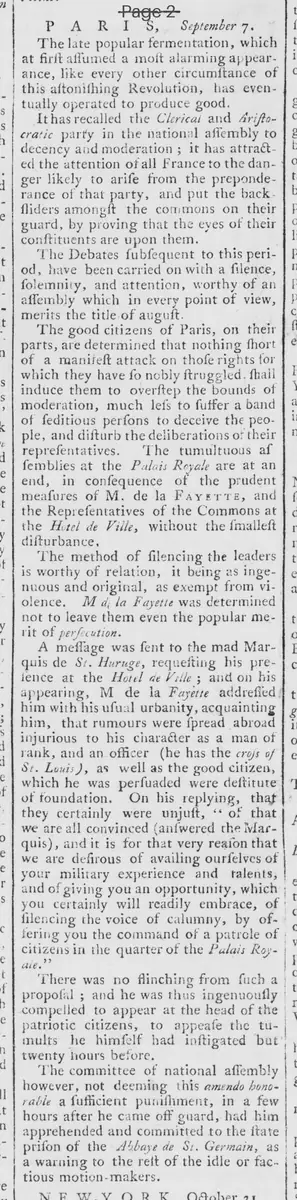
The late popular fermentation, which at first assumed a most alarming appearance, like every other circumstance of this astonishing Revolution, has eventually operated to produce good. It has recalled the Clerical and Aristocratic party in the national assembly to decency and moderation; it has attracted the attention of all France to the danger likely to arise from the preponderance of that party, and put the backsliders amongst the commons on their guard, by proving that the eyes of their constituents are upon them.
The Debates subsequent to this period, have been carried on with a silence, solemnity, and attention, worthy of an assembly which in every point of view, merits the title of august.
The good citizens of Paris, on their parts, are determined that nothing short of a manifest attack on those rights for which they have so nobly struggled, shall induce them to overstep the bounds of moderation, much less to suffer a band of seditious persons to deceive the people, and disturb the deliberations of their representatives. The tumultuous assemblies at the Palais Royale are at an end, in consequence of the prudent measures of M. de la Fayette, and the Representatives of the Commons at the Hotel de Ville, without the smallest disturbance.
The method of silencing the leaders is worthy of relation, it being as ingenious and original, as exempt from violence. M. de la Fayette was determined not to leave them even the popular merit of persecution.
A message was sent to the mad Marquis de St. Huruge, requesting his presence at the Hotel de Ville: and on his appearing, M. de la Fayette addressed him with his usual urbanity, acquainting him, that rumours were spread abroad injurious to his character as a man of rank, and an officer (he has the cross of St. Louis), as well as the good citizen, which he was persuaded were destitute of foundation. On his replying, that they certainly were unjust, "of that we are all convinced" (answered the Marquis), "and it is for that very reason that we are desirous of availing ourselves of your military experience and talents, and of giving you an opportunity, which you certainly will readily embrace, of silencing the voice of calumny, by offering you the command of a patrol of citizens in the quarter of the Palais Royale."
There was no flinching from such a proposal; and he was thus ingenuously compelled to appear at the head of the patriotic citizens, to appease the tumults he himself had instigated but twenty hours before.
The committee of national assembly however, not deeming this amend honorable a sufficient punishment, in a few hours after he came off guard, had him apprehended and committed to the state prison of the Abbaye de St. Germain, as a warning to the rest of the idle or factious motion-makers.
What sub-type of article is it?
What keywords are associated?
What entities or persons were involved?
Where did it happen?
Foreign News Details
Primary Location
Paris
Event Date
September 7
Key Persons
Outcome
tumultuous assemblies ended; marquis de st. huruge arrested and imprisoned at abbaye de st. germain as warning to agitators.
Event Details
Recent popular unrest in Paris subsided, moderating the National Assembly's debates and alerting France to clerical and aristocratic threats. Citizens vowed restraint unless rights attacked. Lafayette ended Palais Royale tumults by appointing agitator St. Huruge to lead a calming patrol, then had him arrested for incitement.