Thank you for visiting SNEWPapers!
Sign up free
Editorial
August 27, 1798
The Gazette
Portland, Cumberland County, Maine
What is this article about?
Editorial criticizes Vice President Thomas Jefferson for his deist beliefs and public insults to Christianity, including preferring Tom Paine's Age of Reason over the Bible and ridiculing a 1775 congressional fast proposal, contrasting with John Adams' defense of religious respect.
Clipping
OCR Quality
98%
Excellent
Full Text
Mr. Jefferson.
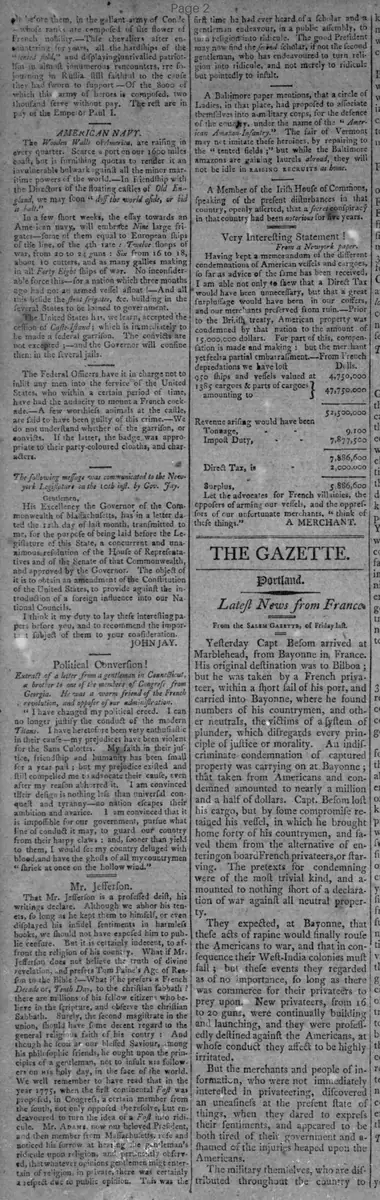
That Mr. Jefferson is a professed deist, his writings declare. Although we abhor his tenets, so long as he kept them to himself, or even displayed his infidel sentiments in harmless books, we should not have exposed him to public censure. But it is certainly indecent, to affront the religion of his country. What if Mr. Jefferson does not believe the truth of divine revelation, and prefers Tom Paine's Age of Reason to the Bible?—What if he prefers a French Decade or Tenth Day, to the Christian Sabbath? There are millions of his fellow citizens who believe in the scripture, and observe the Christian Sabbath. Surely, the second magistrate in the union, should have some decent regard to the general religious faith of his country: And though he scoffs at our blessed Saviour, among his philosophic friends, he ought upon the principles of a gentleman, not to insult his followers on his holy day, in the face of the world.
We well remember to have read that in the year 1775, when the first continental Fast was proposed, in Congress, a certain member from the south, not only opposed the resolve, but endeavoured to turn the idea of a Fast into ridicule. Mr. Adams, now our beloved President, and then member from Massachusetts, rose and expressed his sorrow at hearing the gentleman's ridicule upon religion, and pertinently observed, that whatever opinions gentlemen might entertain of religion, in private, there was certainly a respect due to public opinion. This was the first time he had ever heard of a scholar and a gentleman endeavour, in a public assembly, to turn religion into ridicule. The good President may now find the second scholar, if not the second gentleman, who has endeavoured to turn religion into ridicule, and not merely to ridicule but pointedly to insult.
That Mr. Jefferson is a professed deist, his writings declare. Although we abhor his tenets, so long as he kept them to himself, or even displayed his infidel sentiments in harmless books, we should not have exposed him to public censure. But it is certainly indecent, to affront the religion of his country. What if Mr. Jefferson does not believe the truth of divine revelation, and prefers Tom Paine's Age of Reason to the Bible?—What if he prefers a French Decade or Tenth Day, to the Christian Sabbath? There are millions of his fellow citizens who believe in the scripture, and observe the Christian Sabbath. Surely, the second magistrate in the union, should have some decent regard to the general religious faith of his country: And though he scoffs at our blessed Saviour, among his philosophic friends, he ought upon the principles of a gentleman, not to insult his followers on his holy day, in the face of the world.
We well remember to have read that in the year 1775, when the first continental Fast was proposed, in Congress, a certain member from the south, not only opposed the resolve, but endeavoured to turn the idea of a Fast into ridicule. Mr. Adams, now our beloved President, and then member from Massachusetts, rose and expressed his sorrow at hearing the gentleman's ridicule upon religion, and pertinently observed, that whatever opinions gentlemen might entertain of religion, in private, there was certainly a respect due to public opinion. This was the first time he had ever heard of a scholar and a gentleman endeavour, in a public assembly, to turn religion into ridicule. The good President may now find the second scholar, if not the second gentleman, who has endeavoured to turn religion into ridicule, and not merely to ridicule but pointedly to insult.
What sub-type of article is it?
Moral Or Religious
Partisan Politics
What keywords are associated?
Jefferson Deism
Religious Insult
Christian Sabbath
1775 Fast
Tom Paine
John Adams
What entities or persons were involved?
Thomas Jefferson
John Adams
Tom Paine
Congress
Editorial Details
Primary Topic
Criticism Of Jefferson's Deism And Public Disrespect For Christianity
Stance / Tone
Strongly Critical And Condemnatory
Key Figures
Thomas Jefferson
John Adams
Tom Paine
Congress
Key Arguments
Jefferson Is A Professed Deist Whose Writings Declare His Beliefs
It Is Indecent For Jefferson To Affront The Religion Of His Country Publicly
Jefferson Prefers Tom Paine's Age Of Reason To The Bible
Jefferson Prefers A French Decade To The Christian Sabbath
In 1775, A Southern Member (Implied Jefferson) Ridiculed A Congressional Fast Proposal
John Adams Expressed Sorrow At Ridiculing Religion In Public And Emphasized Respect Due To Public Opinion