Thank you for visiting SNEWPapers!
Sign up free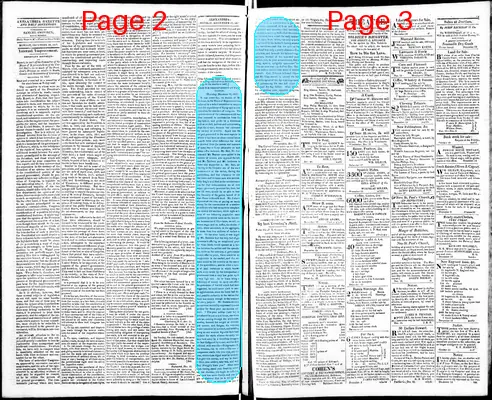
Alexandria Gazette & Daily Advertiser
Alexandria, Virginia
What is this article about?
In the U.S. House of Representatives on December 17, 1817, debate resumed on the commutation bill for soldiers' compensation. Speakers including Ball, Colston, Beecher opposed it, citing taxes on the poor; Baldwin and Anderson supported, emphasizing protection from speculators. Holmes sarcastically critiqued sympathy for soldiers. Harrison and Johnson responded; Clay moved to amend the bill.
Merged-components note: Continuation of the congressional correspondence article across pages; relabeled 'story' component to 'domestic_news' for consistency.
Clippings

1 of 2
OCR Quality
Full Text
FROM OUR CORRESPONDENT AT WASHINGTON.
Thursday, December 18, 1817.
It was yesterday, on motion of Mr. Holmes, in the House of Representatives, referred to a select committee to enquire into the expediency of fixing upon a compensation for members of congress. The consideration of the commutation bill was then resumed in continuation from the day before, and crowded a discussion still more dull, tedious and uninteresting than the former, because less enlivened by variety or novelty. Again was the subject presented in the same aspects in which it had been so often viewed before - with little other difference than what it derived from the names and manners of some two or three advocates on both sides. - For instance, Mr. Ball, Mr. Colston and Mr. Beecher were added to the number of orators who opposed the bill, and Mr. Baldwin and Mr. Anderson to those who supported it. Mr. Ball, adverting to the frequent use of the word LIBERALITY of the nation, during this proceeding, said that whenever he saw the brave and virtuous men who successfully fought and bled in the revolutionary war for that independence we all now enjoy, generously provided for, then, but not till then, should he be able to hear the liberality of the nation talked of in that House without a blush. Mr. Colston deprecated the idea of paying so much money for the convenience of a number of soldiers who had no cause to complain, nor indeed did murmur, while eight millions of our labouring population were squeezed by severe taxes on the immediate necessaries of life - taxes, on salt, on brown sugar and on coffee, the duties of which alone amounted, in the aggregate, to more than two millions of dollars a year. On the other hand, it was urged by Mr. Baldwin that the very fact of government's offering an established price for those lands, would operate as a barrier between the soldier and the speculator, while on the contrary, if government should offer no price, there would be no competition in the market, and the soldiers would be left entirely at the mercy of the speculators; and he cited a variety of past instances in which bounty lands were raised by the interposition of government from a very low price up to a very high one. As to there being a deficiency of money to carry into effect the provisions of the bill which had been suggested, he could never yield to such an apprehension, since the house had the best possible authority in the nation that there was money enough in the treasury for every purpose. Mr. Holmes derided the extreme sensibility expressed by some persons for those poor meritorious soldiers. "The poor soldier (said he) is introduced to you as a virtuous, war-worn veteran, coming through the wilderness, bending beneath the weight of distress, and sorrow, and fatigue, his tottering frame sustained by a crutch, and hobbling along on one wooden leg - his bare head exhibits the mark whence the scalp had been torn away by a relentless savage - his face disfigured by a scar, and his flesh inflicted with wounds. - Bridgewater, Erie, Orleans, rise to view. - The tear of compassion starts into your eye, and the poor, meritorious object must be relieved. You give him money, and say to him - "Here, poor soldier, take this, and may God Almighty bless you." After some time, having eased your heart by relieving his distress, you begin to reflect - you view him more closely, and you begin to discover that he is not quite so lame, or weak, or miserable, as you at first imagined."
Imagine that the leg which appears to be a wooden one, is just like his other, composed of bone and flesh, and blood and muscles—that the crutch has only a walking staff—that the wound on his head, from which the scalp appeared to have been taken, was only a mark occasioned by his barber's having shaved him too close—and that the scar on his forehead was only a pretty dimple.—You strip him, and beneath his tattered regimentals, instead of the wounded poor soldier, you, to your astonishment, find a smug, spruce, sprightly speculator.—This sarcasm was repelled by Gen. Harrison with a considerable share of honest warmth. Col. Johnson followed him—and Mr. Clay moved to amend the bill by striking out all but the enacting clause and introducing the new bill which he had read the day before. After which, the committee rose, reported progress, and obtained leave to sit again.
What sub-type of article is it?
What keywords are associated?
What entities or persons were involved?
Where did it happen?
Domestic News Details
Primary Location
Washington
Event Date
December 17, 1817
Key Persons
Outcome
the committee rose, reported progress, and obtained leave to sit again.
Event Details
On motion of Mr. Holmes, a select committee was referred to inquire into compensation for members of Congress. Debate on the commutation bill resumed, with opposition from Mr. Ball, Mr. Colston, and Mr. Beecher citing taxes and liberality issues, and support from Mr. Baldwin and Mr. Anderson on protecting soldiers from speculators. Mr. Holmes sarcastically described the 'poor soldier' as a speculator. Gen. Harrison and Col. Johnson repelled the sarcasm. Mr. Clay moved to amend the bill.