Thank you for visiting SNEWPapers!
Sign up free
Literary
October 31, 1837
Alexandria Gazette
Alexandria, Alexandria County, District Of Columbia
What is this article about?
A satirical poem from the New York Courier, addressed to Native American tribes like Foxes, Sacs, and Sioux, mocking their exhibition as government curiosities after cheap land sales, and urging them to return to their wilds. Attributed to P. B., quoting Leather Stocking.
Clipping
OCR Quality
95%
Excellent
Full Text
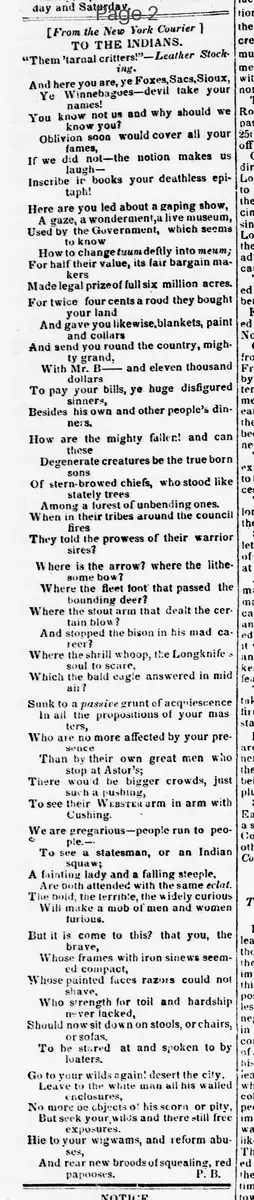
[From the New York Courier]
TO THE INDIANS.
"Them 'tarnal critters!"-Leather Stocking.
And here you are, ye Foxes, Sacs, Sioux,
Ye Winnebagoes-devil take your names!
You know not us and why should we know you?
Oblivion soon would cover all your fames,
If we did not-the notion makes us laugh-
Inscribe in books your deathless epitaph!
Here are you led about a gaping show,
A gaze, a wonderment, a live museum,
Used by the Government, which seems to know
How to change tuum deftly into meum;
For half their value, its fair bargain makers
Made legal prize of full six million acres.
For twice four cents a rood they bought your land
And gave you likewise, blankets, paint and collars
And send you round the country, mighty grand,
With Mr. B. and eleven thousand dollars
To pay your bills, ye huge disfigured sinners,
Besides his own and other people's dinners.
How are the mighty fallen! and can these
Degenerate creatures be the true born sons
Of stern-browed chiefs, who stood like stately trees
Among a forest of unbending ones.
When in their tribes around the council fires
They told the prowess of their warrior sires?
Where is the arrow? where the lithe-some bow?
Where the fleet foot that passed the bounding deer?
Where the stout arm that dealt the certain blow?
And stopped the bison in his mad career?
Where the shrill whoop, the Long knife's soul to scare,
Which the bald eagle answered in mid air?
Sunk to a passive grunt of acquiescence
In all the propositions of your masters,
Who are no more affected by your presence
Than by their own great men who stop at Astor's;
There would be bigger crowds, just such a pushing,
To see their Webster arm in arm with Cushing.
We are gregarious-people run to people.-
To see a statesman, or an Indian squaw;
A fainting lady and a falling steed,
Are both attended with the same eclat.
The bold, the terrible, the widely curious
Will make a mob of men and women furious.
But it is come to this? that you, the brave,
Whose frames with iron sinews seemed compact,
Whose painted faces razors could not shave.
Who strength for toil and hardship never lacked,
Should now sit down on stools, or chairs, or sofas,
To be stared at and spoken to by loafers.
Go to your wilds again: desert the city.
Leave to the white man all his walled enclosures,
No more be objects of his scorn or pity,
But seek your wilds and there still free exposures.
Hie to your wigwams, and reform abuses,
And rear new broods of squealing, red papooses.
P. B.
TO THE INDIANS.
"Them 'tarnal critters!"-Leather Stocking.
And here you are, ye Foxes, Sacs, Sioux,
Ye Winnebagoes-devil take your names!
You know not us and why should we know you?
Oblivion soon would cover all your fames,
If we did not-the notion makes us laugh-
Inscribe in books your deathless epitaph!
Here are you led about a gaping show,
A gaze, a wonderment, a live museum,
Used by the Government, which seems to know
How to change tuum deftly into meum;
For half their value, its fair bargain makers
Made legal prize of full six million acres.
For twice four cents a rood they bought your land
And gave you likewise, blankets, paint and collars
And send you round the country, mighty grand,
With Mr. B. and eleven thousand dollars
To pay your bills, ye huge disfigured sinners,
Besides his own and other people's dinners.
How are the mighty fallen! and can these
Degenerate creatures be the true born sons
Of stern-browed chiefs, who stood like stately trees
Among a forest of unbending ones.
When in their tribes around the council fires
They told the prowess of their warrior sires?
Where is the arrow? where the lithe-some bow?
Where the fleet foot that passed the bounding deer?
Where the stout arm that dealt the certain blow?
And stopped the bison in his mad career?
Where the shrill whoop, the Long knife's soul to scare,
Which the bald eagle answered in mid air?
Sunk to a passive grunt of acquiescence
In all the propositions of your masters,
Who are no more affected by your presence
Than by their own great men who stop at Astor's;
There would be bigger crowds, just such a pushing,
To see their Webster arm in arm with Cushing.
We are gregarious-people run to people.-
To see a statesman, or an Indian squaw;
A fainting lady and a falling steed,
Are both attended with the same eclat.
The bold, the terrible, the widely curious
Will make a mob of men and women furious.
But it is come to this? that you, the brave,
Whose frames with iron sinews seemed compact,
Whose painted faces razors could not shave.
Who strength for toil and hardship never lacked,
Should now sit down on stools, or chairs, or sofas,
To be stared at and spoken to by loafers.
Go to your wilds again: desert the city.
Leave to the white man all his walled enclosures,
No more be objects of his scorn or pity,
But seek your wilds and there still free exposures.
Hie to your wigwams, and reform abuses,
And rear new broods of squealing, red papooses.
P. B.
What sub-type of article is it?
Poem
Satire
What themes does it cover?
Political
Liberty Freedom
Taxation Oppression
What keywords are associated?
Native Americans
Land Theft
Government Exhibition
Satire
Wilderness
Displacement
What entities or persons were involved?
P. B.
Literary Details
Title
To The Indians.
Author
P. B.
Subject
Satire On Native American Exhibition And Land Theft
Form / Style
Satirical Address In Verse
Key Lines
And Here You Are, Ye Foxes, Sacs, Sioux,
For Twice Four Cents A Rood They Bought Your Land
How Are The Mighty Fallen! And Can These
Go To Your Wilds Again: Desert The City.
Hie To Your Wigwams, And Reform Abuses,