Thank you for visiting SNEWPapers!
Sign up free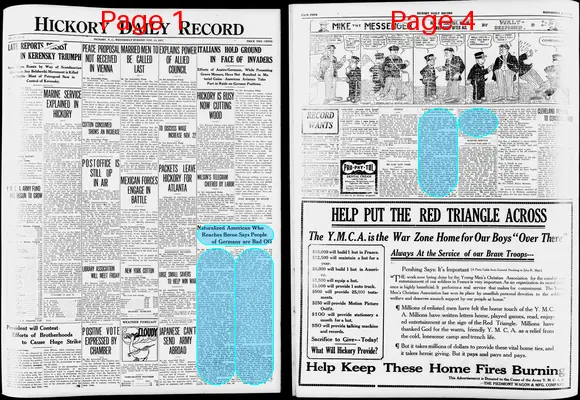
Hickory Daily Record
Hickory, Catawba County, North Carolina
What is this article about?
A naturalized American who lived in Germany during WWI reports from Berne on Nov. 14 acute suffering, mutinies in army and navy repressed by executions, desperate desire for peace among elites to avoid alienating America, dire economic situation predicting collapse, hatred toward Wilson, potential post-war confiscations and loan repudiations, and declining Pan-Germanism.
Merged-components note: Continuation of the Naturalized American report on Germany from page 1 to page 4; relabeled from story to foreign_news to match the primary content focus.
Clippings
1 of 2
OCR Quality
Full Text
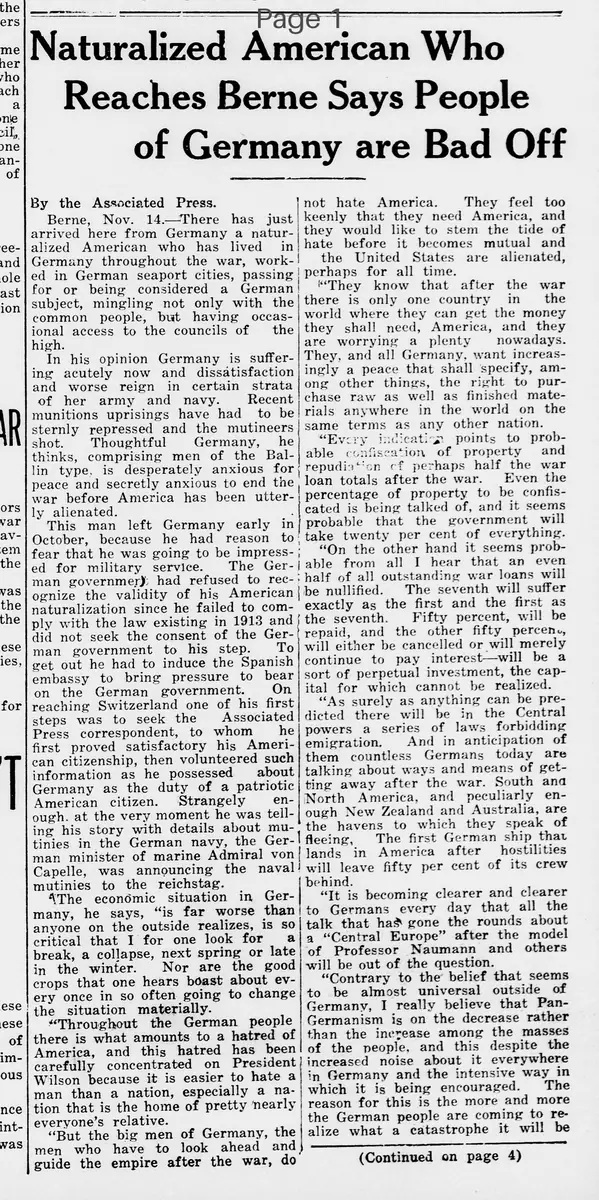
By the Associated Press.
Berne, Nov. 14.-There has just arrived here from Germany a naturalized American who has lived in Germany throughout the war, worked in German seaport cities, passing for or being considered a German subject, mingling not only with the common people, but having occasional access to the councils of the high.
In his opinion Germany is suffering acutely now and dissatisfaction and worse reign in certain strata of her army and navy.
Recent munitions uprisings have had to be sternly repressed and the mutineers shot.
Thoughtful Germany, he thinks, comprising men of the Ballin type, is desperately anxious for peace and secretly anxious to end the war before America has been utterly alienated.
This man left Germany early in October, because he had reason to fear that he was going to be impressed for military service.
The German government had refused to recognize the validity of his American naturalization since he failed to comply with the law existing in 1913 and did not seek the consent of the German government to his step.
To get out he had to induce the Spanish embassy to bring pressure to bear on the German government.
On reaching Switzerland one of his first steps was to seek the Associated Press correspondent, to whom he first proved satisfactorily his American citizenship, then volunteered such information as he possessed about Germany as the duty of a patriotic American citizen. Strangely enough, at the very moment he was telling his story with details about mutinies in the German navy, the German minister of marine Admiral von Capelle, was announcing the naval mutinies to the reichstag.
The economic situation in Germany, he says, "is far worse than anyone on the outside realizes, is so critical that I for one look for a break, a collapse, next spring or late in the winter. Nor are the good crops that one hears boast about every once in so often going to change the situation materially.
"Throughout the German people there is what amounts to a hatred of America, and this hatred has been carefully concentrated on President Wilson because it is easier to hate a man than a nation, especially a nation that is the home of pretty nearly everyone's relative.
"But the big men of Germany, the men who have to look ahead and guide the empire after the war, do not hate America.
They feel too keenly that they need America, and they would like to stem the tide of hate before it becomes mutual and the United States are alienated, perhaps for all time.
They know that after the war there is only one country in the world where they can get the money they shall need, America, and they are worrying a plenty nowadays.
They, and all Germany, want increasingly a peace that shall specify, among other things, the right to purchase raw as well as finished materials anywhere in the world on the same terms as any other nation.
"Every indication points to probable confiscation of property and repudiation of perhaps half the war loan totals after the war.
Even the percentage of property to be confiscated is being talked of, and it seems probable that the government will take twenty per cent of everything.
"On the other hand it seems probable from all I hear that an even half of all outstanding war loans will be nullified. The seventh will suffer exactly as the first and the first as the seventh. Fifty percent, will be repaid, and the other fifty percent, will either be cancelled or will merely continue to pay interest-will be a sort of perpetual investment, the capital for which cannot be realized.
"As surely as anything can be predicted there will be in the Central powers a series of laws forbidding emigration. And in anticipation of them countless Germans today are talking about ways and means of getting away after the war. South and North America, and peculiarly enough New Zealand and Australia, are the havens to which they speak of fleeing.
The first German ship that lands in America after hostilities will leave fifty per cent of its crew behind.
"It is becoming clearer and clearer to Germans every day that all the talk that has gone the rounds about a "Central Europe" after the model of Professor Naumann and others will be out of the question.
"Contrary to the belief that seems to be almost universal outside of Germany, I really believe that Pan-Germanism is on the decrease rather than the increase among the masses of the people, and this despite the increased noise about it everywhere in Germany and the intensive way in which it is being encouraged.
The reason for this is the more and more the German people are coming to realize what a catastrophe it will be (Continued on page 4)
NATURALIZED AMERICANS (Continued from page 1) for them after the war is over if they are hated in all the world. Pan-Germanism, they are coming to feel, is likely to intensify the feeling against them, and thereby make their economic struggle in the future more difficult. He then touched briefly on Austro-German relations and cautioned against any hope that Austria will fall away from her big ally, for, be explained, she is too dependent financially and militarily, to be able to shake loose, much as she might like to do so. The German military authorities see to it that German soldiers are intermingled with Austrian troops not only to spur them on in fighting but also to prevent their quitting. Regarding the naval and military situation he told of mutinies aboard battleships as hinted at by Von Capelle. The men had, he said, dismounted guns and thrown them overboard. had assaulted officers and refused to obey orders. in the hope of crippling the German navy and bringing about a peace of desperation in that way. The mutinous forces, however, had not been large or strong enough to accomplish much, and had been put down. Most of them were shot. others in exceptional cases had been put back into service on their promise to be good. This spirit, he continued, extended to the army also, fanned to a flame occasionally by sectional jealousy and dislike. Thus he said he knew that miniature battles had been fought between Bavaria and Prussian troops, and that certain troops on the east front had on one occasion mutinied and declared in favor of marching on Berlin rather than Petrograd. Naturally all news about these and similar clashes had been carefully suppressed and leaked out only when the soldiers returned or wrote home, in the same way the sailors in Hamburg and Kiel spread the first reports of the mutinies aboard the ships.
What sub-type of article is it?
What keywords are associated?
What entities or persons were involved?
Where did it happen?
Foreign News Details
Primary Location
Germany
Event Date
Nov. 14
Key Persons
Outcome
mutineers shot; predicted economic collapse next spring or late winter; probable confiscation of 20% property and repudiation of half war loans post-war; mutinies suppressed without major impact.
Event Details
A naturalized American reports from Berne on Germany's acute suffering, dissatisfaction in army and navy leading to repressed mutinies and executions, elite anxiety for peace to maintain ties with America, hatred toward Wilson among people but need for American finance among leaders, dire economic crisis worse than realized, declining Pan-Germanism, strong Austro-German ties, and suppressed clashes like Bavaria-Prussia fights and eastern front mutiny favoring march on Berlin.