Thank you for visiting SNEWPapers!
Sign up free
Story
September 27, 1808
The New Hampshire Gazette
Portsmouth, Rockingham County, New Hampshire
What is this article about?
President Thomas Jefferson responds to Boston citizens dissenting from the Embargo policy, defending it as a preferable alternative to war, preserving national rights against British and French edicts, and expressing hope for congressional resolution.
Clipping
OCR Quality
97%
Excellent
Full Text
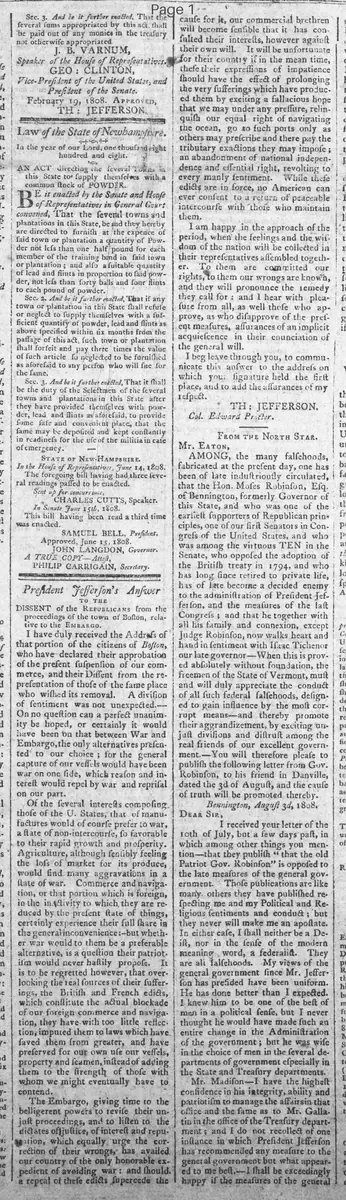
President Jefferson's Answer TO THE DISSENT of the Republicans from the proceedings of the town of Boston, relative to the EMBARGO.
I have duly received the Address of that portion of the citizens of Boston, who have declared their approbation of the present suspension of our commerce, and their Dissent from the representation of those of the same place who wished its removal. A division of sentiment was not unexpected.—On no question can a perfect unanimity be hoped, or certainly it would have been on that between War and Embargo, the only alternatives presented to our choice; for the general capture of our vessels would have been war on one side, which reason and interest would repel by war and reprisal on our part.
Of the several interests composing those of the U. States, that of manufactures would of course prefer to war, a state of non-intercourse, so favorable to their rapid growth and prosperity. Agriculture, although sensibly feeling the loss of market for its produce, would find many aggravations in a state of war. Commerce and navigation, or that portion which is foreign, in the inactivity to which they are reduced by the present state of things, certainly experience their full share in the general inconvenience:—but whether war would to them be a preferable alternative, is a question their patriotism would never hastily propose. It is to be regretted however, that overlooking the real sources of their sufferings, the British and French edicts, which constitute the actual blockade of our foreign commerce and navigation, they have with too little reflection, imputed them to laws which have saved them from greater, and have preserved for our own use our vessels, property and seamen, instead of adding them to the strength of those with whom we might eventually have to contend.
The Embargo, giving time to the belligerent powers to revise their unjust proceedings, and to listen to the dictates of justice, of interest and reputation, which equally urge the correction of their wrongs, has, as we have reason to believe, availed our country of the only honorable expedient of avoiding war: and should a repeal of those edicts supersede the cause for it, our commercial brethren will become sensible that it has consulted their interests, however against their own will. It will be unfortunate for their country if in the mean time, these their expressions of impatience should have the effect of prolonging the very sufferings which have produced them by exciting a fallacious hope that we may under any pressure, relinquish our equal right of navigating the ocean, go to such ports only as others may prescribe and there pay the tributary exactions they may impose; an abandonment of national independence and essential right, revolting to every manly sentiment. While these edicts are in force, no American can ever consent to a return of peaceable intercourse with those who maintain them. I am happy in the approach of the period, when the feelings and the wisdom of the nation will be collected in their representatives assembled together. To them are committed our rights, to them our wrongs are known, and they will pronounce the remedy they call for: and I hear with pleasure from all, as well those who approve, as who disapprove of the present measures, assurances of an implicit acquiescence in their enunciation of the general will.
I beg leave through you, to communicate this answer to the address on which your signature held the first place, and to add the assurances of my respect.
TH: JEFFERSON.
Col. Edward Prettyman.
I have duly received the Address of that portion of the citizens of Boston, who have declared their approbation of the present suspension of our commerce, and their Dissent from the representation of those of the same place who wished its removal. A division of sentiment was not unexpected.—On no question can a perfect unanimity be hoped, or certainly it would have been on that between War and Embargo, the only alternatives presented to our choice; for the general capture of our vessels would have been war on one side, which reason and interest would repel by war and reprisal on our part.
Of the several interests composing those of the U. States, that of manufactures would of course prefer to war, a state of non-intercourse, so favorable to their rapid growth and prosperity. Agriculture, although sensibly feeling the loss of market for its produce, would find many aggravations in a state of war. Commerce and navigation, or that portion which is foreign, in the inactivity to which they are reduced by the present state of things, certainly experience their full share in the general inconvenience:—but whether war would to them be a preferable alternative, is a question their patriotism would never hastily propose. It is to be regretted however, that overlooking the real sources of their sufferings, the British and French edicts, which constitute the actual blockade of our foreign commerce and navigation, they have with too little reflection, imputed them to laws which have saved them from greater, and have preserved for our own use our vessels, property and seamen, instead of adding them to the strength of those with whom we might eventually have to contend.
The Embargo, giving time to the belligerent powers to revise their unjust proceedings, and to listen to the dictates of justice, of interest and reputation, which equally urge the correction of their wrongs, has, as we have reason to believe, availed our country of the only honorable expedient of avoiding war: and should a repeal of those edicts supersede the cause for it, our commercial brethren will become sensible that it has consulted their interests, however against their own will. It will be unfortunate for their country if in the mean time, these their expressions of impatience should have the effect of prolonging the very sufferings which have produced them by exciting a fallacious hope that we may under any pressure, relinquish our equal right of navigating the ocean, go to such ports only as others may prescribe and there pay the tributary exactions they may impose; an abandonment of national independence and essential right, revolting to every manly sentiment. While these edicts are in force, no American can ever consent to a return of peaceable intercourse with those who maintain them. I am happy in the approach of the period, when the feelings and the wisdom of the nation will be collected in their representatives assembled together. To them are committed our rights, to them our wrongs are known, and they will pronounce the remedy they call for: and I hear with pleasure from all, as well those who approve, as who disapprove of the present measures, assurances of an implicit acquiescence in their enunciation of the general will.
I beg leave through you, to communicate this answer to the address on which your signature held the first place, and to add the assurances of my respect.
TH: JEFFERSON.
Col. Edward Prettyman.
What sub-type of article is it?
Historical Event
What themes does it cover?
Justice
Moral Virtue
What keywords are associated?
Embargo
Jefferson Response
Boston Dissent
War Alternative
National Rights
British Edicts
French Edicts
What entities or persons were involved?
Thomas Jefferson
Edward Prettyman
Citizens Of Boston
Where did it happen?
Boston
Story Details
Key Persons
Thomas Jefferson
Edward Prettyman
Citizens Of Boston
Location
Boston
Story Details
Jefferson defends the Embargo policy against Boston dissenters, arguing it avoids war, protects national interests from British and French edicts, and preserves commerce for future resumption, urging patience until Congress acts.