Thank you for visiting SNEWPapers!
Sign up free
Letter to Editor
February 7, 1795
Gazette Of The United States And Daily Evening Advertiser
Philadelphia, Philadelphia County, Pennsylvania
What is this article about?
R. Hare defends his porter brewing business practices in response to accusations by Messrs. B. W. Morris and Robertson, clarifying misunderstandings, detailing sales agreements, and criticizing combinations formed by bottlers to pressure him into altering terms, dated February 6, 1795.
Clipping
OCR Quality
98%
Excellent
Full Text
Messrs. Dunlap and Claypoole,
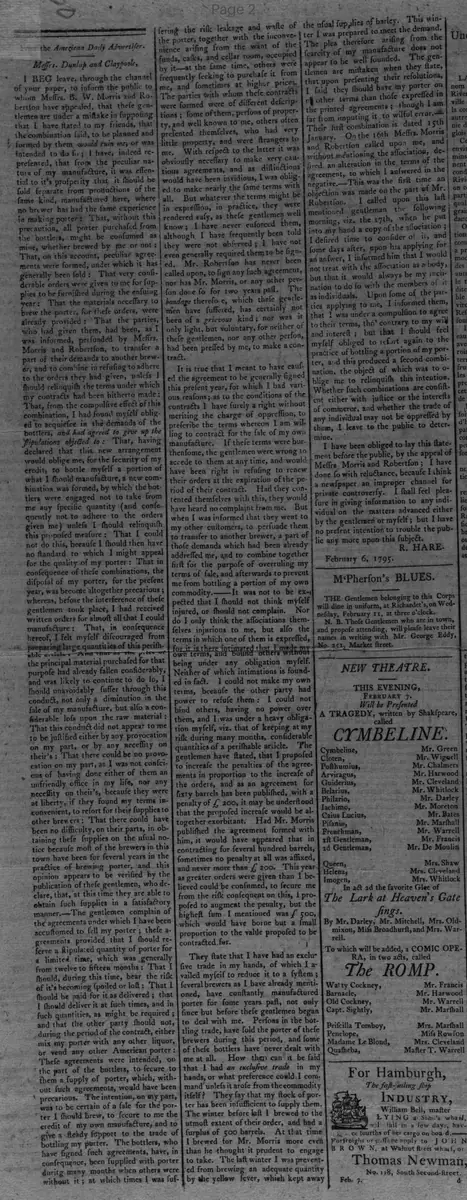
I beg leave, through the channel of your paper, to inform the public to whom Messrs. B. W. Morris and Robertson have appealed, that these gentlemen are under a mistake in supposing that I have stated to my friends, that the combination said to be planned and formed by them would ruin me or was intended to do so. I have, indeed, represented, that on the peculiar nature of my manufacture, it was essential to its prosperity that it should be sold separate from productions of the same kind, manufactured here, where no brewer has had the same experience in making porter. That, without this precaution, all porter purchased from the bottlers, might be consumed as mine, whether brewed by me or not. That, on this account, peculiar agreements were formed, under which it has generally been sold. That very considerable orders were given to me for supplies to be furnished during the ensuing year. That the materials necessary to brew the porter, for these orders, were already provided. That the parties, who had given them, had been, as I was informed, persuaded by Messrs. Morris and Robertson, to transfer a part of their demands to another brewer, and to combine in refusing to adhere to the orders they had given, unless I should relinquish the terms under which my contracts had been hitherto made. That, from the compulsive effect of this combination, I had found myself obliged to acquiesce in the demands of the bottlers, and had agreed to give up the stipulations objected to. That, having declared that this new arrangement would oblige me, for the security of my credit to bottle myself a portion of what I should manufacture, a new combination was formed, by which the bottlers were engaged not to take from me any specific quantity (and consequently not to adhere to the orders given me) unless I should relinquish this proposed measure. That I could not do this, because I should then have no standard to which I might appeal for the quality of my porter. That in consequence of these combinations, the disposal of my porter, for the present year, was become altogether precarious; whereas, before the interference of these gentlemen took place, I had received written orders for almost all that I could manufacture. That, in consequence hereof, I felt myself discouraged from preparing large quantities of this perishable article. The principal material purchased for that purpose had already fallen considerably, and was likely to continue to do so, I should unavoidably suffer through this conduct, not only a diminution in the sale of my manufacture, but also a considerable loss upon the raw material. That this conduct did not appear to me to be justified either by any provocation on my part, or by any necessity on theirs. That there could be no provocation on my part, as I was not conscious of having done either of them an unfriendly office in my life, nor any necessity on theirs, because they were at liberty, if they found my terms inconvenient, to resort for their supplies to other brewers. That there could have been no difficulty, on their parts, in obtaining these supplies on the usual notice because most of the brewers in this town have been for several years in the practice of brewing porter, and this opinion appears to be verified by the publication of these gentlemen, who declare, that, at this time they are able to obtain such supplies in a satisfactory manner. The gentlemen complain of the agreements under which I have been accustomed to sell my porter; these agreements provided that I should reserve a stipulated quantity of porter for a limited time, which was generally from twelve to fifteen months. That I should, during this time, bear the risk of its becoming spoiled or lost. That I should be paid for it as delivered; that I should deliver it at such times, and in such quantities, as might be required: and that the other party should not, during the period of the contract, either mix my porter with any other liquor or vend any other American porter. These agreements were intended, on the part of the bottlers, to secure to them a supply of porter, which, without such agreements, would have been precarious. The intention, on my part was to be certain of a sale for the porter I should brew, to secure to me the credit of my own manufacture, and to give a steady support to the trade of bottling my porter. The bottlers, who have signed such agreements, have, in consequence, been supplied with porter during many months when others were without it; at which times I was suffering the risk leakage and waste of the porter, together with the inconvenience arising from the want of the funds, casks, and cellar room, occupied by it at the same time, others were frequently seeking to purchase it from me, and sometimes at higher prices. The parties with whom these contracts were formed were of different descriptions; some of them, persons of property, and well known to me, others often presented themselves, who had very little property, and were strangers to me. With respect to the latter it was obviously necessary to make very cautious agreements, and as distinctions would have been invidious, I was obliged to make nearly the same terms with all. But whatever the terms might be in expression, in practice, they were rendered easy, as these gentlemen well know; I have never enforced them, although, I have frequently been told they were not observed; I have not even generally required them to be signed. Mr. Robertson has never been called upon, to sign any such agreement, nor has Mr. Morris, or any other person done so for two years past. The bondage therefore, which these gentlemen have suffered, has certainly not been of a grievous kind; nor was it only light, but voluntary, for neither of these gentlemen, nor any other person, had been pressed by me, to make a contract. It is true that I meant to have caused the agreement to be generally signed this present year, for which I had various reasons; as to the conditions of the contracts I have surely a right without meriting the charge of oppression, to prescribe the terms whereon I am willing to contract for the sale of my own manufacture. If these terms were burdensome, the gentlemen were wrong to accede to them at any time, and would have been right in refusing to renew their orders at the expiration of the period of their contract. Had they contented themselves with this, they would have heard no complaint from me. But when I was informed that they went to my other customers, to persuade them to transfer to another brewer, a part of those demands which had been already addressed me, and to combine together first for the purpose of overruling my terms of sale, and afterwards to prevent me from bottling a portion of my own commodity. It was not to be expected that I should not think myself injured, or should not complain. Nor do I only think the associations themselves injurious to me, but also the terms in which one of them is expressed, for it is there intimated that I made my own terms, and bound others without being under any obligation myself. Neither of which intimations is founded in fact. I could not make my own terms, because the other party had power to refuse them: I could not bind others, having no power over them, and I was under a heavy obligation myself, viz. that of keeping at my risk during many months, considerable quantities of a perishable article. The gentlemen have stated, that I proposed to increase the penalties of the agreements in proportion to the increase of the orders, and as an agreement for sixty barrels has been published, with a penalty of 200, it may be understood that the proposed increase would be altogether exorbitant. Had Mr. Morris published the agreement formed with him, it would have appeared that in contracting for several hundred barrels, sometimes no penalty at all was affixed, and never more than 200. This year as greater orders were given than I believed could be consumed, to secure me from the risk consequent on this, I proposed to augment the penalty, but the highest sum I mentioned was 500 which would have borne but a small proportion to the value proposed to be contracted for. They state that I have had an exclusive trade in my hands, of which I availed myself to reduce it to a system; several brewers as I have already mentioned, have constantly manufactured porter for some years past, not only since but before these gentlemen began to deal with me. Persons in the bottling trade, have sold the porter of these brewers during this period, and some of these bottlers have never dealt with me at all. How then can it be said that I had an exclusive trade in my hands, or what preference could I command unless it arose from the commodity itself? They say that my stock of porter has been insufficient to supply them. The winter before last I brewed to the utmost extent of their order, and had a surplus of 500 barrels. At that time I brewed for Mr. Morris more even than he thought it prudent to engage to take. The last winter I was prevented from brewing an adequate quantity by the yellow fever, which kept away the usual supplies of barley. This winter I was prepared to meet the demand. The plea therefore arising from the scarcity of my manufacture does not appear to be well founded. The gentlemen are mistaken when they state, that upon presenting their resolutions, I said they should have my porter on no other terms than those expressed in the printed agreements; though I am far from imputing it to wilful error. January. On the 16th Messrs. Morris and Robertson called upon me, and Their first combination is dated 15th without mentioning the association, desired an alteration in the terms of the agreement, to which I answered in the negative. This was the first time an objection was made on the part of Mr. Robertson. I called upon this last mentioned gentleman the following morning, viz. the 17th, when he put into my hand a copy of the association; I desired time to consider of it, and some days after, upon his applying for an answer, I informed him that I would not treat with the association as a body, but that it would always be my inclination to do so with the members of it as individuals. Upon some of the parties applying to me, I informed them, that I was under a compulsion to agree to their terms, tho' contrary to my will and interest: but that I should feel myself obliged to resort again to the practice of bottling a portion of my porter, and this produced a second combination, the object of which was to oblige me to relinquish this intention. Whether such combinations are consistent either with justice or the interests of commerce, and whether the trade of any individual may not be oppressed by them, I leave to the public to determine. I have been obliged to lay this statement before the public, by the appeal of Messrs Morris and Robertson; I have done so with reluctance, because I think a newspaper an improper channel for private controversy. I shall feel pleasure in giving information to any individual on the matters advanced either by the gentlemen or myself; but I have no present intention to trouble the public any more upon this subject.
R. HARE.
February 6, 1795.
I beg leave, through the channel of your paper, to inform the public to whom Messrs. B. W. Morris and Robertson have appealed, that these gentlemen are under a mistake in supposing that I have stated to my friends, that the combination said to be planned and formed by them would ruin me or was intended to do so. I have, indeed, represented, that on the peculiar nature of my manufacture, it was essential to its prosperity that it should be sold separate from productions of the same kind, manufactured here, where no brewer has had the same experience in making porter. That, without this precaution, all porter purchased from the bottlers, might be consumed as mine, whether brewed by me or not. That, on this account, peculiar agreements were formed, under which it has generally been sold. That very considerable orders were given to me for supplies to be furnished during the ensuing year. That the materials necessary to brew the porter, for these orders, were already provided. That the parties, who had given them, had been, as I was informed, persuaded by Messrs. Morris and Robertson, to transfer a part of their demands to another brewer, and to combine in refusing to adhere to the orders they had given, unless I should relinquish the terms under which my contracts had been hitherto made. That, from the compulsive effect of this combination, I had found myself obliged to acquiesce in the demands of the bottlers, and had agreed to give up the stipulations objected to. That, having declared that this new arrangement would oblige me, for the security of my credit to bottle myself a portion of what I should manufacture, a new combination was formed, by which the bottlers were engaged not to take from me any specific quantity (and consequently not to adhere to the orders given me) unless I should relinquish this proposed measure. That I could not do this, because I should then have no standard to which I might appeal for the quality of my porter. That in consequence of these combinations, the disposal of my porter, for the present year, was become altogether precarious; whereas, before the interference of these gentlemen took place, I had received written orders for almost all that I could manufacture. That, in consequence hereof, I felt myself discouraged from preparing large quantities of this perishable article. The principal material purchased for that purpose had already fallen considerably, and was likely to continue to do so, I should unavoidably suffer through this conduct, not only a diminution in the sale of my manufacture, but also a considerable loss upon the raw material. That this conduct did not appear to me to be justified either by any provocation on my part, or by any necessity on theirs. That there could be no provocation on my part, as I was not conscious of having done either of them an unfriendly office in my life, nor any necessity on theirs, because they were at liberty, if they found my terms inconvenient, to resort for their supplies to other brewers. That there could have been no difficulty, on their parts, in obtaining these supplies on the usual notice because most of the brewers in this town have been for several years in the practice of brewing porter, and this opinion appears to be verified by the publication of these gentlemen, who declare, that, at this time they are able to obtain such supplies in a satisfactory manner. The gentlemen complain of the agreements under which I have been accustomed to sell my porter; these agreements provided that I should reserve a stipulated quantity of porter for a limited time, which was generally from twelve to fifteen months. That I should, during this time, bear the risk of its becoming spoiled or lost. That I should be paid for it as delivered; that I should deliver it at such times, and in such quantities, as might be required: and that the other party should not, during the period of the contract, either mix my porter with any other liquor or vend any other American porter. These agreements were intended, on the part of the bottlers, to secure to them a supply of porter, which, without such agreements, would have been precarious. The intention, on my part was to be certain of a sale for the porter I should brew, to secure to me the credit of my own manufacture, and to give a steady support to the trade of bottling my porter. The bottlers, who have signed such agreements, have, in consequence, been supplied with porter during many months when others were without it; at which times I was suffering the risk leakage and waste of the porter, together with the inconvenience arising from the want of the funds, casks, and cellar room, occupied by it at the same time, others were frequently seeking to purchase it from me, and sometimes at higher prices. The parties with whom these contracts were formed were of different descriptions; some of them, persons of property, and well known to me, others often presented themselves, who had very little property, and were strangers to me. With respect to the latter it was obviously necessary to make very cautious agreements, and as distinctions would have been invidious, I was obliged to make nearly the same terms with all. But whatever the terms might be in expression, in practice, they were rendered easy, as these gentlemen well know; I have never enforced them, although, I have frequently been told they were not observed; I have not even generally required them to be signed. Mr. Robertson has never been called upon, to sign any such agreement, nor has Mr. Morris, or any other person done so for two years past. The bondage therefore, which these gentlemen have suffered, has certainly not been of a grievous kind; nor was it only light, but voluntary, for neither of these gentlemen, nor any other person, had been pressed by me, to make a contract. It is true that I meant to have caused the agreement to be generally signed this present year, for which I had various reasons; as to the conditions of the contracts I have surely a right without meriting the charge of oppression, to prescribe the terms whereon I am willing to contract for the sale of my own manufacture. If these terms were burdensome, the gentlemen were wrong to accede to them at any time, and would have been right in refusing to renew their orders at the expiration of the period of their contract. Had they contented themselves with this, they would have heard no complaint from me. But when I was informed that they went to my other customers, to persuade them to transfer to another brewer, a part of those demands which had been already addressed me, and to combine together first for the purpose of overruling my terms of sale, and afterwards to prevent me from bottling a portion of my own commodity. It was not to be expected that I should not think myself injured, or should not complain. Nor do I only think the associations themselves injurious to me, but also the terms in which one of them is expressed, for it is there intimated that I made my own terms, and bound others without being under any obligation myself. Neither of which intimations is founded in fact. I could not make my own terms, because the other party had power to refuse them: I could not bind others, having no power over them, and I was under a heavy obligation myself, viz. that of keeping at my risk during many months, considerable quantities of a perishable article. The gentlemen have stated, that I proposed to increase the penalties of the agreements in proportion to the increase of the orders, and as an agreement for sixty barrels has been published, with a penalty of 200, it may be understood that the proposed increase would be altogether exorbitant. Had Mr. Morris published the agreement formed with him, it would have appeared that in contracting for several hundred barrels, sometimes no penalty at all was affixed, and never more than 200. This year as greater orders were given than I believed could be consumed, to secure me from the risk consequent on this, I proposed to augment the penalty, but the highest sum I mentioned was 500 which would have borne but a small proportion to the value proposed to be contracted for. They state that I have had an exclusive trade in my hands, of which I availed myself to reduce it to a system; several brewers as I have already mentioned, have constantly manufactured porter for some years past, not only since but before these gentlemen began to deal with me. Persons in the bottling trade, have sold the porter of these brewers during this period, and some of these bottlers have never dealt with me at all. How then can it be said that I had an exclusive trade in my hands, or what preference could I command unless it arose from the commodity itself? They say that my stock of porter has been insufficient to supply them. The winter before last I brewed to the utmost extent of their order, and had a surplus of 500 barrels. At that time I brewed for Mr. Morris more even than he thought it prudent to engage to take. The last winter I was prevented from brewing an adequate quantity by the yellow fever, which kept away the usual supplies of barley. This winter I was prepared to meet the demand. The plea therefore arising from the scarcity of my manufacture does not appear to be well founded. The gentlemen are mistaken when they state, that upon presenting their resolutions, I said they should have my porter on no other terms than those expressed in the printed agreements; though I am far from imputing it to wilful error. January. On the 16th Messrs. Morris and Robertson called upon me, and Their first combination is dated 15th without mentioning the association, desired an alteration in the terms of the agreement, to which I answered in the negative. This was the first time an objection was made on the part of Mr. Robertson. I called upon this last mentioned gentleman the following morning, viz. the 17th, when he put into my hand a copy of the association; I desired time to consider of it, and some days after, upon his applying for an answer, I informed him that I would not treat with the association as a body, but that it would always be my inclination to do so with the members of it as individuals. Upon some of the parties applying to me, I informed them, that I was under a compulsion to agree to their terms, tho' contrary to my will and interest: but that I should feel myself obliged to resort again to the practice of bottling a portion of my porter, and this produced a second combination, the object of which was to oblige me to relinquish this intention. Whether such combinations are consistent either with justice or the interests of commerce, and whether the trade of any individual may not be oppressed by them, I leave to the public to determine. I have been obliged to lay this statement before the public, by the appeal of Messrs Morris and Robertson; I have done so with reluctance, because I think a newspaper an improper channel for private controversy. I shall feel pleasure in giving information to any individual on the matters advanced either by the gentlemen or myself; but I have no present intention to trouble the public any more upon this subject.
R. HARE.
February 6, 1795.
What sub-type of article is it?
Persuasive
Informative
What themes does it cover?
Commerce Trade
What keywords are associated?
Porter Brewing
Sales Agreements
Bottlers Combination
Commercial Dispute
Exclusive Contracts
Brewing Penalties
Yellow Fever Impact
What entities or persons were involved?
R. Hare
Messrs. Dunlap And Claypoole
Letter to Editor Details
Author
R. Hare
Recipient
Messrs. Dunlap And Claypoole
Main Argument
r. hare clarifies he did not claim the bottlers' combination would ruin him, defends his exclusive sales agreements as necessary for quality and business security, and argues that the combinations by morris and robertson unjustly pressured him to alter terms, harming his trade.
Notable Details
Agreements Stipulate Reserving Porter For 12 15 Months At Brewer's Risk
Penalties Up To 500 For Larger Orders
Yellow Fever Affected Barley Supply Last Winter
Combinations Dated January 15 And Subsequent
Interactions On January 16 And 17, 1795