Thank you for visiting SNEWPapers!
Sign up free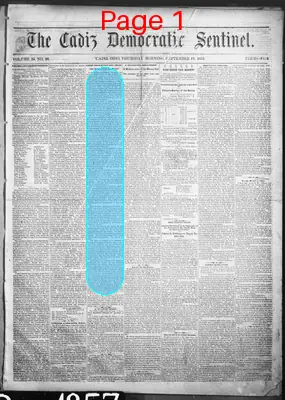
Editorial
September 17, 1857
The Cadiz Democratic Sentinel
Cadiz, Harrison County, Ohio
What is this article about?
Editorial criticizes Ohio Governor Salmon P. Chase for neglecting his duty under the 1856 Treasury law to oversee and restrain Treasurer Gibson from illegal acts, despite reports of mismanagement and insufficient securities for public funds.
Clipping

OCR Quality
95%
Excellent
Full Text
"The King Can do no Wrong."
In monarchical governments, the people are taught to speak and act on the doctrine that "the king can do no wrong." In this free State of Ohio—in this State where we have heard so much vaporing about "free speech"—it would seem from the indignant complaints of Black Republican editors and politicians, that a similar theory is sought to be established in respect to Salmon P. Chase, Governor of Ohio. Every attempt to examine and criticise the action of the Governor under the Treasury law of 8th April, 1856, is denounced as if it were an outrage on right and decency. Every intimation that he has neglected any part of his duty under that important law is treated as a vile attempt at misrepresentation.
Free from any desire to falsify Gov. Chase, but determined that neither his own haughtiness nor the insolence of his tools shall deter us from our chosen course, we propose in this article again to fix the readers attention on certain duties devolved on the Governor by the seventeenth section of the new Treasury law passed 8th April, 1856, as follows:
"Sec. 17. If from any such examination or from any other satisfactory evidence, the Governor shall ascertain that the state shall have suffered any damage, or shall be in immediate danger of an injury or damage from any illegal act done, or about to be done, by the treasurer, or from his refusing or neglecting to comply with any requirement of law touching the receipt, keeping or paying out any money belonging to the State, or keeping or rendering account thereof, or shall have taken insufficient security for any money deposited elsewhere than in the treasury office in Columbus, it shall in every such case be THE DUTY OF THE GOVERNOR to direct the attorney general forthwith to institute the proper proceedings in the court of common pleas of Franklin county to restrain the treasurer from all such illegal acts."
Here was a duty, both new and grave, imposed by solemn enactment of law on the Governor of Ohio. He was required to stand as guardian over the Treasury. To save it from danger and abuse, he was required to call on the court to enjoin the Treasurer from every illegal or hazardous act. He did not do it. He neglected the discharge of this high and salutary duty. He thought only of Kansas leaving the Treasury to the sole care of the very man whom the law intended to place under his constant vigilance and restraint.
But it may be claimed that Governor Chase was ignorant that there was any occasion for his interference with the Treasurer. This pretense cannot stand—it is false. The Investigating Committee of his own friends made him aware that the Treasury was mismanaged and in danger. Observe the following single paragraph taken from the report made by that committee early last January:
"By the 12th section of the act of April 8, 1856, prescribing the duties of the Auditor and Treasurer, it is provided that 'no money belonging or due to the State shall be deposited, placed or kept by the Treasurer, or by his direction, order or assent, elsewhere than in the treasury office at Columbus, without security as provided in said section.' The Treasurer has, partially, NOT FULLY IN ANY INSTANCE complied with the requirements of that section."
Here was plain, palpable proof brought directly to the notice of the Governor by a committee of his own friends, showing that Gibson had not executed the law—that he was putting the public money in jeopardy—that the very case for asking the restraining power of Court had already occurred and then existed. Yet in the face of this notice to the Governor, he moved not an inch—he sat dumb as a man of wood, only thinking and talking of "bleeding Kansas—bleeding Kansas!"
Nor was the above by any means the only information placed in black and white before the Governor. Below are one or two more paragraphs from the same report. We will not lengthen this article by comments on these paragraphs. The intelligent reader will be struck with the facts they present. We copy as follows:
"The firm of Kimball & Co. bankers, of Cleveland, consisting of the late Attorney General, (now deceased) and his brother-in-law Philo Chamberlin, was formed last spring, and soon after its formation, obtained of the treasurer a deposit of about $30,000 of public funds, with the understanding, as the committee learned from the treasurer, that it should be repaid if required to meet the July interest. No part of this deposit had been paid, December 15, 1855; it had then increased.
About the 1st of January, 1856, Bartlett & Smith paid Mr. Breslin, the late Treasurer, $40,000 due the treasury from the securities of his predecessor, for which they took real estate and other effects, as stated in the depositions of Mr. Sullivant, Mr. Carrington and Mr. Smith, which have not hitherto been available in their business. In the statements furnished by the Treasurer, it is shown that the firm have been indebted to the treasury in about the same amount, at least since the 14th of March, 1856. On the 15th of December, 1856, they were liable to the treasury for $171,650 46. Their bond is $50,000, with Thomas Sparrow as surety. They have withdrawn $40,000 from their business, and invested in unproductive and unavailable assets; have provided funds to start a bank in Maryland, and on the 15th of December were liable to the treasury for $171,650 46!!!"
Men of sense, men of thought! Look at the facts presented in the extracts which are given above, and say if you can, that Salmon P. Chase in failing to "restrain" Gibson as the 17th section of Kelley's Treasury law required, did not most shamefully neglect the discharge of his solemn duty. Newark Advocate.
In monarchical governments, the people are taught to speak and act on the doctrine that "the king can do no wrong." In this free State of Ohio—in this State where we have heard so much vaporing about "free speech"—it would seem from the indignant complaints of Black Republican editors and politicians, that a similar theory is sought to be established in respect to Salmon P. Chase, Governor of Ohio. Every attempt to examine and criticise the action of the Governor under the Treasury law of 8th April, 1856, is denounced as if it were an outrage on right and decency. Every intimation that he has neglected any part of his duty under that important law is treated as a vile attempt at misrepresentation.
Free from any desire to falsify Gov. Chase, but determined that neither his own haughtiness nor the insolence of his tools shall deter us from our chosen course, we propose in this article again to fix the readers attention on certain duties devolved on the Governor by the seventeenth section of the new Treasury law passed 8th April, 1856, as follows:
"Sec. 17. If from any such examination or from any other satisfactory evidence, the Governor shall ascertain that the state shall have suffered any damage, or shall be in immediate danger of an injury or damage from any illegal act done, or about to be done, by the treasurer, or from his refusing or neglecting to comply with any requirement of law touching the receipt, keeping or paying out any money belonging to the State, or keeping or rendering account thereof, or shall have taken insufficient security for any money deposited elsewhere than in the treasury office in Columbus, it shall in every such case be THE DUTY OF THE GOVERNOR to direct the attorney general forthwith to institute the proper proceedings in the court of common pleas of Franklin county to restrain the treasurer from all such illegal acts."
Here was a duty, both new and grave, imposed by solemn enactment of law on the Governor of Ohio. He was required to stand as guardian over the Treasury. To save it from danger and abuse, he was required to call on the court to enjoin the Treasurer from every illegal or hazardous act. He did not do it. He neglected the discharge of this high and salutary duty. He thought only of Kansas leaving the Treasury to the sole care of the very man whom the law intended to place under his constant vigilance and restraint.
But it may be claimed that Governor Chase was ignorant that there was any occasion for his interference with the Treasurer. This pretense cannot stand—it is false. The Investigating Committee of his own friends made him aware that the Treasury was mismanaged and in danger. Observe the following single paragraph taken from the report made by that committee early last January:
"By the 12th section of the act of April 8, 1856, prescribing the duties of the Auditor and Treasurer, it is provided that 'no money belonging or due to the State shall be deposited, placed or kept by the Treasurer, or by his direction, order or assent, elsewhere than in the treasury office at Columbus, without security as provided in said section.' The Treasurer has, partially, NOT FULLY IN ANY INSTANCE complied with the requirements of that section."
Here was plain, palpable proof brought directly to the notice of the Governor by a committee of his own friends, showing that Gibson had not executed the law—that he was putting the public money in jeopardy—that the very case for asking the restraining power of Court had already occurred and then existed. Yet in the face of this notice to the Governor, he moved not an inch—he sat dumb as a man of wood, only thinking and talking of "bleeding Kansas—bleeding Kansas!"
Nor was the above by any means the only information placed in black and white before the Governor. Below are one or two more paragraphs from the same report. We will not lengthen this article by comments on these paragraphs. The intelligent reader will be struck with the facts they present. We copy as follows:
"The firm of Kimball & Co. bankers, of Cleveland, consisting of the late Attorney General, (now deceased) and his brother-in-law Philo Chamberlin, was formed last spring, and soon after its formation, obtained of the treasurer a deposit of about $30,000 of public funds, with the understanding, as the committee learned from the treasurer, that it should be repaid if required to meet the July interest. No part of this deposit had been paid, December 15, 1855; it had then increased.
About the 1st of January, 1856, Bartlett & Smith paid Mr. Breslin, the late Treasurer, $40,000 due the treasury from the securities of his predecessor, for which they took real estate and other effects, as stated in the depositions of Mr. Sullivant, Mr. Carrington and Mr. Smith, which have not hitherto been available in their business. In the statements furnished by the Treasurer, it is shown that the firm have been indebted to the treasury in about the same amount, at least since the 14th of March, 1856. On the 15th of December, 1856, they were liable to the treasury for $171,650 46. Their bond is $50,000, with Thomas Sparrow as surety. They have withdrawn $40,000 from their business, and invested in unproductive and unavailable assets; have provided funds to start a bank in Maryland, and on the 15th of December were liable to the treasury for $171,650 46!!!"
Men of sense, men of thought! Look at the facts presented in the extracts which are given above, and say if you can, that Salmon P. Chase in failing to "restrain" Gibson as the 17th section of Kelley's Treasury law required, did not most shamefully neglect the discharge of his solemn duty. Newark Advocate.
What sub-type of article is it?
Partisan Politics
Economic Policy
Legal Reform
What keywords are associated?
Ohio Treasury
Chase Neglect
Gibson Mismanagement
Treasury Law 1856
Public Funds Security
Kansas Distraction
What entities or persons were involved?
Salmon P. Chase
Gibson
Investigating Committee
Kimball & Co.
Bartlett & Smith
Philo Chamberlin
Thomas Sparrow
Editorial Details
Primary Topic
Neglect Of Duty By Governor Chase In Overseeing State Treasury
Stance / Tone
Strongly Critical Of Governor Chase's Inaction
Key Figures
Salmon P. Chase
Gibson
Investigating Committee
Kimball & Co.
Bartlett & Smith
Philo Chamberlin
Thomas Sparrow
Key Arguments
Governor Chase Neglected Duty Under Section 17 Of 1856 Treasury Law To Restrain Treasurer From Illegal Acts
Chase Ignored Report From His Own Committee Showing Treasurer's Non Compliance With Deposit Security Requirements
Treasury Mismanaged With Insufficient Securities For Deposits Like $30,000 To Kimball & Co.
Bartlett & Smith Liable For $171,650 With Inadequate Bond
Chase Focused On Kansas Issues Instead Of State Treasury Oversight