Thank you for visiting SNEWPapers!
Sign up free
Alexandria Gazette
Alexandria, Alexandria County, District Of Columbia
What is this article about?
Correspondence from Washington on July 19 reports on the Revenue Bill's progress in Congress, expected Senate passage without changes, House-Senate tensions, and speculation on presidential veto amid links to the Land Bill.
Clipping
OCR Quality
Full Text
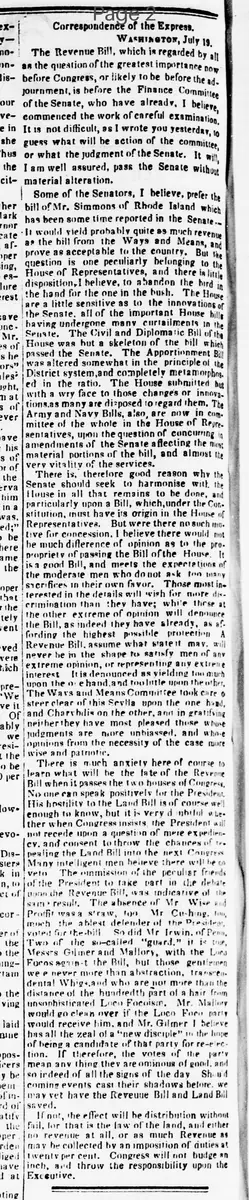
Washington, July 19.
The Revenue Bill, which is regarded by all as the question of the greatest importance now before Congress, or likely to be before the adjournment, is before the Finance Committee of the Senate, who have already, I believe, commenced the work of careful examination. It is not difficult, as I wrote you yesterday, to guess what will be action of the committee or what the judgment of the Senate.
It will I am well assured, pass the Senate without material alteration.
Some of the Senators, I believe, prefer the bill of Mr. Simmons of Rhode Island which has been some time reported in the Senate. It would yield probably quite as much revenue as the bill from the Ways and Means, and prove as acceptable. The question is one peculiarly belonging to the House of Representatives, and there in little disposition, I believe, to abandon the bird in the hand for the one in the bush. The House are a little sensitive as to the innovations of the Senate, all of the important House bills having undergone many curtailments in the Senate. The Civil and Diplomatic Bill of the House was but a skeleton of the bill which passed the Senate. The Apportionment Bill was altered somewhat in the principle of the District system, and completely metamorphosed in the ratio. The House submitted but with a wry face to those changes or innovations, as many are disposed to regard them. The Army and Navy Bills, also, are now in committee of the whole in the House of Representatives, upon the question of concurring in amendments of the Senate affecting the most material portions of the bill, and almost the very vitality of the services.
There is, therefore good reason why the Senate should seek to harmonise with the House in all that remains to be done, and particularly upon a Bill, which, under the Constitution, must have its origin in the House of Representatives. But were there no such motive for concession, I believe there would not be much difference of opinion as to the propriety of passing the Bill of the House. It is a good Bill, and meets the expectations of the moderate men who do not ask too many sacrifices in their own favor. Those most interested in the details will wish for more discrimination than they have; while those at the other extreme of opinion will denounce the Bill, as indeed they have already, as affording the highest possible protection. A Revenue Bill, assume what state it may, will never be in the shape to satisfy men of any extreme opinion, or representing any extreme interest. It is denounced as yielding too much upon the one hand, and too little upon the other. The Ways and Means Committee took care to steer clear of this Scylla upon the one hand, and Charybdis on the other, and in gratifying neither they have most pleased those whose judgments are more unbiased, and whose opinions from the necessity of the case more wise and patriotic.
There is much anxiety here of course to learn what will be the fate of the Revenue Bill when it passes the two houses of Congress. No one can speak positively for the President. His hostility to the Land Bill is of course well enough to know, but it is very doubtful whether when Congress insists the President will not recede upon a question of mere expediency, and consent to throw the chances of repealing the Land Bill into the next Congress. Many intelligent men believe there will be no veto. The omission of the peculiar friends of the President to take part in the debate upon the Revenue Bill, was indicative of the same result. The absence of Mr. Wise and Proffit was a straw, to Mr. Cushing, too much the ablest defender of the President, voted for the bill. So did Mr. Irwin, of Penn. Two of the so-called "guard," it is true. Messrs. Glynn and Mallory, with the Loco Focos against the Bill, but those gentlemen were never more than abstraction, transimental Whigs, and who are not more than the distance of the hundredth part of a hair from unsophisticated Loco Focoism. Mr. Mallory would go clean over if the Loco Foco party would receive him, and Mr. Gilmer I believe has all the zeal of a "new disciple" with the hope of being a candidate of that party for re-election. If therefore, the votes of the party mean any thing they are ominous of good, and so indeed of all the signs of the day. Should coming events cast their shadows before, we may yet have the Revenue Bill and Land Bill saved.
If not, the effect will be distribution without fail, for that is the law of the land, and either no revenue at all, or as much Revenue as may be collected by an imposition of duties at Twenty per cent. Congress will not budge an inch, and throw the responsibility upon the Executive.
What sub-type of article is it?
What keywords are associated?
What entities or persons were involved?
Where did it happen?
Domestic News Details
Primary Location
Washington
Event Date
July 19
Key Persons
Outcome
expected to pass senate without material alteration; uncertain presidential veto; potential distribution of land revenue if vetoed.
Event Details
The Revenue Bill is under examination by the Senate Finance Committee and expected to pass without changes. Some Senators prefer Mr. Simmons' bill, but the House bill is favored due to sensitivities over Senate alterations to prior bills. The bill balances moderate interests, avoiding extremes. Speculation on President's stance, with signs indicating possible approval; links to Land Bill and potential veto discussed.