Thank you for visiting SNEWPapers!
Sign up free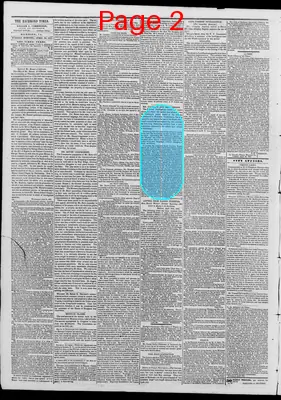
Editorial
April 22, 1851
Richmond Daily Times
Richmond, Virginia
What is this article about?
An editorial critiques John C. Calhoun's authorship of the 1828 South Carolina Tariff Protest, arguing it embodies divisive state-rights doctrines leading to nullification and discontent with federal legislation. A Mississippi citizen's letter claims Calhoun hid his authorship due to doubts about its orthodoxy.
Clipping
OCR Quality
95%
Excellent
Full Text
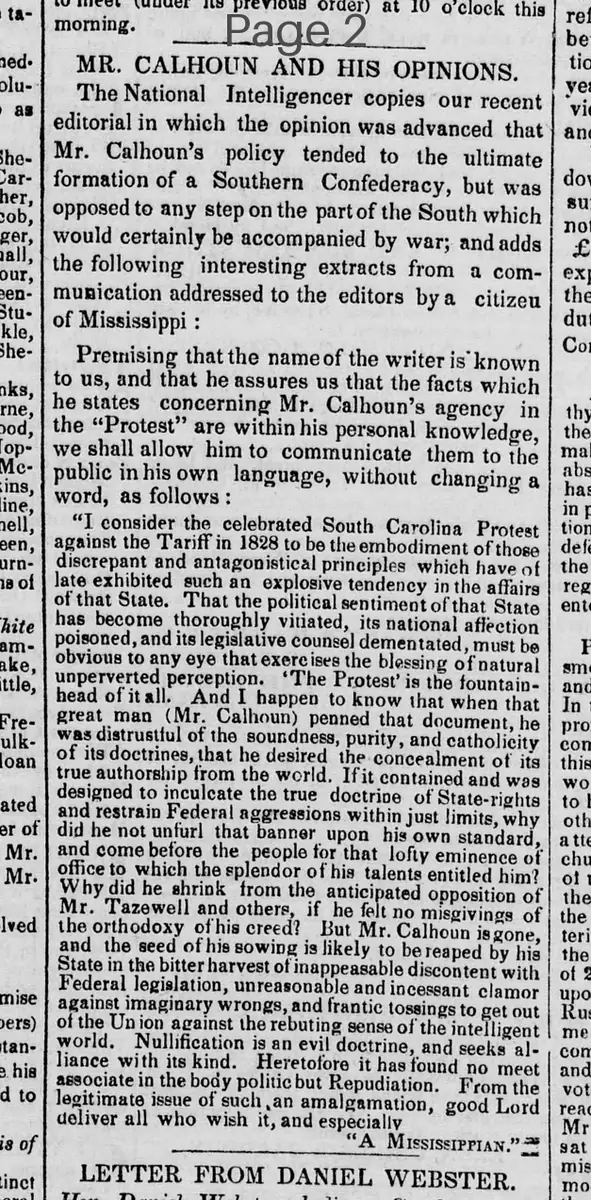
MR. CALHOUN AND HIS OPINIONS.
The National Intelligencer copies our recent
editorial in which the opinion was advanced that
Mr. Calhoun's policy tended to the ultimate
formation of a Southern Confederacy, but was
opposed to any step on the part of the South which
would certainly be accompanied by war; and adds
the following interesting extracts from a com-
munication addressed to the editors by a citizen
of Mississippi:
Premising that the name of the writer is known
to us, and that he assures us that the facts which
he states concerning Mr. Calhoun's agency in
the "Protest" are within his personal knowledge,
we shall allow him to communicate them to the
public in his own language, without changing a
word, as follows:
"I consider the celebrated South Carolina Protest
against the Tariff in 1828 to be the embodiment of those
discrepant and antagonistical principles which have of
late exhibited such an explosive tendency in the affairs
of that State. That the political sentiment of that State
has become thoroughly vitiated, its national affection
poisoned, and its legislative counsel dementated, must be
obvious to any eye that exercises the blessing of natural
unperverted perception. 'The Protest' is the fountain-
head of it all. And I happen to know that when that
great man (Mr. Calhoun) penned that document, he
was distrustful of the soundness, purity, and catholicity
of its doctrines, that he desired the concealment of its
true authorship from the world. If it contained and was
designed to inculcate the true doctrine of State-rights
and restrain Federal aggressions within just limits, why
did he not unfurl that banner upon his own standard.
and come before the people for that lofty eminence of
office to which the splendor of his talents entitled him?
Why did he shrink from the anticipated opposition of
Mr. Tazewell and others, if he felt no misgivings of
the orthodoxy of his creed? But Mr. Calhoun is gone,
and the seed of his sowing is likely to be reaped by his
State in the bitter harvest of inappeasable discontent with
Federal legislation, unreasonable and incessant clamor
against imaginary wrongs, and frantic tossings to get out
of the Union against the rebutting sense of the intelligent
world. Nullification is an evil doctrine, and seeks al-
liance with its kind. Heretofore it has found no meet
associate in the body politic but Repudiation. From the
legitimate issue of such an amalgamation, good Lord
deliver all who wish it, and especially
AMISSISSIPPIAN."
The National Intelligencer copies our recent
editorial in which the opinion was advanced that
Mr. Calhoun's policy tended to the ultimate
formation of a Southern Confederacy, but was
opposed to any step on the part of the South which
would certainly be accompanied by war; and adds
the following interesting extracts from a com-
munication addressed to the editors by a citizen
of Mississippi:
Premising that the name of the writer is known
to us, and that he assures us that the facts which
he states concerning Mr. Calhoun's agency in
the "Protest" are within his personal knowledge,
we shall allow him to communicate them to the
public in his own language, without changing a
word, as follows:
"I consider the celebrated South Carolina Protest
against the Tariff in 1828 to be the embodiment of those
discrepant and antagonistical principles which have of
late exhibited such an explosive tendency in the affairs
of that State. That the political sentiment of that State
has become thoroughly vitiated, its national affection
poisoned, and its legislative counsel dementated, must be
obvious to any eye that exercises the blessing of natural
unperverted perception. 'The Protest' is the fountain-
head of it all. And I happen to know that when that
great man (Mr. Calhoun) penned that document, he
was distrustful of the soundness, purity, and catholicity
of its doctrines, that he desired the concealment of its
true authorship from the world. If it contained and was
designed to inculcate the true doctrine of State-rights
and restrain Federal aggressions within just limits, why
did he not unfurl that banner upon his own standard.
and come before the people for that lofty eminence of
office to which the splendor of his talents entitled him?
Why did he shrink from the anticipated opposition of
Mr. Tazewell and others, if he felt no misgivings of
the orthodoxy of his creed? But Mr. Calhoun is gone,
and the seed of his sowing is likely to be reaped by his
State in the bitter harvest of inappeasable discontent with
Federal legislation, unreasonable and incessant clamor
against imaginary wrongs, and frantic tossings to get out
of the Union against the rebutting sense of the intelligent
world. Nullification is an evil doctrine, and seeks al-
liance with its kind. Heretofore it has found no meet
associate in the body politic but Repudiation. From the
legitimate issue of such an amalgamation, good Lord
deliver all who wish it, and especially
AMISSISSIPPIAN."
What sub-type of article is it?
Constitutional
Economic Policy
Partisan Politics
What keywords are associated?
Calhoun Opinions
South Carolina Protest
Tariff 1828
Nullification Doctrine
State Rights
Federal Aggressions
Southern Confederacy
What entities or persons were involved?
Mr. Calhoun
Mr. Tazewell
National Intelligencer
Citizen Of Mississippi
Editorial Details
Primary Topic
Critique Of Calhoun's 1828 South Carolina Tariff Protest
Stance / Tone
Critical Of Nullification And State Rights Doctrines
Key Figures
Mr. Calhoun
Mr. Tazewell
National Intelligencer
Citizen Of Mississippi
Key Arguments
South Carolina Protest Against Tariff In 1828 Embodies Discrepant Principles Causing Explosive Tendencies
Calhoun Penned The Protest But Distrusted Its Doctrines And Concealed Authorship
Calhoun Shrank From Public Avowal Due To Anticipated Opposition
Protest Leads To Vitiated Political Sentiment And Poisoned National Affection In South Carolina
Nullification Is An Evil Doctrine Allied With Repudiation
Calhoun's Policy Sows Seeds Of Discontent With Federal Legislation And Threats To Leave The Union