Thank you for visiting SNEWPapers!
Sign up free
Letter to Editor
March 24, 1818
Richmond Enquirer
Richmond, Richmond County, Virginia
What is this article about?
A response to 'Arator' on Indian corn farming, advocating informed practices like deep and cross ploughing, proper root cutting, and considering soil cycles and labor for Virginia planters to sustain productivity without over-relying on corn.
Clipping
OCR Quality
95%
Excellent
Full Text
FOR THE ENQUIRER.
INDIAN CORN.
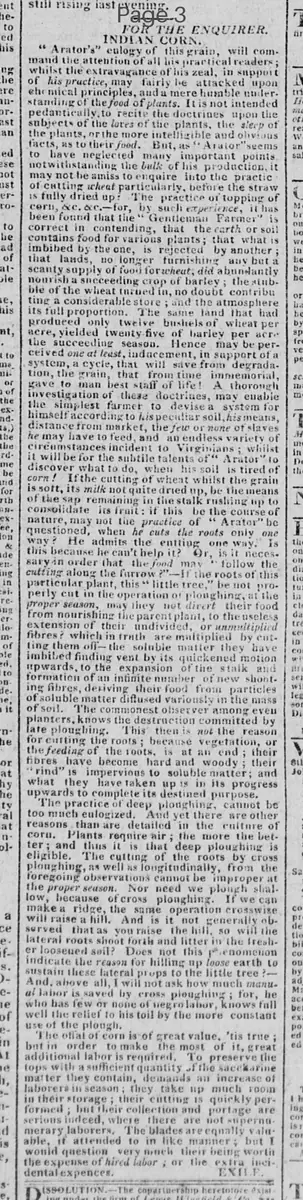
"Arator's" eulogy of this grain, will command the attention of all his practical readers; whilst the extravagance of his zeal, in support of his practice, may fairly be attacked upon chemical principles, and a mere humble understanding of the food of plants. It is not intended pedantically, to recite the doctrines upon the subjects of the loves of the plants, the sleep of the plants, or the more intelligible and obvious facts, as to their food. But, as "Arator" seems to have neglected many important points notwithstanding the bulk of his production, it may not be amiss to enquire into the practice of cutting wheat particularly, before the straw is fully dried up? The practice of topping of corn, &c. &c.—for, by such experience, it has been found that the "Gentleman Farmer" is correct in contending, that the earth or soil contains food for various plants; that what is imbibed by the one, is rejected by another; that lands, no longer furnishing any but a scanty supply of food for wheat, did abundantly nourish a succeeding crop of barley; the stubble of the wheat turned in, no doubt contributing a considerable store: and the atmosphere its full proportion. The same land that had produced only twelve bushels of wheat per acre, yielded twenty-five of barley per acre the succeeding season. Hence may be perceived one at least, inducement, in support of a system, a cycle, that will save from degradation, the grain, that from time immemorial, gave to man best staff of life! A thorough investigation of these doctrines, may enable the simplest farmer to devise a system for himself according to his peculiar soil, his means, distance from market, the few or none of slaves he may have to feed, and an endless variety of circumstances incident to Virginians; whilst it will be for the subtile talents of "Arator" to discover what to do, when his soil is tired of corn! If the cutting of wheat whilst the grain is soft, its milk not quite dried up, be the means of the sap remaining in the stalk rushing up to consolidate its fruit: if this be the course of nature, may not the practice of "Arator" be questioned, when he cuts the roots only one way? He admits the cutting one way." Is this because he can't help it? Or, is it necessary in order that the food may follow the cutting along the furrow?"
If the roots of this particular plant, this "little tree," be not properly cut in the operation of ploughing, at the proper season, may they not direct their food from nourishing the parent plant, to the useless extension of their undivided, or unmultiplied fibres? which in truth are multiplied by cutting them off—the soluble matter they have imbibed finding vent by its quickened motion upwards, to the expansion of the stalk and formation of an infinite number of new shooting fibres, deriving their food from particles of soluble matter diffused variously in the mass of soil. The commonest observer among even planters, knows the destruction committed by late ploughing. This then is not the reason for cutting the roots; because vegetation, or the feeding of the roots, is at an end; their fibres have become hard and woody; their "rind" is impervious to soluble matter; and what they have taken up is in its progress upwards to complete its destined purpose.
The practice of deep ploughing, cannot be too much eulogized. And yet there are other reasons, than are detailed in the culture of corn. Plants require air; the more the better; and thus it is that deep ploughing is eligible. The cutting of the roots by cross ploughing, as well as longitudinally, from the foregoing observations cannot be improper at the proper season. Nor need we plough shallow, because of cross ploughing. If we can make a ridge, the same operation crosswise will raise a hill. And is it "not generally observed that as you raise the hill, so will the lateral roots shoot forth and litter in the fresher loosened soil? Does not this phenomenon indicate the reason for hilling up loose earth to sustain these lateral props to the little tree?
And, above all, I will not ask how much manual labor is saved by cross ploughing; for, he who has few or none of negro labor, knows full well the relief to his toil by the more constant use of the plough.
The stalk of corn is of great value, 'tis true; but in order to make the most of it, great additional labor is required. To preserve the tops with a sufficient quantity of the saccharine matter they contain, demands an increase of laborers in season; they take up much room in their storage; their cutting is quickly performed; but their collection and portage are serious indeed, where there are not supernumerary laborers. The blades are equally valuable, if attended to in like manner; but I would question very much their being worth the expense of hired labor; or the extra incidental expenses.
EXULE.
INDIAN CORN.
"Arator's" eulogy of this grain, will command the attention of all his practical readers; whilst the extravagance of his zeal, in support of his practice, may fairly be attacked upon chemical principles, and a mere humble understanding of the food of plants. It is not intended pedantically, to recite the doctrines upon the subjects of the loves of the plants, the sleep of the plants, or the more intelligible and obvious facts, as to their food. But, as "Arator" seems to have neglected many important points notwithstanding the bulk of his production, it may not be amiss to enquire into the practice of cutting wheat particularly, before the straw is fully dried up? The practice of topping of corn, &c. &c.—for, by such experience, it has been found that the "Gentleman Farmer" is correct in contending, that the earth or soil contains food for various plants; that what is imbibed by the one, is rejected by another; that lands, no longer furnishing any but a scanty supply of food for wheat, did abundantly nourish a succeeding crop of barley; the stubble of the wheat turned in, no doubt contributing a considerable store: and the atmosphere its full proportion. The same land that had produced only twelve bushels of wheat per acre, yielded twenty-five of barley per acre the succeeding season. Hence may be perceived one at least, inducement, in support of a system, a cycle, that will save from degradation, the grain, that from time immemorial, gave to man best staff of life! A thorough investigation of these doctrines, may enable the simplest farmer to devise a system for himself according to his peculiar soil, his means, distance from market, the few or none of slaves he may have to feed, and an endless variety of circumstances incident to Virginians; whilst it will be for the subtile talents of "Arator" to discover what to do, when his soil is tired of corn! If the cutting of wheat whilst the grain is soft, its milk not quite dried up, be the means of the sap remaining in the stalk rushing up to consolidate its fruit: if this be the course of nature, may not the practice of "Arator" be questioned, when he cuts the roots only one way? He admits the cutting one way." Is this because he can't help it? Or, is it necessary in order that the food may follow the cutting along the furrow?"
If the roots of this particular plant, this "little tree," be not properly cut in the operation of ploughing, at the proper season, may they not direct their food from nourishing the parent plant, to the useless extension of their undivided, or unmultiplied fibres? which in truth are multiplied by cutting them off—the soluble matter they have imbibed finding vent by its quickened motion upwards, to the expansion of the stalk and formation of an infinite number of new shooting fibres, deriving their food from particles of soluble matter diffused variously in the mass of soil. The commonest observer among even planters, knows the destruction committed by late ploughing. This then is not the reason for cutting the roots; because vegetation, or the feeding of the roots, is at an end; their fibres have become hard and woody; their "rind" is impervious to soluble matter; and what they have taken up is in its progress upwards to complete its destined purpose.
The practice of deep ploughing, cannot be too much eulogized. And yet there are other reasons, than are detailed in the culture of corn. Plants require air; the more the better; and thus it is that deep ploughing is eligible. The cutting of the roots by cross ploughing, as well as longitudinally, from the foregoing observations cannot be improper at the proper season. Nor need we plough shallow, because of cross ploughing. If we can make a ridge, the same operation crosswise will raise a hill. And is it "not generally observed that as you raise the hill, so will the lateral roots shoot forth and litter in the fresher loosened soil? Does not this phenomenon indicate the reason for hilling up loose earth to sustain these lateral props to the little tree?
And, above all, I will not ask how much manual labor is saved by cross ploughing; for, he who has few or none of negro labor, knows full well the relief to his toil by the more constant use of the plough.
The stalk of corn is of great value, 'tis true; but in order to make the most of it, great additional labor is required. To preserve the tops with a sufficient quantity of the saccharine matter they contain, demands an increase of laborers in season; they take up much room in their storage; their cutting is quickly performed; but their collection and portage are serious indeed, where there are not supernumerary laborers. The blades are equally valuable, if attended to in like manner; but I would question very much their being worth the expense of hired labor; or the extra incidental expenses.
EXULE.
What sub-type of article is it?
Informative
Persuasive
Philosophical
What themes does it cover?
Agriculture
Science Nature
What keywords are associated?
Indian Corn
Arator Critique
Ploughing Practices
Plant Food
Soil Management
Virginia Farming
Cross Ploughing
Labor Saving
What entities or persons were involved?
Exule.
For The Enquirer.
Letter to Editor Details
Author
Exule.
Recipient
For The Enquirer.
Main Argument
critiques 'arator's' practices in indian corn cultivation, emphasizing chemical principles of plant food, the benefits of deep and cross ploughing for root management and soil aeration, and labor-saving techniques suitable for virginia farmers with limited slaves.
Notable Details
References To Cutting Wheat Before Fully Dried
Example Of Land Yielding 12 Bushels Wheat Then 25 Bushels Barley
Discussion Of Root Cutting Direction And Plant Sap
Eulogy Of Deep Ploughing For Air Access
Value Of Corn Stalks And Blades But Labor Costs