Thank you for visiting SNEWPapers!
Sign up free
Story
June 1, 1816
Daily National Intelligencer
Washington, District Of Columbia
What is this article about?
General Alexander Smyth addresses electors of Wythe County, defending his military decisions during the early War of 1812, criticizing superiors for failures, and offering his services for the House of Delegates after retirement.
Clipping
OCR Quality
98%
Excellent
Full Text
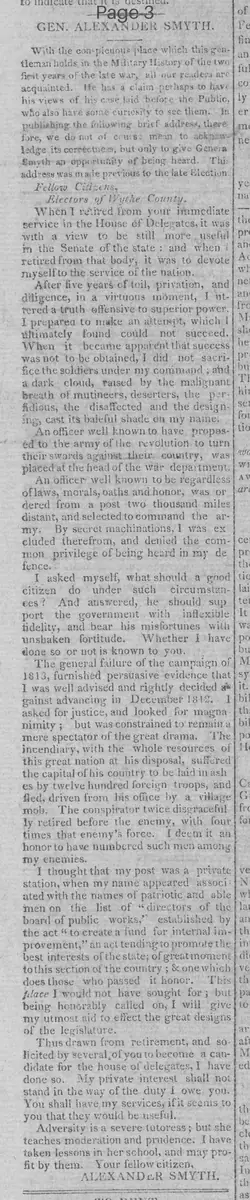
GEN. ALEXANDER SMYTH.
With the conspicuous place which this gentleman holds in the Military History of the two first years of the late war, all our readers are acquainted. He has a claim perhaps to have his views of his case laid before the Public, who also have some curiosity to see them. In publishing the following brief address, therefore, we do not of course mean to acknowledge its correctness, but only to give General Smyth an opportunity of being heard. This address was made previous to the late Election.
Fellow Citizens,
Electors of Wythe County.
When I retired from your immediate service in the House of Delegates, it was with a view to be still more useful in the Senate of the state: and when I retired from that body, it was to devote myself to the service of the nation. After five years of toil, privation, and diligence, in a virtuous moment, I uttered a truth offensive to superior power. I prepared to make an attempt, which I ultimately found could not succeed. When it became apparent that success was not to be obtained, I did not sacrifice the soldiers under my command; and a dark cloud, raised by the malignant breath of mutineers, deserters, the perfidious, the disaffected and the designing, cast its baleful shade on my name. An officer well known to have proposed to the army of the revolution to turn their swords against their country, was placed at the head of the war department. An officer well known to be regardless of laws, morals, oaths and honor, was ordered from a post two thousand miles distant, and selected to command the army. By secret machinations, I was excluded therefrom, and denied the common privilege of being heard in my defence.
I asked myself, what should a good citizen do under such circumstances? And answered, he should support the government with inflexible fidelity, and bear his misfortunes with unshaken fortitude. Whether I have done so or not is known to you.
The general failure of the campaign of 1813, furnished persuasive evidence that I was well advised and rightly decided against advancing in December 1812. I asked for justice, and looked for magnanimity; but was constrained to remain a mere spectator of the great drama. The incendiary, with the whole resources of this great nation at his disposal, suffered the capital of his country to be laid in ashes by twelve hundred foreign troops, and fled, driven from his office by a village mob. The conspirator twice disgracefully retired before the enemy, with four times that enemy's force. I deem it an honor to have numbered such men among my enemies.
I thought that my post was a private station, when my name appeared associated with the names of patriotic and able men on the list of "directors of the board of public works," established by the act "to create a fund for internal improvement," an act tending to promote the best interests of the state; of great moment to this section of the country; & one which does those who passed it honor. This place I would not have sought for; but being honorably called on, I will give my utmost aid to effect the great designs of the legislature.
Thus drawn from retirement, and so solicited by several of you to become a candidate for the house of delegates, I have done so. My private interest shall not stand in the way of the duty I owe you. You shall have my services, if it seems to you that they would be useful.
Adversity is a severe tutoress; but she teaches moderation and prudence. I have taken lessons in her school, and may profit by them.
Your fellow citizen,
ALEXANDER SMYTH
With the conspicuous place which this gentleman holds in the Military History of the two first years of the late war, all our readers are acquainted. He has a claim perhaps to have his views of his case laid before the Public, who also have some curiosity to see them. In publishing the following brief address, therefore, we do not of course mean to acknowledge its correctness, but only to give General Smyth an opportunity of being heard. This address was made previous to the late Election.
Fellow Citizens,
Electors of Wythe County.
When I retired from your immediate service in the House of Delegates, it was with a view to be still more useful in the Senate of the state: and when I retired from that body, it was to devote myself to the service of the nation. After five years of toil, privation, and diligence, in a virtuous moment, I uttered a truth offensive to superior power. I prepared to make an attempt, which I ultimately found could not succeed. When it became apparent that success was not to be obtained, I did not sacrifice the soldiers under my command; and a dark cloud, raised by the malignant breath of mutineers, deserters, the perfidious, the disaffected and the designing, cast its baleful shade on my name. An officer well known to have proposed to the army of the revolution to turn their swords against their country, was placed at the head of the war department. An officer well known to be regardless of laws, morals, oaths and honor, was ordered from a post two thousand miles distant, and selected to command the army. By secret machinations, I was excluded therefrom, and denied the common privilege of being heard in my defence.
I asked myself, what should a good citizen do under such circumstances? And answered, he should support the government with inflexible fidelity, and bear his misfortunes with unshaken fortitude. Whether I have done so or not is known to you.
The general failure of the campaign of 1813, furnished persuasive evidence that I was well advised and rightly decided against advancing in December 1812. I asked for justice, and looked for magnanimity; but was constrained to remain a mere spectator of the great drama. The incendiary, with the whole resources of this great nation at his disposal, suffered the capital of his country to be laid in ashes by twelve hundred foreign troops, and fled, driven from his office by a village mob. The conspirator twice disgracefully retired before the enemy, with four times that enemy's force. I deem it an honor to have numbered such men among my enemies.
I thought that my post was a private station, when my name appeared associated with the names of patriotic and able men on the list of "directors of the board of public works," established by the act "to create a fund for internal improvement," an act tending to promote the best interests of the state; of great moment to this section of the country; & one which does those who passed it honor. This place I would not have sought for; but being honorably called on, I will give my utmost aid to effect the great designs of the legislature.
Thus drawn from retirement, and so solicited by several of you to become a candidate for the house of delegates, I have done so. My private interest shall not stand in the way of the duty I owe you. You shall have my services, if it seems to you that they would be useful.
Adversity is a severe tutoress; but she teaches moderation and prudence. I have taken lessons in her school, and may profit by them.
Your fellow citizen,
ALEXANDER SMYTH
What sub-type of article is it?
Biography
Historical Event
What themes does it cover?
Misfortune
Justice
Moral Virtue
What keywords are associated?
Alexander Smyth
War Of 1812
Military Defense
Wythe County
House Of Delegates
Internal Improvement
What entities or persons were involved?
Alexander Smyth
Where did it happen?
Wythe County
Story Details
Key Persons
Alexander Smyth
Location
Wythe County
Event Date
Previous To The Late Election, Campaign Of 1813, December 1812
Story Details
General Smyth defends his refusal to advance in December 1812 during the War of 1812, criticizes superiors for failures including the burning of the capital, affirms loyalty to government despite personal attacks, and offers services as candidate for House of Delegates and director of public works.