Thank you for visiting SNEWPapers!
Sign up free
Alexandria Daily Gazette, Commercial & Political
Alexandria, Virginia
What is this article about?
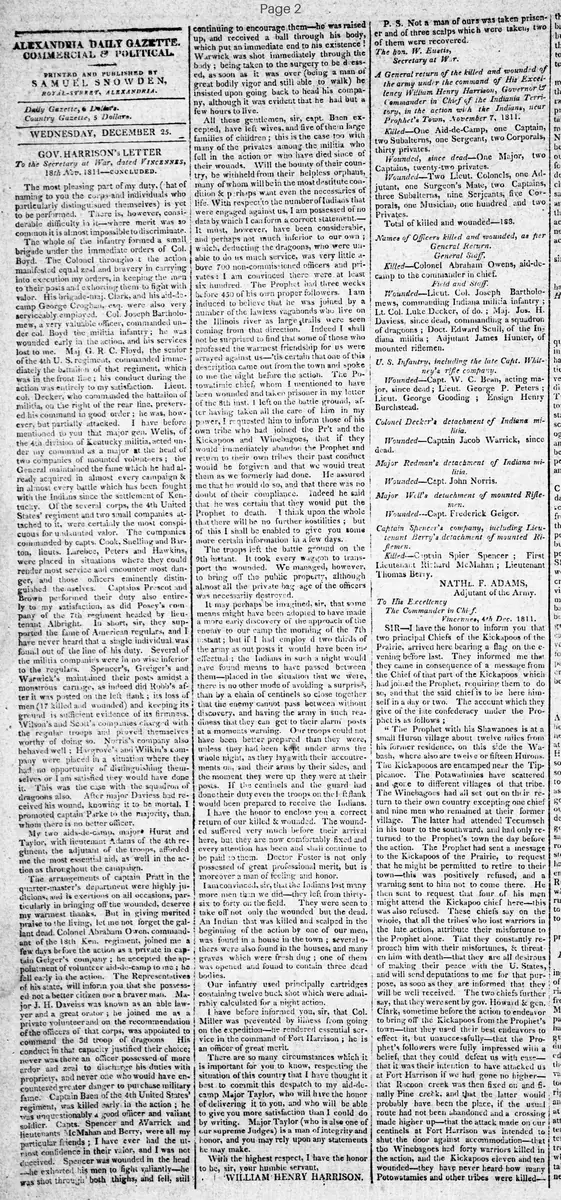
Governor William Henry Harrison's letter to the Secretary of War details the Battle of Tippecanoe on November 7, 1811, near Prophet's Town. He praises the bravery of U.S. regulars and militia, reports 188 killed and wounded, estimates heavy Indian losses, and notes the destruction of the Prophet's town.
Merged-components note: The return of killed and wounded is a direct continuation of Gov. Harrison's letter describing the battle, forming a single coherent story on the Tippecanoe engagement.
Clipping
OCR Quality
Full Text
To the Secretary at War, dated Vincennes,
18th Nov. 1811—Concluded.
The most pleasing part of my duty, (that of
naming to you the corps and individuals who
particularly distinguished themselves) is yet
to be performed. There is, however, consi-
derable difficulty in it—where merit was so
common it is almost impossible to discriminate.
The whole of the infantry formed a small
brigade under the immediate orders of Col.
Boyd. The Colonel throughout the action
manifested equal zeal and bravery in carrying
into execution my orders, in keeping the men
to their posts and exhorting them to fight with
valor. His brigade-maj. Clark, and his aid-de-
camp George Croghan, esq. were also very
serviceably employed. Col. Joseph Bartholo-
mew, a very valuable officer, commanded un-
der col. Boyd the militia infantry; he was
wounded early in the action, and his services
lost to me. Maj. G. R. C. Floyd, the senior
of the 4th U. S. regiment, commanded imme-
diately the battalion of that regiment, which
was in the front line; his conduct during the
action was entirely to my satisfaction. Lieut.
col. Decker, who commanded the battalion of
militia, on the right of the rear line, preserv-
ed his command in good order: he was, how-
ever, but partially attacked. I have before
mentioned to you that major gen. Wells, of
the 4th division of Kentucky militia, acted un-
der my command as a major at the head of
two companies of mounted volunteers; the
General maintained the fame which he had al-
ready acquired in almost every campaign &
in almost every battle which has been fought
with the Indians since the settlement of Ken-
tucky. Of the several corps, the 4th United
States' regiment and two small companies at-
tached to it, were certainly the most conspi-
cuous for undaunted valor. The companies
commanded by capts. Cook, Snelling and Bar-
ton, lieuts. Larrabee, Peters and Hawkins,
were placed in situations where they could
render most service and encounter most dan-
ger, and those officers eminently distin-
guished themselves. Captains Prescott and
Brown performed their duty also entire-
ly to my satisfaction, as did Posey's com-
pany of the 7th regiment headed by lieu-
tenant Albright. In short, sir, they sup-
ported the fame of American regulars, and I
have never heard that a single individual, was
found out of the line of his duty. Several of
the militia companies were in no wise inferior
to the regulars. Spencer's, Geiger's and
Warwick's maintained their posts amidst a
monstrous carnage, as indeed did Robb's af-
ter it was posted on the left flank; its loss of
men (17 killed and wounded) and keeping its
ground is sufficient evidence of its firmness.
Wilson's and Scott's companies charged with
the regular troops and proved themselves
worthy of doing so. Norris's company also
behaved well; Hargrove's and Wilkins' com-
pany were placed in a situation where they
had no opportunity of distinguishing them-
themselves or I am satisfied they would have done
it. This was the case with the squadron of
dragoons also. After major Daviess had re-
ceived his wound, knowing it to be mortal, I
promoted captain Parke to the majority, than,
whom there is no better officer.
My two aids-de-camp, major Hurst and
Taylor, with lieutenant Adams of the 4th re-
giment, the adjutant of the troops, afforded
me the most essential aid, as well in the ac-
tion as throughout the campaign.
The arrangements of captain Pratt in the
quarter-master's department were highly ju-
dicious, and his exertions on all occasions, par-
ticularly in bringing off the wounded, deserve
my warmest thanks. But in giving merited
praise to the living, let me not forget the gal-
lant dead. Colonel Abraham Owen, command-
ant of the 18th Ken. regiment, joined me a
few days before the action as a private in cap-
tain Geiger's company: he accepted the ap-
pointment of volunteer aid-de-camp to me; he
fell early in the action. The Representatives
of his state, will inform you that she possess-
ed not a better citizen nor a braver man. Ma-
jor J. H. Daviess was known as an able law-
yer and a great orator; he joined me as a
private volunteer and on the recommendation
of the officers of that corps, was appointed to
command the 3d troop of dragoons
His
conduct in that capacity justified their choice;
never was there an officer possessed of more
ardor and zeal to discharge his duties with
propriety, and never one who would have en-
countered greater danger to purchase military
fame. Captain Bean of the 4th United States
regiment, was killed early in the action; he
was unquestionably a good officer and valiant
soldier. Capts. Spencer and Warwick and
lieutenants McMahan and Berry, were all my
particular friends; I have ever had the ut-
most confidence in their valor, and I was not
deceaved. Spencer was wounded in the head
—he exhorted his men to fight valiantly—he
was shot through both thighs, and fell, still
continuing to encourage them he was raised
up, and received a ball through his body.
which put an immediate end to his existence!
Warwick was shot immediately through the
body; being taken to the surgery to be dress-
ed, as soon as it was over (being a man of
great bodily vigor and still able to walk) he
insisted upon going back to head his compa-
ny, although it was evident that he had but a
few hours to live.
All these gentlemen, sir, capt. Bean ex-
cepted, have left wives, and five of them large
families of children; this is the case too with
many of the privates among the militia who
fell in the action or who have died since of
their wounds. Will the bounty of their coun-
try, be withheld from their helpless orphans,
many of whom will be in the most destitute con-
dition & perhaps want even the necessaries of
life. With respect to the number of Indians that
were engaged against us, I am possessed of no
data by which I can form a correct statement.—
It must, however, have been considerable,
and perhaps not much inferior to our own;
which, deducting the dragoons, who were un-
able to do us much service, was very little a-
bove 700 non-commissioned officers and pri-
vates: I am convinced there were at least
six hundred. The Prophet had three weeks
before 450 of his own proper followers. I am
induced to believe that he was joined by a
number of the lawless vagabonds who live on
the Illinois river as large trails were seen
coming from that direction. Indeed I shall
not be surprised to find that some of those who
professed the warmest friendship for us were
arrayed against us—'tis certain that one of this
description came out from the town and spoke
to me the night before the action. The Po-
towatamic chief, whom I mentioned to have
been wounded and taken prisoner in my letter
of the 8th inst. I left on the battle ground, af-
ter having taken all the care of him in my
power, I requested him to inform those of his
own tribe who had joined the Prop't and the
Kickapoos and Winnebagoes, that if they
would immediately abandon the Prophet and
return to their own tribes their past conduct
would be forgiven and that we would treat
them as we formerly had done. He assured
me that he would do so, and that there was no
doubt of their compliance. Indeed he said
that he was certain that they would put the
Prophet to death. I think upon the whole
that there will be no further hostilities; but
of this I shall be enabled to give you some
more certain information in a few days.
The troops left the battle ground on the
9th instant. It took every waggon to trans-
port the wounded. We managed, however,
to bring off the public property, although
almost all the private baggage of the officers
was necessarily destroyed.
It may perhaps be imagined, sir, that some
means might have been adopted to have made
a more early discovery of the approach of the
enemy to our camp the morning of the 7th
instant; but if I had employed two thirds of
the army as out posts it would have been in-
effectual; the Indians in such a night would
have found means to have passed between
them—placed in the situation that we were,
there is no other mode of avoiding a surprise,
than by a chain of centinels so close together
that the enemy cannot pass between without
discovery, and having the army in such rea-
diness that they can get to their alarm posts
at a moments warning. Our troops could not
have been better prepared than they were,
unless they had been kept under arms the
whole night, as they lay with their accoutre-
ments on, and their arms by their sides, and
the moment they were up they were at their
posts. If the centinels and the guard had
done their duty even the troops on the left flank
would been prepared to receive the Indians.
I have the honor to enclose you a correct
return of our killed & wounded. The wound-
ed suffered very much before their arrival
here, but they are now comfortably fixed and
every attention has been and shall continue to
be paid to them. Doctor Foster is not only
possessed of great professional merit, but is
moreover a man of feeling and honor.
I am convinced, sir, that the Indians lost many
more men than we did they left from thirty-
six to forty on the field. They were seen to
take off not only the wounded but the dead.
An Indian that was killed and scalped in the
beginning of the action by one of our men,
was found in a house in the town; several o-
thers were also found in the houses, and many
graves which were fresh dug; one of them
was opened and found to contain three dead
bodies.
Our infantry used principally cartridges
containing twelve buck shot which were admi-
rably calculated for a night action.
I have before informed you, sir, that Col.
Miller was prevented by illness from going
on the expedition—he rendered essential ser-
vice in the command of Fort Harrison; he is
an officer of great merit.
There are so many circumstances which it
is important for you to know, respecting the
situation of this country that I have thought it
best to commit this despatch to my aid-de-
camp Major Taylor, who will have the honor
of delivering it to you, and who will be able
to give you more satisfaction than I could do
by writing. Major Taylor (who is also one of
our supreme Judges) is a man of integrity and
honor, and you may rely upon any statements
he may make.
With the highest respect, I have the honor
to be, sir, your humble servant,
WILLIAM HENRY HARRISON
P. S. Not a man of ours was taken prison-
er—er and of three scalps which were taken two
of them were recovered.
The hon. W. Eustis,
Secretary at War.
General return of the killed and wounded of
the army under the command of His Excel-
lency William Henry Harrison, Governor &
Commander in Chief of the Indiana Terri-
tory, in the action with the Indians, near
Prophet's Town, November 7. 1811.
Killed—One Aid-de-Camp, one Captain,
two Subalterns, one Sergeant, two Corporals,
thirty privates.
Wounded, since dead—One Major, two
Captains, twenty-two privates.
Wounded—Two Lieut. Colonels, one Ad-
jutant, one Surgeon's Mate, two Captains,
three Subalterns, nine Sergeants, five Cor-
porals, one Musician, one hundred and two
Privates.
Total of killed and wounded—188.
Names of Officers killed and wounded, as per
General Return.
General Staff.
Killed—Colonel Abraham Owen, aid-de-
camp to the commander in chief.
Field and Staff
Wounded—Lieut. Col. Joseph Bartholo-
mew, commanding Indiana militia infantry;
Lt. Col. Luke Decker, of do.; Maj. Jos. H.
Daviess, since dead, commanding a squadron
of dragoons: Doct. Edward Scull, of the In-
diana militia; Adjutant James Hunter, of
mounted riflemen.
U. S. Infantry, including the late Capt. Whit-
ney's rifle company.
Wounded—Capt. W. C. Bean, acting ma-
jor, since dead; Lieut. George P. Peters;
Lieut. George Gooding; Ensign Henry
Burchstead.
Colonel Decker's detachment of Indiana mi-
litia.
Wounded—Captain Jacob Warrick, since
dead.
Major Redman's detachment of Indiana mi-
litia.
Wounded—Capt. John Norris.
Major Wells' detachment of mounted Rifle-
men.
Wounded—Capt. Frederick Geiger.
Captain Spencer's company, including Lieu-
tenant Berry's detachment of mounted Ri-
flemen.
Killed—Captain Spier Spencer;
First
Lieutenant Richard McMahan; Lieutenant
Thomas Berry.
NATHL. F. ADAMS,
Adjutant of the Army.
To His Excellency
The Commander in Chief.
Vincennes, 4th Dec. 1811.
What sub-type of article is it?
What themes does it cover?
What keywords are associated?
What entities or persons were involved?
Where did it happen?
Story Details
Key Persons
Location
Near Prophet's Town, Indiana Territory
Event Date
November 7, 1811
Story Details
Harrison praises the valor of U.S. regulars and militia in repelling a surprise Indian attack at dawn, led by the Prophet. He details officers' bravery, reports 62 killed and 126 wounded, estimates 600+ Indian warriors with heavy losses, and notes the town's destruction and potential end to hostilities.