Thank you for visiting SNEWPapers!
Sign up free
Daily Richmond Whig
Richmond, Virginia
What is this article about?
John Jackson protests to President Andrew Jackson the sudden recall of his consular commission to Martinique, attributing it to influence from a 'Central Committee' due to his past opposition to Jackson's election. He accuses Jackson of tyranny, unfitness for office, and rewarding sycophants while punishing political opponents.
Clipping
OCR Quality
Full Text
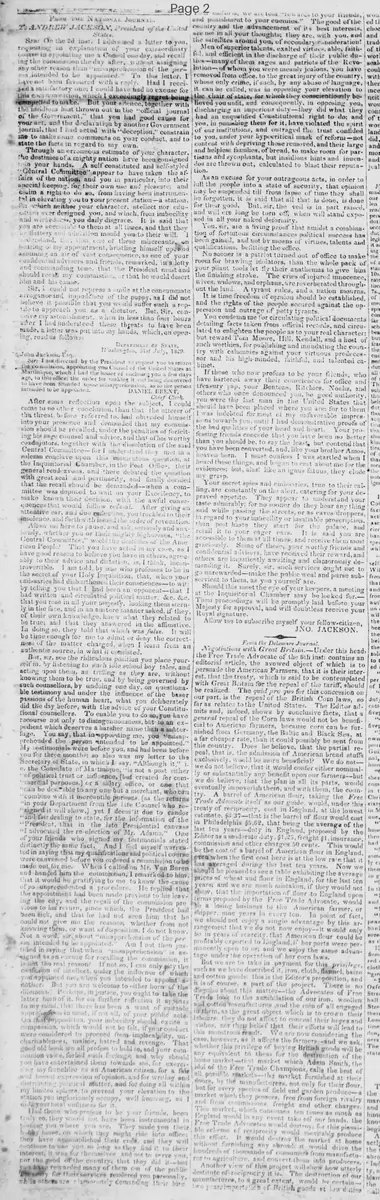
ANDREW JACKSON, President of the United States.
Sir: On the 2d inst. I addressed a letter to you, requesting an explanation of your extraordinary course in appointing me a Consul one day, and recalling the commission the day after, without assigning any other reason than "misapprehension of the person intended to be appointed." To this letter, I have not been favoured with a reply. Had I received a satisfactory one; I could have had no excuse for this communication, which I exceedingly regret being compelled to make. But your silence, together with the insidious hint thrown out in the "official journal of the Government," that you had good cause for your act, and the declaration by another Government journal, that I had acted with "deception," constrain me to make some comments on your conduct, and to state the facts in regard to my own.
Through an erroneous estimate of your character, the destinies of a mighty nation have been consigned to your hands. A self constituted and self-styled "Central Committee" appear to have taken the affairs of the nation, and you in particular, into their special keeping, for their own use and pleasure; and claim a right to do so, from having been instrumental in elevating you to your present station—a station, for which neither your character, intellect nor education ever designed you, and which, from imbecility and wickedness, you daily disgrace. It is said that you are accessible to them at all times, and that by flattery and adulation they mould you to their will. I understand, Sir, that one of these miscreants, on bearing of my appointment, bristling himself up, and assuming an air of vast consequence as one of your confidential advisers and friends, remarked, in a lofty and commanding tone, that the President must and should recall my commission; that he would desert him and his cause.
Sir, I could not repress a smile at the consummate arrogance and impudence of the puppy, as I did not believe it possible that you would suffer such a reptile to approach you as a dictator. But, Sir, conceive my astonishment, when in less than four hours after I had understood these threats to have been made, a letter was put into my hands, which, on opening, read as follows:
Department of State,
Washington, 31st July, 1829.
John Jackson, Esq.
Sir: I am directed by the President to request you to return the commission, appointing you Consul of the United States at Martinique, which I had the honor of enclosing to you a few days ago, to this office: the order for making it out being discovered to have been founded upon misapprehension, as to the person intended to be appointed.
DANIEL BRENT,
Chief Clerk.
After some reflection upon the subject, I could come to no other conclusion, than that the utterer of the threat, before referred to, had obtruded himself into your presence and demanded that my commission should be recalled, under the penalties of forfeiting his sage counsel and advice, and that of his worthy coadjutors, together with the dissolution of the said Central Committee—for I understand they met in a solemn conclave upon this momentous question, at the Inquisitorial Chamber, in the Post Office, their general rendezvous, and there debated the question with great zeal and pertinacity, and finally decided that the recall should be demanded—when a committee was deputed to wait on your Excellency, to make known their decision, with the awful consequences that would follow refusal. After giving an attentive ear, and due reflection, you truckled to their insolence, and forthwith issued the order of revocation.
Allow me here to pause, and ask, seriously and anxiously, whether you or their mighty highnesses, "the Central Committee," will the destinies of the American People? That you have acted in my case, as I have good reason to believe you have in others, agreeably to their advice and dictation, is, I think, incontrovertible. I am told, by one who professes to be in the secret of your Holy Inquisition, that, when your emissaries had disburthened their consciences—to wit: by telling you that I had been an opponent—that I had written and circulated political matter, &c. &c. that you rose in all your majesty, looking them sternly in the face, and in an austere manner asked, if they, of their own knowledge, knew what they related to be true; and that they answered in the affirmative.
In doing so, they told that which was false. It will be time enough for me to admit or deny the correctness of the matter charged, when I learn from an authentic source, in what it consisted.
But, sir, see the ridiculous position you place yourself in, by listening to such idle school boy tales, and acting upon them, as trifling as they are, without knowing them to be true, and by being governed by such counsellors, by undoing one day, on questionable testimony and under the influence of the baser passions of the human heart, what you deliberately did the day before, with the advice of your Constitutional counsellors. To enable you to do so, you have recourse not only to disingenuousness, but to an expedient which deserves a harsher name than a subterfuge. You say, that in appointing me, you "misapprehended the person intended to be appointed."
My testimonials were before you, and had been before you for three months; so also was my letter to the Secretary of State, in which I say, "Although it," i.e. the Consulate of Martinique, "is not a post either of political trust or influence, (but created for commercial purposes,) or a salary office, or one that can be desirable to any one but a merchant, who can combine with it mercantile pursuits, (as the returns in your Department from the late Consul who resigned it will show,) yet I deem it due to candor and fair dealing to state, for the information of the President, that in the late Presidential canvass I advocated the re-election of Mr. Adams." One of your friends who signed my testimonials stated distinctly the same fact. And I feel myself warranted in saying that my qualifications and political course were canvassed before you ordered a commission to be made out for me. When I called on Mr. Van Buren and handed him the commission, I remarked to him, that it would be gratifying to me to know the cause of so unprecedented a procedure. He replied that the appointment had been made previous to his leaving the city, and the recall of the commission previous to his return, since which, the President had been sick, and that he had not seen him; that he could not give me the reasons; whether from not knowing them, or want of disposition. I do not know.
Not a word, sir, about "misapprehension of the person intended to be appointed." Am I not then justified in saying that when "misapprehension" is assigned as an excuse for recalling the commission, it is not the real reason? If not so, I can only pity the confusion of intellect, under the influence of which you appointed me, when you intended to appoint another. But you are welcome to either horn of the dilemma. Perhaps, in justice, you ought to take the latter horn of it, for on further reflection it appears to my mind, that there has been a want of suitable apprehension in most, if not all, of your public acts.
On that supposition, your imbecility should excite a compassion, which would not be felt, if your conduct were considered to proceed from implacability, uncharitableness, malice, hatred and revenge. That good old book we all profess to hold to, and your communion vows, forbid such feelings; and why should you have entertained them towards me, for exercising my franchise as an American citizen, or a fair and honest expression of opinion, and for writing and distributing political matter, and for doing all within my limited sphere, to prevent your elevation to the station you ingloriously occupy, well knowing, as I did, your total unfitness for it.
Had those who profess to be your true friends, been truly so, they would not have been instrumental in placing you where you are. They made you their hobby horse, on which they might ride into office: they have accomplished their ends, and they will continue to use you as long as they find it to their interest, it was for themselves and not to serve you, nor the good of the country, that they did it—but you have rewarded many of them out of the public Treasury for their services rendered you personally, while others are clamorously demanding the like.
We are told "such as sow to your friends, reap to your enemies." The good of the country and the advancement of its best interests, are not in all your thoughts; they are, with you, and the satellites around you, of secondary consideration! Men of superior talents, exalted virtues, able, faithful, and efficient in the discharge of their public duties—many of them sages and patriots of the Revolution—of whom you were meanly jealous, you have removed from office, to the great injury of the country, whose only crime, if such, by any abuse of language, it can be called, was in opposing your elevation to the chair of state, for which they conscientiously believed you unfit, and consequently, in opposing you, discharging an imperious duty—they did what they had an unqualified Constitutional right to do: and you, in punishing them for it, have violated the spirit of our institutions, and outraged the trust confided to you, under your hypocritical mask of reform—not content with depriving those removed, and their large and helpless families, of bread, to make room for partisans and sycophants, but insidious hints and innuendos are thrown out, calculated to blast their reputation.
As an excuse for your outrageous acts, in order to lull the people into a state of security, that opinion may be suspended till from lapse of time they shall be forgotten, it is said that all that is done, is done for their good. But, sir, the veil is in part raised, and will ere long be torn off, when you will stand exposed in all your naked deformity.
You, sir, are a living proof that amidst a combination of fortuitous circumstances political success has been gained, and not by means of virtues, talents and qualifications, befitting the office.
No sooner is a patriot turned out of office to make room for brawling idolators, than the whole pack of your pliant tools let fly their anathemas to give him the finishing stroke. The cries of injured innocence, wives, widows, and orphans, are reverberated throughout the land. A tyrant rules, and a nation mourns.
It is time freedom of opinion should be established, and the rights of the people secured against the oppression and outrage of petty tyrants.
You condemn me for circulating political documents detailing facts taken from official records, and circulated to enlighten the people as to your real character: but reward Tom Moore, Hill, Kendall, and a host of such worthies, for publishing and inundating the country with calumnies against your virtuous predecessor and his high-minded, faithful, and talented cabinet.
If those who now profess to be your friends, who have bartered away their consciences for office and treasury pap, your Bentons, Ritchies, Norths, and others who once denounced you, be good authority, you were the last man in the United States that should have been placed where you are: for to them I was indebted for most of my unfavorable impressions towards you, until I had demonstrative proofs of the bad qualities of your head and heart. Your professing friends concede that you have been no better than you should be, to say the least but contend that you have been converted, and, like your brother Amos, heaven born. I must confess I was startled when I heard these things, and began to cast about me for the evidences; but, alas! like an ignus fatuus, they elude my grasp.
Your secret spies and emissaries, true to their calling, are constantly on the alert, catering for your depraved appetite. They appear to understand your taste admirably; for no sooner do they hear any thing said while passing the streets, or as eaves droppers, in regard to your imbecility or insatiable proscription, than post haste they start for the palace, and retail it to your eager ears. It is said you are accessible to them at all times, and receive them most graciously. Some of these, your worthy friends and confidential advisers, have received their reward, and others are impatiently awaiting and clamorously demanding it. Surely, sir, such services ought not to go unrewarded—make the public weal and purse subservient to them, as you yourself are.
Should this meet the eye of your keepers, a meeting at the Inquisitorial Chamber may be looked for. Their proceedings will be promptly laid before your Majesty for approval, and will doubtless receive your Royal signature.
Allow me to subscribe myself your fellow-citizen,
JNO. JACKSON.
What sub-type of article is it?
What themes does it cover?
What keywords are associated?
What entities or persons were involved?
Letter to Editor Details
Author
Jno. Jackson
Recipient
Andrew Jackson, President Of The United States
Main Argument
the president appointed and immediately recalled the writer's consular commission due to political opposition and influence from a 'central committee,' demonstrating tyranny, unfitness for office, and violation of constitutional rights by punishing dissenters.
Notable Details