Thank you for visiting SNEWPapers!
Sign up free
The Virginia Gazette
Richmond, Williamsburg, Richmond County, Virginia
What is this article about?
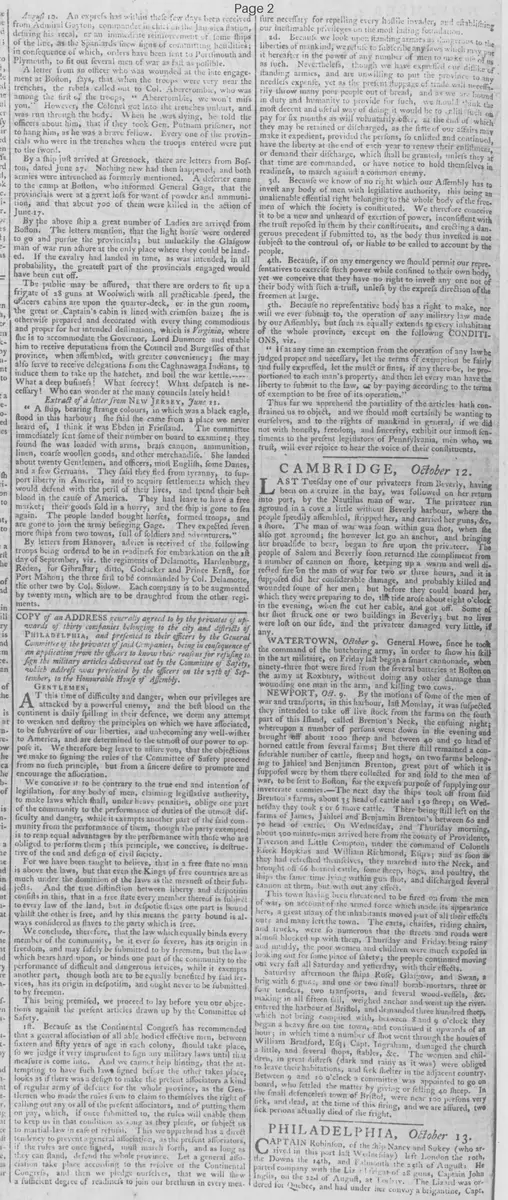
Privates from over thirty Philadelphia military companies presented an address to their officers and the Pennsylvania House of Assembly on September 27, objecting to signing Committee of Safety military articles, citing concerns over unequal obligations, standing armies, and legislative overreach, advocating for a general association per Continental Congress.
Clipping
OCR Quality
Full Text
GENTLEMEN,
At this time of difficulty and danger, when our privileges are attacked by a powerful enemy, and the best blood on the continent is daily spilling in their defence, we deem any attempt to weaken and destroy the principles on which we have associated, to be subversive of our liberties, and unbecoming any well-wisher to America, and are determined to the utmost of our power to oppose it. We therefore beg leave to assure you, that the objections we make to signing the rules of the Committee of Safety proceed from no such principle, but from a sincere desire to promote and encourage the association.
We conceive it to be contrary to the true end and intention of legislation, for any body of men, claiming legislative authority, to make laws which shall, under heavy penalties, oblige one part of the community to the performance of duties of the utmost difficulty and danger, while it exempts another part of the said community from the performance of them, though the party exempted is to reap equal advantages by the performance with those who are obliged to perform them; this principle, we conceive, is destructive of the end and design of civil society.
For we have been taught to believe, that in a free state no man is above the laws, but that even the Kings of free countries are as much under the dominion of the laws as the meanest of their subjects. And the true distinction between liberty and despotism consists in this, that in a free state every member thereof is subject to every law of the land, but in despotic states one part is bound whilst the other is free, and by this means the party bound is always considered as slaves to the party which is free.
We conclude, therefore, that the law which equally binds every member of the community, be it ever so severe, has its origin in freedom, and may safely be submitted to by freemen, but the law which bears hard upon, or binds one part of the community to the performance of difficult and dangerous services, while it exempts another part, though both are to be equally benefited by said services, has its origin in despotism, and ought never to be submitted to by freemen.
This being premised, we proceed to lay before you our objections against the present articles drawn up by the Committee of Safety.
1st. Because as the Continental Congress has recommended that a general association of all able bodied effective men, between sixteen and fifty years of age in each colony, should take place, so we judge it very imprudent to sign any military laws until that measure is come into. And we cannot help hinting, that the attempting to have such law signed before the other takes place, looks as if there was a design to make the present associators a kind of regular army of defence for the whole province, as the Gentlemen who made the rules seem to claim to themselves the right of calling out any or all of the present associators, and of putting them on pay, which, if once submitted to, the rules will enable them to keep us in that condition as long as they please, or subject us to martial-law in case of refusal. This we apprehend has a direct tendency to prevent a general association, as the present associators, if the rules are once signed, must march forth, and as long as they can stand, defend the whole province. Let a general association take place according to the resolve of the Continental Congress, and then we pledge ourselves, that we will show a sufficient degree of readiness to join our brethren in every measure necessary for repelling every hostile invader, and establishing our inestimable privileges on the most lasting foundation.
2d. Because we look upon standing armies as dangerous to the liberties of mankind, we refuse to subscribe any laws which may put it hereafter in the power of any number of men to make use of us as such. Nevertheless, though we have expressed our dislike of standing armies, and are unwilling to put the province to any needless expense, yet as the present stoppage of trade will necessarily throw many poor people out of bread, and as we are bound in duty and humanity to provide for such, we should think the most decent and useful way of doing it would be to enlist such on pay for six months as will voluntarily offer, at the end of which they may be retained or discharged, as the state of our affairs may make it expedient, provided the persons so enlisted and continued, have the liberty at the end of each year to renew their enlistment, or demand their discharge, which shall be granted, unless they at that time are commanded, or have notice to hold themselves in readiness, to march against a common enemy.
3d. Because we know of no right which our Assembly has to invest any body of men with legislative authority, this being an unalienable essential right belonging to the whole body of the freemen of which the society is constituted. We therefore conceive it to be a new and unheard of exertion of power, inconsistent with the trust reposed in them by their constituents, and erecting a dangerous precedent if submitted to, as the body thus invested is not subject to the controul of, or liable to be called to account by the people.
4th. Because, if on any emergency we should permit our representatives to exercise such power while confined to their own body, yet we conceive that they have no right to invest any one not of their body with such a trust, unless by the express direction of the freemen at large.
5th. Because no representative body has a right to make, nor will we ever submit to, the operation of any military law made by our Assembly, but such as equally extends to every inhabitant of the whole province, except on the following CONDITIONS, viz.
"If at any time an exemption from the operation of any law be judged proper and necessary, let the terms of exemption be fairly and fully expressed, let the mulct or fines, if any there be, be proportioned to each man's property, and then let every man have the liberty to submit to the law, or by paying according to the terms of exemption to be free of its operation."
Thus far we apprehend the partiality of the articles hath constrained us to object, and we should most certainly be wanting to ourselves, and to the rights of mankind in general, if we did not with honesty, freedom, and sincerity, exhibit our inmost sentiments to the present legislators of Pennsylvania, men who, we trust, will ever rejoice to hear the voice of their constituents.
What sub-type of article is it?
What keywords are associated?
Where did it happen?
Domestic News Details
Primary Location
Philadelphia
Event Date
27th Of September
Outcome
address presented to officers and house of assembly expressing objections to military articles.
Event Details
Privates of over thirty companies refused to sign military articles from the Committee of Safety, presenting an address outlining five objections based on principles of equality, opposition to standing armies, and legislative authority, advocating for a general association as recommended by the Continental Congress.