Thank you for visiting SNEWPapers!
Sign up free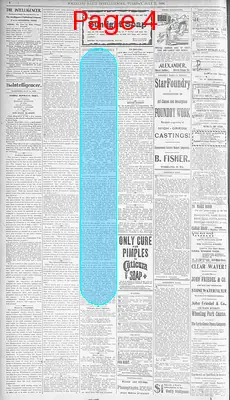
Story
July 21, 1896
The Wheeling Daily Intelligencer
Wheeling, Ohio County, West Virginia
What is this article about?
A review of General T.M. Harris's book on the 1865 assassination of President Lincoln, the conspiracy involving John Wilkes Booth and others, the military trial that convicted Mrs. Surratt, and evidence linking Confederate leaders like Jefferson Davis.
Clipping

OCR Quality
95%
Excellent
Full Text
ASSASSINATION OF LINCOLN.
It is thirty-one years since an assassin plunged this nation into the deepest grief and most mournful agony it ever knew since its foundation. Numbed by that sorrow for years, chastening time has only lately softened the sorrow of those days when men's passions were watered by tears when they realized their impotence. Caesar was struck down, because of ambition, by self-appointed executioners who feared he would enslave the liberties of a great people, but Abraham Lincoln was cowardly and cruelly murdered when he was engaged in formulating acts of mercy and contemplating placating the sullen anger of a misguided and conquered section of a nation. The passing years have softened the asperities of the dark days of the rebellion and at this time we can consider and reflect on the stirring events and tragedies of the war without passion and vindictiveness.
It is in such a spirit that General T. M. Harris has written of the assassination of President Lincoln and the great conspiracy which climaxed the end of the bitter conflict with the most heinous crime in history.
General Harris it will be remembered was a member of the military commission that tried those who were connected with John Wilkes Booth in the plot to murder the heads of the government, among them being Mrs. Surratt, who was hung. There was at that time and still is in some sections a sentimental feeling for Mrs. Surratt, because she was a woman. The members of that commission have been assaulted through the press in the most bitter terms, in season and out of season, but without any reference or consideration for the mass of testimony that was before the tribunal that condemned the unfortunate woman to death.
General Harris in his preface says that "the judgment of those who carefully studied the testimony at the time was formed upon a competent knowledge of the facts."
However, since that time a new generation has sprung up and General Harris' object in writing his book is to give the true history of the tragedy. "The necessity for this," he says, "has been emphasized by a recent revival of efforts that have been made from time to time, ever since the execution of the assassins that were condemned to death, to prejudice public sentiment against the government by the assumption of the innocence of one of the parties executed-Mrs. Surratt."
General Harris treats every phase of that great trial in a calm, judicial style, having the advantage of access to the official report as taken in short-hand by Ben Pittman. There is no attempt to sway the mind of the reader by prejudicial opinions: the facts are presented without color or exaggeration. The work is of special credence from the fact that it was written not only by a man of high integrity and impeccable honor, but one whose sad mission it was to sit in judgment on those who conspired to remove by violence from the stage of action the martyr President. It appeals with strong interest to the young men who only know of the great tragedy by legend or tale. It is a history that all young Americans of to-day should be familiar with. The work of General Harris goes back of the protagonists in the tragedy and gives a succinct account of those who were charged with abetting them to do the awful deed they did.
Of these the author says: The commission was not called upon to render a decision as to the innocence or guilt of the persons charged by the government with being co-conspirators with John H. Surratt and John Wilkes Booth who were not in the custody of the government and so not before the commission; but the government having assumed the responsibility of charging Jefferson Davis, George N. Sanders, Beverly Tucker, Jacob Thompson, William C. Cleary, Clement C. Clay, George Harper, George Young and others, with conspiring to kill and murder Abraham Lincoln, Andrew Johnson, William H. Seward and Ulysses S. Grant, was under the necessity of vindicating its honor and dignity before the world by presenting the evidence in its possession on which its charge was founded.
The main purpose of General Harris' book is to present this evidence to the public and to show the full significance of the plot and with whom it originated. He writes without personal enmity to those who are yet living and who were connected with the assassination, dealing candidly, yet fairly, with them. He says: They made themselves conspicuous in their connection with public affairs of the greatest importance, and so their acts belong to the public. If they have made a bad record, it is due to the truth of history, General Harris, the author, is still living at his home in Harrisville, Ritchie county, this state, and through somewhat advanced in years, retains an unimpaired intellect and healthy body and is respected and honored not only at home, but wherever his acquaintance extends beyond his peaceful, rural habitation. The book is published by the American Citizen Company, Boston, Mass.
It is thirty-one years since an assassin plunged this nation into the deepest grief and most mournful agony it ever knew since its foundation. Numbed by that sorrow for years, chastening time has only lately softened the sorrow of those days when men's passions were watered by tears when they realized their impotence. Caesar was struck down, because of ambition, by self-appointed executioners who feared he would enslave the liberties of a great people, but Abraham Lincoln was cowardly and cruelly murdered when he was engaged in formulating acts of mercy and contemplating placating the sullen anger of a misguided and conquered section of a nation. The passing years have softened the asperities of the dark days of the rebellion and at this time we can consider and reflect on the stirring events and tragedies of the war without passion and vindictiveness.
It is in such a spirit that General T. M. Harris has written of the assassination of President Lincoln and the great conspiracy which climaxed the end of the bitter conflict with the most heinous crime in history.
General Harris it will be remembered was a member of the military commission that tried those who were connected with John Wilkes Booth in the plot to murder the heads of the government, among them being Mrs. Surratt, who was hung. There was at that time and still is in some sections a sentimental feeling for Mrs. Surratt, because she was a woman. The members of that commission have been assaulted through the press in the most bitter terms, in season and out of season, but without any reference or consideration for the mass of testimony that was before the tribunal that condemned the unfortunate woman to death.
General Harris in his preface says that "the judgment of those who carefully studied the testimony at the time was formed upon a competent knowledge of the facts."
However, since that time a new generation has sprung up and General Harris' object in writing his book is to give the true history of the tragedy. "The necessity for this," he says, "has been emphasized by a recent revival of efforts that have been made from time to time, ever since the execution of the assassins that were condemned to death, to prejudice public sentiment against the government by the assumption of the innocence of one of the parties executed-Mrs. Surratt."
General Harris treats every phase of that great trial in a calm, judicial style, having the advantage of access to the official report as taken in short-hand by Ben Pittman. There is no attempt to sway the mind of the reader by prejudicial opinions: the facts are presented without color or exaggeration. The work is of special credence from the fact that it was written not only by a man of high integrity and impeccable honor, but one whose sad mission it was to sit in judgment on those who conspired to remove by violence from the stage of action the martyr President. It appeals with strong interest to the young men who only know of the great tragedy by legend or tale. It is a history that all young Americans of to-day should be familiar with. The work of General Harris goes back of the protagonists in the tragedy and gives a succinct account of those who were charged with abetting them to do the awful deed they did.
Of these the author says: The commission was not called upon to render a decision as to the innocence or guilt of the persons charged by the government with being co-conspirators with John H. Surratt and John Wilkes Booth who were not in the custody of the government and so not before the commission; but the government having assumed the responsibility of charging Jefferson Davis, George N. Sanders, Beverly Tucker, Jacob Thompson, William C. Cleary, Clement C. Clay, George Harper, George Young and others, with conspiring to kill and murder Abraham Lincoln, Andrew Johnson, William H. Seward and Ulysses S. Grant, was under the necessity of vindicating its honor and dignity before the world by presenting the evidence in its possession on which its charge was founded.
The main purpose of General Harris' book is to present this evidence to the public and to show the full significance of the plot and with whom it originated. He writes without personal enmity to those who are yet living and who were connected with the assassination, dealing candidly, yet fairly, with them. He says: They made themselves conspicuous in their connection with public affairs of the greatest importance, and so their acts belong to the public. If they have made a bad record, it is due to the truth of history, General Harris, the author, is still living at his home in Harrisville, Ritchie county, this state, and through somewhat advanced in years, retains an unimpaired intellect and healthy body and is respected and honored not only at home, but wherever his acquaintance extends beyond his peaceful, rural habitation. The book is published by the American Citizen Company, Boston, Mass.
What sub-type of article is it?
Historical Event
Crime Story
Biography
What themes does it cover?
Crime Punishment
Tragedy
Justice
What keywords are associated?
Lincoln Assassination
John Wilkes Booth
Mrs Surratt
Conspiracy Trial
General Harris
Confederate Plot
What entities or persons were involved?
Abraham Lincoln
John Wilkes Booth
Mrs. Surratt
General T. M. Harris
Jefferson Davis
Where did it happen?
United States
Story Details
Key Persons
Abraham Lincoln
John Wilkes Booth
Mrs. Surratt
General T. M. Harris
Jefferson Davis
Location
United States
Event Date
1865
Story Details
Review of General T. M. Harris's book detailing the assassination of President Abraham Lincoln by John Wilkes Booth and conspirators, the military trial condemning Mrs. Surratt and others, and evidence implicating Confederate leaders like Jefferson Davis in the plot.