Thank you for visiting SNEWPapers!
Sign up free
The Fairfield Herald
Winnsboro, Fairfield County, South Carolina
What is this article about?
During Mr. Bradley's speech in the Surratt case in Washington, he references John Wilkes Booth's suppressed diary, portraying Booth as a fanatic madman with a radical family heritage involving abolitionism and idolization of Brutus, despite his accomplishments and maternal affection.
Clipping
OCR Quality
Full Text
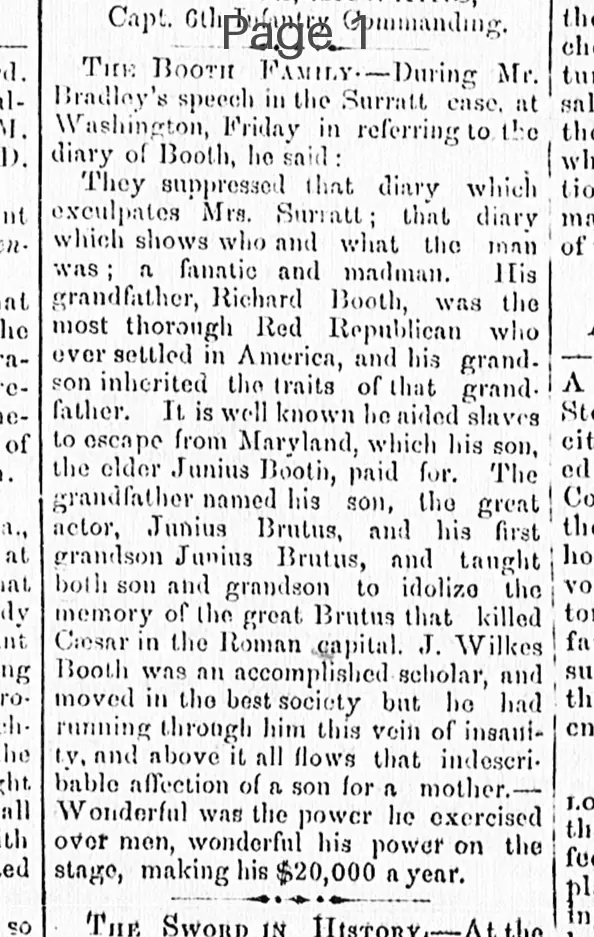
They suppressed that diary which exculpates Mrs. Surratt; that diary which shows who and what the man was; a fanatic and madman. His grandfather, Richard Booth, was the most thorough Red Republican who ever settled in America, and his grandson inherited the traits of that grandfather. It is well known he aided slaves to escape from Maryland, which his son, the elder Junius Booth, paid for. The grandfather named his son, the great actor, Junius Brutus, and his first grandson Junius Brutus, and taught both son and grandson to idolize the memory of the great Brutus that killed Caesar in the Roman capital. J. Wilkes Booth was an accomplished scholar, and moved in the best society but he had running through him this vein of insanity, and above it all flows that indescribable affection of a son for a mother. Wonderful was the power he exercised over men, wonderful his power on the stage, making his $20,000 a year.
What sub-type of article is it?
What themes does it cover?
What keywords are associated?
What entities or persons were involved?
Where did it happen?
Story Details
Key Persons
Location
Washington
Story Details
In his speech during the Surratt trial, Mr. Bradley describes the suppressed Booth diary that exculpates Mrs. Surratt and reveals Booth as a fanatic madman. He traces Booth's radical inheritance from grandfather Richard Booth, a Red Republican who aided slave escapes in Maryland, and the family's idolization of Brutus. Booth, an accomplished actor earning $20,000 yearly, was influenced by insanity and deep maternal affection.