Thank you for visiting SNEWPapers!
Sign up free
Literary
August 4, 1821
Winchester Republican
Winchester, Virginia
What is this article about?
Translated French essay on bird natural history, detailing egg structure, chick development from the cicatrice, incubation mechanics via ligaments, parental rearing, feeding behaviors, and protective instincts, with anecdotes on hens, ducks, and turkeys.
Merged-components note: Continuation of the same natural history article on birds; sequential reading order and adjacent columns.
Clipping
OCR Quality
90%
Excellent
Full Text
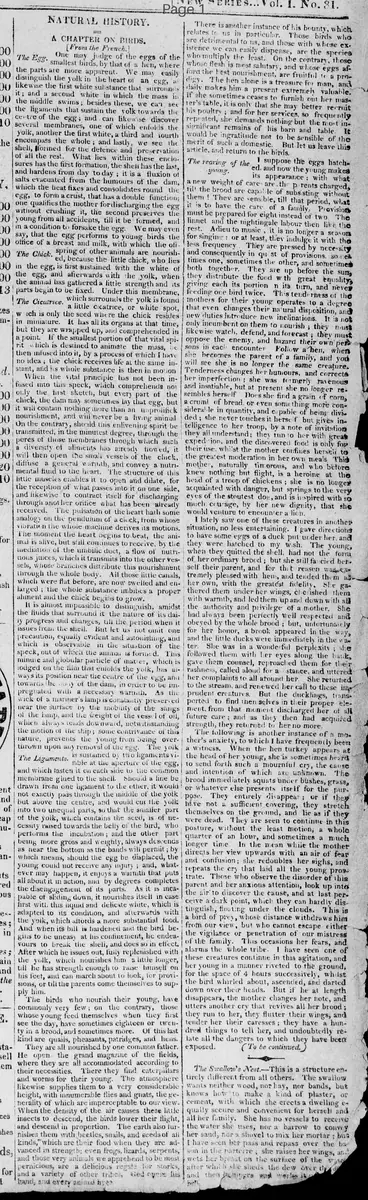
NATURAL HISTORY.
A CHAPTER ON BIRDS.
[From the French.]
One may judge of the eggs of the smallest birds, by that of a hen, where the parts are more apparent. We may easily distinguish the yolk in the heart of an egg, likewise the first white substance that surrounds it; and a second white in which the mass in the middle swims; besides these, we can see the ligaments that sustain the yolk towards the centre of the egg; and can likewise discover several membranes, one of which enfolds the yolk, another the first white, a third and fourth encompass the whole; and lastly, we see the shell, formed for the defence and preservation of all the rest. What lies within these enclosures has the first formation, the shell has the last, and hardens from day to day; it is a fluxion of salts evacuated from the humours of the dam, which the heat fixes and consolidates round the egg, to form a crust, that has a double function; one qualifies the mother for discharging the egg without crushing it, the second preserves the young from all accidents, till it be formed, and in a condition to forsake the egg. We may even say, that the egg performs to young birds the office of a breast and milk, with which the offspring of other animals are nourished, because the little chick, who lies in the egg, is first sustained with the white of the egg, and afterwards with the yolk, when the animal has gathered a little strength and its parts begin to be fixed. Under this membrane, which surrounds the yolk is found
The Cicatrice.
a little cicatrice, or white spot, which is only the seed where the chick resides in miniature. it has all its organs at that time, but they are wrapped up, and comprehended in a point. if the smallest portion of that vital spirit which is destined to animate the mass, be then infused into it, by a process of which I have no idea; the chick receives life at the same instant, and its whole substance is then in motion
When the vital principle has not been infused into this speck, which comprehends not only the first sketch, but every part of the chick, the dam may sometimes lay that egg, but it will contain nothing more than an aprophilick nourishment, and will never be a living animal
On the contrary, should this enlivening spirit be transmitted, in the minutest degree, through the pores of those membranes through which such a diversity of aliments has already flowed, it will then open the small vessels of the chick, diffuse a general warmth, and convey a nutrimental fluid to the heart. The structure of this little muscle enables it to open and dilate, for the reception of what passes into it on one side, and likewise to contract itself for discharging through another orifice what has been already received. The pulsation of the heart hath some analogy to the pendulum of a clock, from whose vibration the whole machine derives its motions.
The moment the heart begins to beat, the animal is alive, but still continues to receive, by the mediation of the umbilic duct, a flow of nutritious juices, which it transmits into the other vessels, whose branches distribute this nourishment through the whole body. All those little canals, which were flat before, are now swelled and enlarged; the whole substance imbibes a proper aliment and the chick begins to grow.
It is almost impossible to distinguish, amidst the fluids that surround it the nature of its daily progress and changes, till the period when it issues from the shell. But let us not omit one precaution, equally evident and astonishing, and which is observable in the situation of the speck, out of which the animal is formed. This minute and globular particle of matter, which is lodged on the film that enfolds the yolk, has always its position near the centre of the egg, and towards the body of the dam, in order to be impregnated with a necessary warmth. As the wick of a mariner's lamp is constantly preserved near the surface by the mobility of the slungs of the lamp, and the weight of the vessel of oil, which always tends downward, notwithstanding the motion of the ship; some contrivance of this nature, prevents the young from being overthrown upon any removal of the egg. The yolk is sustained by two ligaments visible at the aperture of the egg,
The Ligaments.
and which fasten it on each side to the common membrane glued to the shell. Should a line be drawn from one ligament to the other, it would not exactly pass through the middle of the yolk but above the centre, and would cut the yolk into two unequal parts, so that the smaller part of the yolk, which contains the seed, is of necessity raised towards the belly of the bird, who performs the incubation; and the other part being more gross and weighty, always descends as near the bottom as the bands will permit; by which means, should the egg be displaced, the young could not receive any injury; and, whatever may happen, it enjoys a warmth that puts all about it in action, and by degrees completes the disengagement of its parts. As it is incapable of sliding down, it nourishes itself in ease first with this liquid and delicate white, which is adapted to its condition, and afterwards with the yolk, which affords a more substantial food. And when its bill is hardened and the bird begins to be uneasy at his confinement, he endeavours to break the shell, and does so in effect. After which he issues out, fully replenished with the yolk, which nourishes him a little longer, till he has strength enough to raise himself on his feet, and can march about to look for provisions, or till the parents come themselves to supply him.
The birds who nourish their young, have commonly very few; on the contrary, those whose young feed themselves when they first see the day, have sometimes eighteen or twenty in a brood, and sometimes more. Of this last kind are quails, pheasants, partridges, and hens.
They are all nourished by one common father. He opens the grand magazine of the fields, where they are all accommodated according to their necessities. There they find caterpillars and worms for their young. The atmosphere likewise supplies them to a very considerable height, with innumerable flies and gnats, the generality of which are imperceptible to our view. When the density of the air causes these little insects to descend, the birds lower their flight, and descend in proportion. The earth also furnishes them with beetles, snails, and seeds of all kinds, which are their food when they are advanced in strength; even frogs, lizards, serpents, and those very animals we apprehend to be most pernicious, are a delicious regale for storks, and a variety of other tribes, they obey his hand, god every against hawks.
There is another instance of his bounty, which relates to us in particular. Those birds who are detrimental to us, and those with whose existence we can easily dispense, are the species who multiply the least. On the contrary, those whose flesh is most salutary, and whose eggs afford the best nourishment, are fruitful to a prodigy. The hen alone is a treasure for man, and daily makes him a present extremely valuable. If she sometimes ceases to furnish out her master's table, it is only that she may better recruit his poultry; and for her services, so frequently repeated, she demands nothing but the most insignificant remains of his barn and table. It would be ingratitude not to be sensible of the merit of such a domestic. But let us leave this article, and return to the birds.
I suppose the eggs hatched--
The rearing of the
young.
ed, and now the young makes its appearance; with what a new weight of care are the parents charged, till the brood are capable of subsisting without them! They are sensible, till that period, what it is to have the care of a family. Provision must be prepared for eight instead of two The linnet and the nightingale labour then like the rest. Adieu to music, it is no longer a season for singing: or at least, they indulge it with the less frequency They are pressed by necessity and consequently in quest of provisions, so near times one, sometimes the other, and sometimes both together. They are up before the sun they distribute the food with great equality giving each its portion in its turn, and never feeding one bird twice. This tenderness of the mothers for their young operates to a degree that even changes their natural disposition, and new duties introduce new inclinations. It is not only incumbent on them to nourish; they must likewise watch, defend, and forecast; they must oppose the enemy, and hazard their own persons in each encounter Follow a hen, when she becomes the parent of a family, and you will see she is no longer the same creature. Tenderness changes her humours, and corrects her imperfection; she was formerly ravenous and insatiable, but at present she no longer resembles herself Does she find a grain of corn, a crumb of bread, or even something more considerable in quantity, and capable of being divided; she never touches it herself but gives intelligence to her troop, by a note of invitation they all understand; they run to her with great expedition, and the discovered food is only for their use, whilst the mother confines herself to the greatest moderation in her own meals This mother, naturally timorous, and who before knew nothing but flight, is a heroine at the head of a troop of chickens; she is no longer acquainted with danger, but springs to the very eyes of the stoutest dog, and is inspired with so much courage, by her new dignity, that she would venture to encounter a lion.
I lately saw one of these creatures in another situation, no less entertaining. I gave directions to have some eggs of a duck put under her, and they were hatched to my wish. The young, when they quitted the shell, had not the form of her ordinary brood; but she still fancied herself their parent, and for that reason was extremely pleased with them, and tended them as her own, with the greatest fidelity. She gathered them under her wings, cherished them with warmth, and led them up and down with all the authority and privilege of a mother. She had always been perfectly well respected and obeyed by the whole brood; but, unfortunately for her honor, a brook appeared in the way, and the little ducks were immediately in the water. She was in a wonderful perplexity; she followed them with her eyes along the bank, gave them counsel, reproached them for their rashness, called aloud for assistance, and uttered her complaints to all around her. She returned to the stream, and renewed her call to these imprudent creatures. But the ducklings, transported to find themselves in their proper element, from that moment discharged her of all future care; and as they then had acquired strength, they returned to her no more.
The following is another instance of a mother's anxiety, to which I have frequently been a witness. When the hen turkey appears at the head of her young, she is sometimes heard to send forth such a mournful cry, the cause and intention of which are unknown. The brood immediately squats under bushes, grass, or whatever else presents itself for the purpose. They entirely disappear; or if they have not a sufficient covering, they stretch themselves on the ground, and lie as if they were dead. They are seen to continue in this posture, without the least motion; a whole quarter of an hour, and sometimes a much longer time In the mean while the mother directs her view upwards with an air of fear and confusion; she redoubles her sighs, and repeats the cry that laid all the young prostrate. Those who observe the disorder of this parent and her anxious attention, look up into the air to discover the cause, and at last perceive a dark point, which they can hardly distinguish, floating under the clouds. This is a bird of prey, whose distance withdraws him from our view, but who cannot escape either the vigilance or penetration of our mistress of the family. This occasions her fears, and alarms the whole tribe. I have seen one of these creatures continue in this agitation, and her young in a manner riveted to the ground, for the space of 4 hours successively, whilst the bird whirled about, ascended, and darted down over their heads. But if he at length disappears, the mother changes her note, and utters another cry that revives all her brood: they run to her, they flutter their wings, and tender her their caresses; they have a hundred things to tell her, and undoubtedly relate all the dangers to which they have been exposed.
(To be continued.)
The Swallow's Nest.--This is a structure entirely different from all others. The swallow wants neither wood, nor hay, nor bands, but knows how to make a kind of plaster, or cement, with which she erects a dwelling equally secure and convenient for herself and all her family. She has no vessels to receive the water she uses, nor a barrow to convey her sand, nor a shovel to mix her mortar; but I have seen her pass and repass over the basin in the parterre; she raises her wings, and wets her breast on the surface of the water after which she sheds the dew over the sand and then works and works it
A CHAPTER ON BIRDS.
[From the French.]
One may judge of the eggs of the smallest birds, by that of a hen, where the parts are more apparent. We may easily distinguish the yolk in the heart of an egg, likewise the first white substance that surrounds it; and a second white in which the mass in the middle swims; besides these, we can see the ligaments that sustain the yolk towards the centre of the egg; and can likewise discover several membranes, one of which enfolds the yolk, another the first white, a third and fourth encompass the whole; and lastly, we see the shell, formed for the defence and preservation of all the rest. What lies within these enclosures has the first formation, the shell has the last, and hardens from day to day; it is a fluxion of salts evacuated from the humours of the dam, which the heat fixes and consolidates round the egg, to form a crust, that has a double function; one qualifies the mother for discharging the egg without crushing it, the second preserves the young from all accidents, till it be formed, and in a condition to forsake the egg. We may even say, that the egg performs to young birds the office of a breast and milk, with which the offspring of other animals are nourished, because the little chick, who lies in the egg, is first sustained with the white of the egg, and afterwards with the yolk, when the animal has gathered a little strength and its parts begin to be fixed. Under this membrane, which surrounds the yolk is found
The Cicatrice.
a little cicatrice, or white spot, which is only the seed where the chick resides in miniature. it has all its organs at that time, but they are wrapped up, and comprehended in a point. if the smallest portion of that vital spirit which is destined to animate the mass, be then infused into it, by a process of which I have no idea; the chick receives life at the same instant, and its whole substance is then in motion
When the vital principle has not been infused into this speck, which comprehends not only the first sketch, but every part of the chick, the dam may sometimes lay that egg, but it will contain nothing more than an aprophilick nourishment, and will never be a living animal
On the contrary, should this enlivening spirit be transmitted, in the minutest degree, through the pores of those membranes through which such a diversity of aliments has already flowed, it will then open the small vessels of the chick, diffuse a general warmth, and convey a nutrimental fluid to the heart. The structure of this little muscle enables it to open and dilate, for the reception of what passes into it on one side, and likewise to contract itself for discharging through another orifice what has been already received. The pulsation of the heart hath some analogy to the pendulum of a clock, from whose vibration the whole machine derives its motions.
The moment the heart begins to beat, the animal is alive, but still continues to receive, by the mediation of the umbilic duct, a flow of nutritious juices, which it transmits into the other vessels, whose branches distribute this nourishment through the whole body. All those little canals, which were flat before, are now swelled and enlarged; the whole substance imbibes a proper aliment and the chick begins to grow.
It is almost impossible to distinguish, amidst the fluids that surround it the nature of its daily progress and changes, till the period when it issues from the shell. But let us not omit one precaution, equally evident and astonishing, and which is observable in the situation of the speck, out of which the animal is formed. This minute and globular particle of matter, which is lodged on the film that enfolds the yolk, has always its position near the centre of the egg, and towards the body of the dam, in order to be impregnated with a necessary warmth. As the wick of a mariner's lamp is constantly preserved near the surface by the mobility of the slungs of the lamp, and the weight of the vessel of oil, which always tends downward, notwithstanding the motion of the ship; some contrivance of this nature, prevents the young from being overthrown upon any removal of the egg. The yolk is sustained by two ligaments visible at the aperture of the egg,
The Ligaments.
and which fasten it on each side to the common membrane glued to the shell. Should a line be drawn from one ligament to the other, it would not exactly pass through the middle of the yolk but above the centre, and would cut the yolk into two unequal parts, so that the smaller part of the yolk, which contains the seed, is of necessity raised towards the belly of the bird, who performs the incubation; and the other part being more gross and weighty, always descends as near the bottom as the bands will permit; by which means, should the egg be displaced, the young could not receive any injury; and, whatever may happen, it enjoys a warmth that puts all about it in action, and by degrees completes the disengagement of its parts. As it is incapable of sliding down, it nourishes itself in ease first with this liquid and delicate white, which is adapted to its condition, and afterwards with the yolk, which affords a more substantial food. And when its bill is hardened and the bird begins to be uneasy at his confinement, he endeavours to break the shell, and does so in effect. After which he issues out, fully replenished with the yolk, which nourishes him a little longer, till he has strength enough to raise himself on his feet, and can march about to look for provisions, or till the parents come themselves to supply him.
The birds who nourish their young, have commonly very few; on the contrary, those whose young feed themselves when they first see the day, have sometimes eighteen or twenty in a brood, and sometimes more. Of this last kind are quails, pheasants, partridges, and hens.
They are all nourished by one common father. He opens the grand magazine of the fields, where they are all accommodated according to their necessities. There they find caterpillars and worms for their young. The atmosphere likewise supplies them to a very considerable height, with innumerable flies and gnats, the generality of which are imperceptible to our view. When the density of the air causes these little insects to descend, the birds lower their flight, and descend in proportion. The earth also furnishes them with beetles, snails, and seeds of all kinds, which are their food when they are advanced in strength; even frogs, lizards, serpents, and those very animals we apprehend to be most pernicious, are a delicious regale for storks, and a variety of other tribes, they obey his hand, god every against hawks.
There is another instance of his bounty, which relates to us in particular. Those birds who are detrimental to us, and those with whose existence we can easily dispense, are the species who multiply the least. On the contrary, those whose flesh is most salutary, and whose eggs afford the best nourishment, are fruitful to a prodigy. The hen alone is a treasure for man, and daily makes him a present extremely valuable. If she sometimes ceases to furnish out her master's table, it is only that she may better recruit his poultry; and for her services, so frequently repeated, she demands nothing but the most insignificant remains of his barn and table. It would be ingratitude not to be sensible of the merit of such a domestic. But let us leave this article, and return to the birds.
I suppose the eggs hatched--
The rearing of the
young.
ed, and now the young makes its appearance; with what a new weight of care are the parents charged, till the brood are capable of subsisting without them! They are sensible, till that period, what it is to have the care of a family. Provision must be prepared for eight instead of two The linnet and the nightingale labour then like the rest. Adieu to music, it is no longer a season for singing: or at least, they indulge it with the less frequency They are pressed by necessity and consequently in quest of provisions, so near times one, sometimes the other, and sometimes both together. They are up before the sun they distribute the food with great equality giving each its portion in its turn, and never feeding one bird twice. This tenderness of the mothers for their young operates to a degree that even changes their natural disposition, and new duties introduce new inclinations. It is not only incumbent on them to nourish; they must likewise watch, defend, and forecast; they must oppose the enemy, and hazard their own persons in each encounter Follow a hen, when she becomes the parent of a family, and you will see she is no longer the same creature. Tenderness changes her humours, and corrects her imperfection; she was formerly ravenous and insatiable, but at present she no longer resembles herself Does she find a grain of corn, a crumb of bread, or even something more considerable in quantity, and capable of being divided; she never touches it herself but gives intelligence to her troop, by a note of invitation they all understand; they run to her with great expedition, and the discovered food is only for their use, whilst the mother confines herself to the greatest moderation in her own meals This mother, naturally timorous, and who before knew nothing but flight, is a heroine at the head of a troop of chickens; she is no longer acquainted with danger, but springs to the very eyes of the stoutest dog, and is inspired with so much courage, by her new dignity, that she would venture to encounter a lion.
I lately saw one of these creatures in another situation, no less entertaining. I gave directions to have some eggs of a duck put under her, and they were hatched to my wish. The young, when they quitted the shell, had not the form of her ordinary brood; but she still fancied herself their parent, and for that reason was extremely pleased with them, and tended them as her own, with the greatest fidelity. She gathered them under her wings, cherished them with warmth, and led them up and down with all the authority and privilege of a mother. She had always been perfectly well respected and obeyed by the whole brood; but, unfortunately for her honor, a brook appeared in the way, and the little ducks were immediately in the water. She was in a wonderful perplexity; she followed them with her eyes along the bank, gave them counsel, reproached them for their rashness, called aloud for assistance, and uttered her complaints to all around her. She returned to the stream, and renewed her call to these imprudent creatures. But the ducklings, transported to find themselves in their proper element, from that moment discharged her of all future care; and as they then had acquired strength, they returned to her no more.
The following is another instance of a mother's anxiety, to which I have frequently been a witness. When the hen turkey appears at the head of her young, she is sometimes heard to send forth such a mournful cry, the cause and intention of which are unknown. The brood immediately squats under bushes, grass, or whatever else presents itself for the purpose. They entirely disappear; or if they have not a sufficient covering, they stretch themselves on the ground, and lie as if they were dead. They are seen to continue in this posture, without the least motion; a whole quarter of an hour, and sometimes a much longer time In the mean while the mother directs her view upwards with an air of fear and confusion; she redoubles her sighs, and repeats the cry that laid all the young prostrate. Those who observe the disorder of this parent and her anxious attention, look up into the air to discover the cause, and at last perceive a dark point, which they can hardly distinguish, floating under the clouds. This is a bird of prey, whose distance withdraws him from our view, but who cannot escape either the vigilance or penetration of our mistress of the family. This occasions her fears, and alarms the whole tribe. I have seen one of these creatures continue in this agitation, and her young in a manner riveted to the ground, for the space of 4 hours successively, whilst the bird whirled about, ascended, and darted down over their heads. But if he at length disappears, the mother changes her note, and utters another cry that revives all her brood: they run to her, they flutter their wings, and tender her their caresses; they have a hundred things to tell her, and undoubtedly relate all the dangers to which they have been exposed.
(To be continued.)
The Swallow's Nest.--This is a structure entirely different from all others. The swallow wants neither wood, nor hay, nor bands, but knows how to make a kind of plaster, or cement, with which she erects a dwelling equally secure and convenient for herself and all her family. She has no vessels to receive the water she uses, nor a barrow to convey her sand, nor a shovel to mix her mortar; but I have seen her pass and repass over the basin in the parterre; she raises her wings, and wets her breast on the surface of the water after which she sheds the dew over the sand and then works and works it
What sub-type of article is it?
Essay
What themes does it cover?
Nature
Religious
What keywords are associated?
Birds
Eggs
Incubation
Parental Care
Natural History
Chick Development
Bird Behavior
What entities or persons were involved?
[From The French.]
Literary Details
Title
A Chapter On Birds.
Author
[From The French.]
Key Lines
Under This Membrane, Which Surrounds The Yolk Is Found The Cicatrice. A Little Cicatrice, Or White Spot, Which Is Only The Seed Where The Chick Resides In Miniature.
The Pulsation Of The Heart Hath Some Analogy To The Pendulum Of A Clock, From Whose Vibration The Whole Machine Derives Its Motions.
They Are All Nourished By One Common Father. He Opens The Grand Magazine Of The Fields, Where They Are All Accommodated According To Their Necessities.
This Tenderness Of The Mothers For Their Young Operates To A Degree That Even Changes Their Natural Disposition, And New Duties Introduce New Inclinations.
But The Ducklings, Transported To Find Themselves In Their Proper Element, From That Moment Discharged Her Of All Future Care; And As They Then Had Acquired Strength, They Returned To Her No More.