Thank you for visiting SNEWPapers!
Sign up free
Story
April 1, 1854
Anti Slavery Bugle
New Lisbon, Salem, Columbiana County, Ohio
What is this article about?
Criticism of Mr. Orr's Indian Bill in the National Era, which grants extra land in territories to slave-owning families, with examples of massive acreages for owners of many slaves, viewed as promoting slavery and showing slaveholders' contempt for free states.
Clipping
OCR Quality
98%
Excellent
Full Text
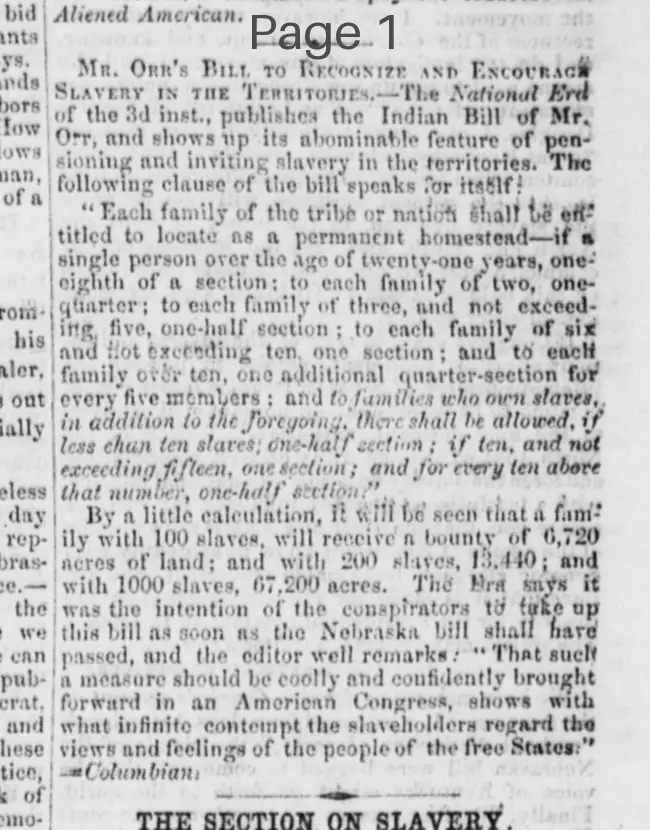
Mr. Orr's Bill to Recognize and Encourage SLAVERY IN THE TERRITORIES.—The National Era of the 3d inst., publishes the Indian Bill of Mr. Orr, and shows up its abominable feature of pensioning and inviting slavery in the territories. The following clause of the bill speaks for itself!
"Each family of the tribe or nation shall be entitled to locate as a permanent homestead—if single person over the age of twenty-one years, one-eighth of a section: to each family of two, one-quarter; to each family of three, and not exceeding, five, one-half section: to each family of six and not exceeding ten one section; and to each family over ten, one additional quarter-section for every five members; and to families who own slaves, in addition to the foregoing, there shall be allowed, if less than ten slaves; one-half section: if ten, and not exceeding fifteen, one section; and for every ten above that number, one-half section?"
By a little calculation, it will be seen that a family with 100 slaves, will receive a bounty of 6,720 acres of land: and with 200 slaves, 13,440; and with 1000 slaves, 67,200 acres. The Era says it was the intention of the conspirators to take up this bill as soon as the Nebraska bill shall have passed, and the editor well remarks: "That such a measure should be coolly and confidently brought forward in an American Congress, shows with what infinite contempt the slaveholders regard the views and feelings of the people of the free States?"
—Columbian
"Each family of the tribe or nation shall be entitled to locate as a permanent homestead—if single person over the age of twenty-one years, one-eighth of a section: to each family of two, one-quarter; to each family of three, and not exceeding, five, one-half section: to each family of six and not exceeding ten one section; and to each family over ten, one additional quarter-section for every five members; and to families who own slaves, in addition to the foregoing, there shall be allowed, if less than ten slaves; one-half section: if ten, and not exceeding fifteen, one section; and for every ten above that number, one-half section?"
By a little calculation, it will be seen that a family with 100 slaves, will receive a bounty of 6,720 acres of land: and with 200 slaves, 13,440; and with 1000 slaves, 67,200 acres. The Era says it was the intention of the conspirators to take up this bill as soon as the Nebraska bill shall have passed, and the editor well remarks: "That such a measure should be coolly and confidently brought forward in an American Congress, shows with what infinite contempt the slaveholders regard the views and feelings of the people of the free States?"
—Columbian
What sub-type of article is it?
Historical Event
What themes does it cover?
Justice
Deception
What keywords are associated?
Slavery
Territories
Indian Bill
Land Allotment
Slave Bounty
Nebraska Bill
What entities or persons were involved?
Mr. Orr
Where did it happen?
The Territories
Story Details
Key Persons
Mr. Orr
Location
The Territories
Event Date
3d Inst.
Story Details
Mr. Orr's Indian Bill provides permanent homestead land allotments to Indian families, with additional sections based on the number of slaves owned, potentially granting thousands of acres to large slaveholders; criticized as a measure to encourage slavery in territories following the Nebraska bill.