Thank you for visiting SNEWPapers!
Sign up free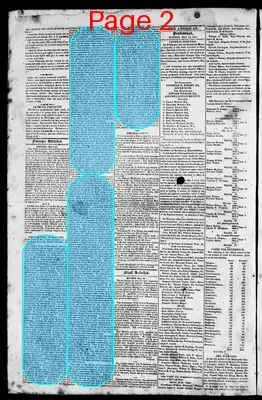
The Rhode Island American, And General Advertiser
Providence, Providence County, Rhode Island
What is this article about?
Reports on seditious Hampden Clubs and Spencean Societies in England pushing for radical parliamentary reform via universal suffrage and annual elections, with preparations for revolution in manufacturing areas; secret committee findings highlight threats of insurrection signaled by failed December 2 riot; arrests for treason; over a million reform petitions received, moderating reformist stances in Parliament.
Clipping
OCR Quality
Full Text
Conclusion of the extract commenced in our last paper from the London Christian Observer.]
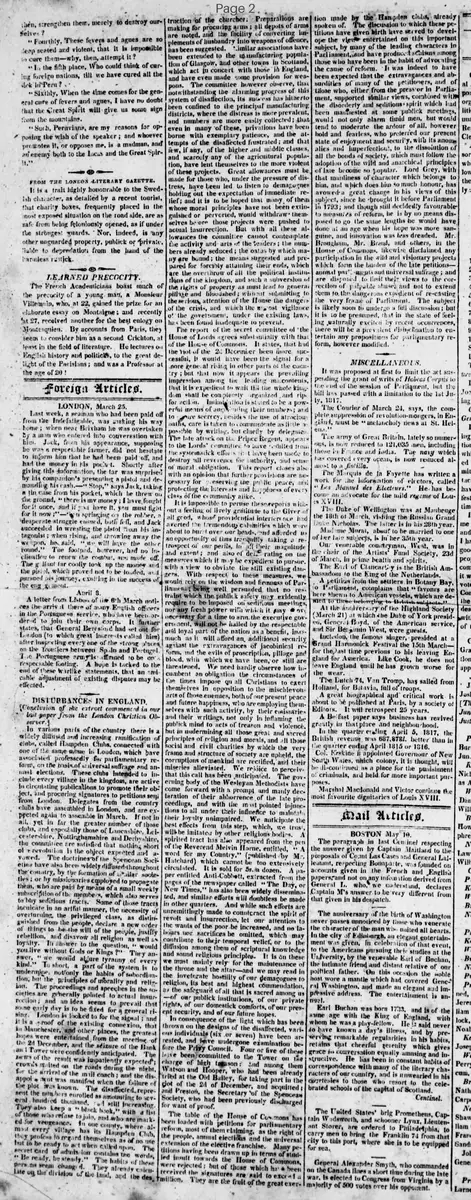
In various parts of the country there is a widely diffused and increasing ramification of clubs, called Hampden Clubs, connected with one of the same name in London, which have associated professedly for parliamentary reform, on the basis of universal suffrage and annual elections. These clubs intended to include every village in the kingdom, are active in circulating publications to promote their object, and procuring signatures to petitions sent from London. Delegates from the country clubs have assembled in London, and are expected again to assemble in March. If not in all, yet in far the greater number of those clubs, and especially those of Lancashire, Leicestershire, Nottinghamshire and Derbyshire, the committee are satisfied that nothing short of a revolution is the object expected and avowed. The doctrines of the Spencean Societies have also been widely diffused throughout the country, by the formation of similar societies; or by missionaries employed to propagate them, who are paid by means of a small weekly subscription of the members, which also serves to buy seditious tracts. Some of those tracts inculcate in an artful manner, the necessity of overthrowing the privileged class, as distinguished from the people, declare a new order of things to be the will of the people, justify rebellion, and disavow all religion as well as loyalty. In answer to the question, "would you live without Gods or Kings?" They answer, "we would abjure tyranny of every kind." In short, a part of the system is to undermine, not only the habits of subordination; but the principles of morality and religion. The proceedings and speeches in the societies are generally pointed to actual insurrection; and an idea seems to prevail that some early day is to be fixed for a general rising. London is looked to for the signal; and it is a proof of the existing connexion, that in Manchester, and other places, the greatest hopes were entertained from the meeting of the 2d December, and the seizure of the Bank and Tower were confidently anticipated. The news of the result was impatiently expected; crowds waited on the roads during the night, for the arrival of the mail coach; and the disappointment was manifest when the failure of the plot was known. The disaffected, represent the numbers enrolled as amounting to several hundred thousand, daily increasing. They also keep a "black book," with a list of those who refuse to join, and who are marked for vengeance. In one county, where almost every village has its Hampden Club, they profess to regard themselves as of no use but to be ready to act when called upon. The secret card of admission contains the words, "Be ready, be steady." The habits of these persons seem changed. They already calculate on the division of the land, and the destruction of the churches: Preparations are making for procuring arms; all depots of arms are noted, and the facility of converting implements of husbandry into weapons of offence, has been suggested. Similar associations have been extended to the manufacturing population of Glasgow, and other towns in Scotland, which act in concert with those in England, and have even made some provision for weapons. The committee however observe, that notwithstanding the alarming progress of this system of disaffection, its success has hitherto been confined to the principal manufacturing districts, where the distress is more prevalent, and numbers are more easily collected; that even in many of these, privations have been borne with exemplary patience, and the attempts of the disaffected frustrated; and that few, if any, of the higher and middle classes, and scarcely any of the agricultural population, have lent themselves to the more violent of these projects. Great allowances must be made for those who, under the pressure of distress, have been led to listen to demagogues holding out the expectation of immediate relief; and it is to be hoped that many of them whose moral principles have not been extinguished or perverted, would withdraw themselves before those projects were pushed to actual insurrection. But with all these allowances the committee cannot contemplate the activity and arts of the leaders; the numbers already seduced; the oaths by which many are bound; the means suggested and prepared for forcibly attaining their ends, which are the overthrow of all the political institutions of the kingdom, and such a subversion of the rights of property as must lead to general pillage and bloodshed; without submitting to the serious attention of the House the dangers of the crisis, and which the most vigilance of the government, under the existing laws, has been found inadequate to prevent.
The report of the secret committee of the House of Lords agrees substantially with that of the House of Commons. It states, that had the riot of the 2d December been more successful, it would have been the signal for a more general rising in other parts of the country; but that now it appears the prevailing impression among the leading malcontents, that it is expedient to wait till the whole kingdom shall be completely organized and ripe for action. Intimidation is stated to be a powerful means of augmenting their numbers; and to ensure secrecy, besides the use of atrocious oaths, care is taken to communicate as little as possible by writing, but chiefly by delegates. The late attack on the Prince Regent, appears to the Lords' committee to have resulted from the systematic efforts that have been made to destroy all reverence for authority, and sense of moral obligation. This report closes also with an opinion that further provisions are necessary for preserving the public peace, and protecting the interests and happiness of every class of the community alike.
It is impossible to peruse these reports without a feeling of lively gratitude to the Giver of all good, whose providential interference had averted the tremendous calamities which were about to burst over our heads, and afforded us an opportunity of thus tranquilly taking a retrospect of our perils, in all their magnitude and extent; and also of deliberating on the measures which it may be expedient to pursue, with a view to obviate the still existing dangers. With respect to these measures, we would rely on the wisdom and firmness of Parliament; being well persuaded that no restraint which the public safety may evidently require to be imposed on seditious meetings, nor any fresh power with which it may be necessary for a time to arm the executive government, will not be hailed by the respectable and loyal part of the nation as a benefit, inasmuch as it will afford an additional security against the extravagances of jacobinical reform, and the evils of proscription, pillage and blood, with which we have been, or still are threatened. We need hardly observe how incumbent an obligation the circumstances of the times impose on all Christians to exert themselves in opposition to the mischievous arts of those enemies, both of our present peace and future happiness, who are employing themselves with such activity, by their emissaries and their writings, not only in inflaming the public mind to acts of treason and violence, but in undermining all those great and sacred principles of religion and morals, and all those social and civil charities by which the very frame and structure of society are upheld, the corruptions of mankind are rectified, and their miseries alleviated. We rejoice to perceive that this call has been anticipated. The governing body of the Wesleyan Methodists have come forward with a prompt and manly declaration of their abhorrence of the late proceedings, and with the most pointed injunctions to all under their influence to maintain their loyalty unimpaired. We anticipate the best effects from this step, which, we trust, will be imitated by other religious bodies. A spirited tract has also appeared from the pen of the Reverend Melvin Horne, entitled, "A word for my Country," (published by Mr. Hatchard) which cannot be too extensively circulated. It is sold for 5s. a dozen. A paper entitled Anti-Cobbett, extracted from the pages of the newspaper called "The Day, or New Times," has also been widely disseminated, and similar efforts will doubtless be made in other quarters. And while such efforts are unremittingly made to counteract the spirit of revolt and insurrection, let our attention to the wants of the poor be increased, and no labours nor sacrifices be omitted, which may contribute to their temporal relief, or to the diffusion among them of scriptural knowledge and sound religious principles. It is on these we must mainly rely for the maintenance of the throne and the altar—and we may read in the inveterate hostility of our demagogues to religion, its best and highest commendation, as the safeguard of all that is sacred among us—of our public institutions, of our private rights, of our domestick comforts, of our present security, and of our future hopes.
In consequence of the light which has been thrown on the designs of the disaffected, various individuals (six or seven) have been arrested, and have undergone examination before the Privy Council. Four or five of these have been committed to the Tower on the charge of high treason: and among them Watson and Hooper, who had been already tried at the Old Bailey, for taking part in the riot of the 2d of December, and acquitted; and Preston, the Secretary of the Spencean Society, who had been previously discharged for want of proof.
The table of the House of Commons has been loaded with petitions for parliamentary reform, most of them claiming, as the right of the people, annual elections and the universal extension of the elective franchise. Many petitions having been drawn up in terms of studied insult towards the House of Commons, were rejected; but of those which have been received the signatures are said to exceed a million. They are the fruit of the great exertion made by the Hampden clubs, already spoken of. The discussion to which these petitions have given birth have served to develop the views entertained on this important subject, by many of the leading characters in Parliament, and have produced schisms among those who have been in the habit of advocating the cause of reform. It was indeed to have been expected that the extravagances and absurdities of many of the petitioners, and of those who, either from the press or in Parliament, supported similar views, combined with the disorderly and seditious spirit which had been manifested at some public meetings, would not only alarm timid men, but would tend to moderate the ardour of all, however bold and fearless, who preferred our present state of enjoyment and security, with its anomalies and imperfections, to the dissolution of all the bonds of society, which must follow the adoption of the wild and anarchical principles of late become so popular. Lord Grey, with that manliness of character which belongs to him, and which does him so much honour, has avowed a great change in his views of this subject, since he brought it before Parliament in 1793; and though still decidedly favourable to measures of reform, he is by no means disposed to go the same lengths he would have done at an age when his hope was more sanguine, and innovation was less dreaded. Mr. Brougham, Mr. Brand, and others, in the House of Commons, likewise disclaimed any participation in the wild and visionary projects which form the burthen of the late petitions—annual parliaments and universal suffrage; and are disposed to limit their views to the correction of palpable abuse, and not to extend them to the dangerous expedient of re-casting the very frame of Parliament. The subject is likely soon to undergo a full discussion; but it is to be presumed, that in the state of feeling naturally excited by recent occurrences, there will be a prevalent disinclination to entertain any propositions for parliamentary reform, however modified.
What sub-type of article is it?
What keywords are associated?
What entities or persons were involved?
Where did it happen?
Foreign News Details
Primary Location
England
Event Date
The 2d Of December
Key Persons
Outcome
various individuals arrested and examined before the privy council; four or five committed to the tower on charge of high treason, including watson, hooper, and preston; petitions for reform received with over a million signatures, some rejected; schisms among reform advocates.
Event Details
Reports from secret committees of House of Lords and Commons detail widespread Hampden Clubs and Spencean Societies promoting universal suffrage, annual elections, and revolution through seditious tracts, oaths, and preparations for insurrection; activities concentrated in manufacturing districts like Lancashire, Leicestershire, Nottinghamshire, Derbyshire, Manchester, and Glasgow; failed riot on 2d December anticipated as signal for rising; intimidation, black books, and arms preparations noted; calls for vigilance, loyalty, and relief for the poor; petitions for parliamentary reform flood House of Commons, leading to moderated reform views among leaders.