Thank you for visiting SNEWPapers!
Sign up free
The Charlotte Journal
Charlotte, Mecklenburg County, North Carolina
What is this article about?
In the U.S. Senate on the 5th instant, a heated debate erupted between Senators Allen, Hannegan, and Haywood over the Oregon territory notice. Hannegan and Allen challenged Haywood's claims about President Polk's views on compromising at 49 degrees versus asserting up to 54°40', citing Polk's past statements and messages. The session ended with adjournment.
Clipping
OCR Quality
Full Text
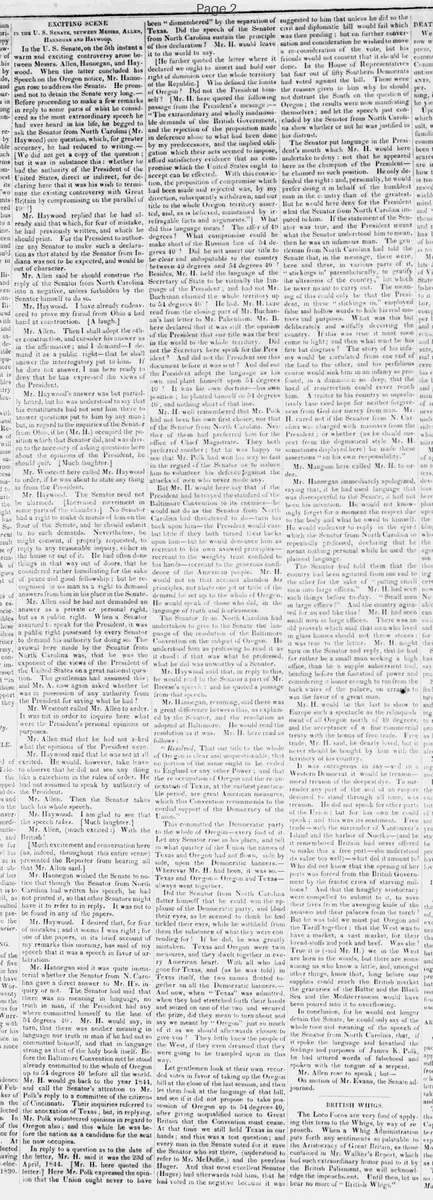
In the U. S. Senate, on the 5th instant a warm and exciting controversy arose between Messrs. Allen, Hannegan, and Haywood. When the latter concluded his Speech on the Oregon notice, Mr. Hannegan rose to address the Senate. He promised not to detain the Senate very long. Before proceeding to make a few remarks in reply to some parts of what he considered as the most extraordinary speech he had ever heard in his life, he begged to ask the Senator from North Carolina (Mr. Haywood) one question, which, for greater accuracy, he had reduced to writing.
[We did not get a copy of the question; but it was in substance this: whether he had the authority of the President of the United States, direct or indirect, for declaring here that it was his wish to terminate the existing controversy with Great Britain by compromising on the parallel of 49
Mr. Haywood replied that he had already said that which, for fear of mistake, he had previously written, and which he should print. For the President to authorize any Senator to make such a declaration as that stated by the Senator from Indiana was not to be expected, and would be out of character.
Mr. Allen said he should construe the reply of the Senator from North Carolina into a negative, unless forbidden by the Senator himself to do so.
Mr. Haywood. I have already endeavored to prove my friend from Ohio a bad hand at construction. [A laugh.]
Mr. Allen. Then I shall adopt the other construction, and consider his answer as in the affirmative: and I demand—I demand it as a public right—that he shall answer the interrogatory put to him. If he does not answer, I am here ready to deny that he has expressed the views of the President.
Mr. Haywood's answer was but partially heard, but he was understood to say that his constituents had not sent him there to answer questions put to him by any man; but, in regard to the inquiries of the Senator from Ohio, if he (Mr. H.) occupied the position which that Senator did, and was driven to the necessity of asking questions here about the opinions of the President, he should quit. [Much laughter.]
Mr. Westcott here called Mr. Haywood to order, if he was about to state any thing as from the President.
Mr. Haywood. The Senator need not be alarmed. [Increased merriment in some parts of the chamber.] No Senator had a right to make demands of him on the floor of the Senate, and he should submit to no such demands. Nevertheless, he might consent, if properly requested, to reply to any reasonable inquiry, either in the house or out of it. He had often done things in that way out of doors, that he considered rather humiliating for the sake of peace and good fellowship: but he recognized in no man as a right to demand answers from him in his place in the Senate.
Mr. Allen said he had not demanded an answer as a private or personal right, but as a public right. When a Senator assumed to speak for the President, it was a public right possessed by every Senator to demand his authority for doing so. The avowal here made by the Senator from North Carolina was, that he was the exponent of the views of the President of the United States on a great national question. The gentleman had assumed this; and Mr. A. now again asked whether he was in possession of any authority from the President for saying what he had?
Mr. Westcott called Mr. Allen to order. It was not in order to inquire here what were the President's personal opinions or purposes.
Mr. Allen said that he had not asked what the opinions of the President were.
Mr. Haywood said that he was not at all excited. He would, however, take leave to observe that he did not see any thing like a catechism in the rules of order. He had not assumed to speak by authority of the President.
Mr. Allen. Then the Senator takes back his whole speech.
Mr. Haywood. I am glad to see that the speech takes. [Much laughter.]
Mr. Allen, (much excited:) With the British!
[Much excitement and conversation here (as, indeed, throughout this entire scene) prevented the Reporter from hearing all that Mr. Allen said.]
Mr. Hannegan wished the Senate to notice that though the Senator from North Carolina had written his speech, he had not printed it, so that other Senators might have it to refer to in reply. It was not to be found in any of the papers.
Mr. Haywood. I desired that, for fear of mistakes; and it seems I was right; for one of the papers, in its brief account of my remarks this morning, has said of my speech that it was a speech in favor of arbitration.
Mr. Hannegan said it was quite immaterial whether the Senator from N. Carolina gave a direct answer to Mr. H.'s inquiry or not. The Senator had said that there was no meaning in language, no truth in man, if the President had any where committed himself to the line of 54 degrees 40. Mr. H. would say, in turn, that there was neither meaning in language nor truth in man if he had not so committed himself, and that in language strong as that of the holy book itself. Before the Baltimore Convention met he stood already committed to the whole of Oregon up to 54 degrees 40' before all the world.
Mr. H. would go back to the year 1844, and call the Senator's attention to Mr. Polk's reply to a committee of the citizens of Cincinnati. Their inquiries referred to the annexation of Texas; but, in replying, Mr. Polk volunteered opinions in regard to Oregon also; and this while he was before the nation as a candidate for the seat he now occupies.
In reply to a question as to the date of the letter, Mr. H. said it was the 23d of April, 1844. [Mr. H. here quoted the letter.] Here Mr. Polk expressed the opinion that the Union ought never to have been "dismembered" by the separation of Texas. Did the speech of the Senator from North Carolina sustain the principle of this declaration? Mr. H. would leave it to the world to say.
[He further quoted the letter where it declared we ought to assert and hold our right of dominion over the whole territory of the Republic.] Who defined the limits of Oregon? Did not the President himself? [Mr. H. here quoted the following passage from the President's message :—
"The extraordinary and wholly inadmissible demands of the British Government, and the rejection of the proposition made in deference alone to what had been done by my predecessors, and the implied obligation which their acts seemed to impose, afford satisfactory evidence that no compromise which the United States ought to accept can be effected. With this conviction, the proposition of compromise which had been made and rejected was, by my direction, subsequently withdrawn, and our title to the whole Oregon territory asserted, and, as is believed, maintained by irrefutable facts and arguments."] What did this language mean? The offer of 49 degrees? What compromise could he make short of the Russian line of 54 degrees 40'? Did he not assert our title to be clear and indisputable to the country between 49 degrees and 54 degrees 40°?
Besides, Mr. H. held the language of the Secretary of State to be virtually the language of the President : and had not Mr. Buchanan claimed the whole territory up to 54 degrees 40'? He had. Mr. H. here read from the closing part of Mr. Buchanan's last letter to Mr. Pakenham. Mr. B. here declared that it was still the opinion of the President that our title was the best in the world to the whole territory. Did not the Secretary here speak for the President? And did not the President see this document before it was sent? And did not the President adopt the language as his own and plant himself upon 54 degrees 40? It was his own doctrine—his own position; he planted himself on 54 degrees 40, and nothing short of that line.
Mr. H. well remembered that Mr. Polk had not been his own first choice, nor that of the Senator from North Carolina. Neither of them had preferred him for the office of Chief Magistrate. They both preferred another; but he was happy to see that Mr. Polk had won his way so fast in the regard of the Senator as to induce him to volunteer his defence against the attacks of men who never made any.
But Mr. H. would here say that if the President had betrayed the standard of the Baltimore Convention to its enemies—he would not do as the Senator from North Carolina had threatened to do—turn his back upon him—the President would care but little if they both turned their backs upon him—but he would denounce him as recreant to his own avowed principles—recreant to the weighty trust confided to his hands—recreant to the generous confidence of the American people. Mr. H. would not on that account abandon his principles, nor abate one jot or tittle of the demand he set up to the whole of Oregon. He would speak of those who did, in the language of truth and fearlessness.
The Senator from North Carolina had undertaken to give to the Senate the language of the resolution of the Baltimore Convention on the subject of Oregon. He understood him as professing to read it as it stood: if that was what he professed, what he did was unworthy of a Senator.
Mr. Haywood said that, in reply to this, he would read to the Senator a part of Mr. Breese's speech : and he quoted a passage from that speech.
Mr. Hannegan, resuming, said there was a great difference between this, as explained by the Senator, and the resolution as adopted at Baltimore. He would read the resolution as it was. Mr. H. here read as follows :
"Resolved, That our title to the whole of Oregon is clear and unquestionable, that no portion of the same ought to be ceded to England or any other Power; and that the re-occupation of Oregon and the re-annexation of Texas, at the earliest practicable period, are great American measures, which this Convention recommends to the cordial support of the Democracy of the Union."
This committed the Democratic party to the whole of Oregon—every foot of it. Let any Senator rise in his place, and tell in what quarter of the Union the names of Texas and Oregon had not flown, side by side, upon the Democratic banners. Wherever Mr. H. had been, it was so. Texas and Oregon—Oregon and Texas—always went together.
Did the Senator from North Carolina flatter himself that he could win the applause of the Democratic party, and blind their eyes, as he seemed to think he had tickled their ears, while he withheld from them the substance of what they were contending for! If he did, he was greatly mistaken. Texas and Oregon were twin measures, and they dwelt together in every American heart. With all who had gone for Texas, and (as he was told) in Texas itself, the two names floated together on all the Democratic banners. And now, when "Texas" was admitted, when they had stretched forth their hands and seized on one of the two and secured the prize, did they mean to turn about and say we meant by "Oregon" just so much of it as we should afterwards choose to give you? They little knew the people of the West, if they even dreamed that they were going to be trampled upon in this way.
Let gentlemen look at their own recorded votes in favor of taking up the Oregon bill at the close of the last session, and then let them look at the language of that bill, and see if it did not propose to take possession of Oregon up to 54 degrees 40, after giving unqualified notice to Great Britain that the Convention must cease. At that time we still held Texas in our hands; and this was a test question; and every man in the Senate voted for it save the Senator who sat there, (understood to refer to Mr. McDuffie,) and the peerless Huger. And that most excellent Senator (Huger) had afterwards told him, that he had voted in the negative because it was suggested to him that unless he did so the civil and diplomatic bill would fail which was then pending; but on further conversation and consideration he wished to move a re-consideration of the vote, but his friends would not consent that it should be done. In the House of Representatives but four out of fifty Southern Democrats had voted against the bill. These were the reasons given to him why he should not distrust the South on the question of Oregon; the results were now manifesting themselves; and let the speech just concluded by the Senator from North Carolina show whether or not he was justified in his distrust.
The Senator put language in the President's mouth which Mr. H. would here undertake to deny : not that he appeared here as the champion of the President—he claimed no such position. He only defended the right: and, personally, he would prefer doing it in behalf of the humblest man in the country than of the greatest. But he would here deny for the President what the Senator from North Carolina imputed to him. If the statement of the Senator was true, and the President meant—what the Senator understood him to mean, then he was an infamous man. The gentleman from North Carolina had told the Senate that, in the message, there were, here and there, in various parts of it, "stickings in" parenthetically, to gratify the ultraisms of the country," but which he never meant to carry out. The meaning of this could only be that the President, in these "stickings in," employed false and hollow words to hide his real motives and purposes. What was this but deliberately and wilfully deceiving the country. If this was true it must soon come to light; and then what must be his fate but disgrace? The story of his infamy would be circulated from one end of the land to the other, and his perfidious course would sink him in an infamy so profound, in a damnation so deep, that the hand of resurrection could never reach him. A traitor to his country so superlatively base need hope for neither forgiveness from God nor mercy from man. Mr. H. cared not if the Senator from N. Carolina was charged with missives from the President : or whether (as he should suspect from the dogmatical style Mr. H. sometimes displayed here) he made these assertions "on his own responsibility."
Mr. Mangum here called Mr. H. to order.
Mr. Hannegan immediately apologized, saying that, if he had used language that was disrespectful to the Senate, it had not been his intention. He would not knowingly forget for a moment the respect due to the body and what he owed to himself. He would endeavor to reply in the spirit which the Senator from North Carolina so repeatedly professed, declaring that he meant nothing personal while he used the plainest language.
The Senator had told them that the country had been agitated from one end to the other for the sake of "putting small men into large offices." Mr. H. had seen such things before to-day. "Small men in large offices!" And the country agitated for an end like this! Mr. H. had seen small men in large offices. There was an old proverb which said that men who lived in glass houses should not throw stones: it was true to the letter. Mr. H. might turn on the Senator and reply, that he had far rather be a small man seeking a high office, than be a supple subservient tool, bending before the footstool of power and considering it honor enough to run from the back stairs of the palace, on errands to win the favor of a great man.
Mr. H. would be the last to show to Europe such a spectacle as the relinquishment of all Oregon north of 49 degrees, and the acceptance of a fine commercial treaty with the bonus of free trade. Free trade, Mr. H. said, he dearly loved, but it never should be bought by him with the territory of his country.
It was outrageous in any—and in a Western Democrat it would be treason—moral treason of the deepest dye. To surrender any part of the soil of an empire destined to stand through all time, was treason. He did not speak for other parts of the Union : but for his own he could speak; and thus was its sentiment. Free trade—with the surrender of Vancouver's Island and the harbor of Nootka—(and be it remembered Britain had never offered to make this a free port—she understood its value too well)—what did it amount to? Who did not know that the opening of her ports was forced from the British Government by the frantic cries of starving millions? "And that the haughty aristocracy were compelled to submit to it, to save their lives from the avenging knife of the assassin and their palaces from the torch? But he was told we must put Oregon and the Tariff together : that the West was to have a market, a vast market, for their bread-stuffs and pork and beef. Was she? True it is (said Mr. H.) we in the West are born in the woods, but there are some among us who know a little, and, amongst other things, know that, long before our supplies could reach the British market the granaries of the Baltic and the Black Sea and the Mediterranean would have been poured into it to overflowing.
In conclusion, for he would not longer detain the Senate, he could only say of the whole tone and meaning of the speech of the Senator from North Carolina, that, if it spoke the language and breathed the feelings and purposes of James K. Polk, he had uttered words of falsehood and spoken with the tongue of a serpent.
Mr. Allen rose to speak; but—
On motion of Mr. Evans, the Senate adjourned.
What sub-type of article is it?
What keywords are associated?
What entities or persons were involved?
Where did it happen?
Domestic News Details
Primary Location
U. S. Senate
Event Date
On The 5th Instant
Key Persons
Outcome
the senate adjourned on motion of mr. evans.
Event Details
A heated debate in the U.S. Senate arose between Senators Allen, Hannegan, and Haywood regarding Haywood's speech on the Oregon notice. Hannegan questioned Haywood's authority to claim President Polk's wish for compromise at 49 degrees, citing Polk's prior commitments to 54 degrees 40 minutes. Exchanges involved demands for clarification, points of order, quotes from Polk's letters and messages, and references to the Baltimore Convention resolution. Hannegan defended Polk's position on full Oregon claim, linking it to Texas annexation.