Thank you for visiting SNEWPapers!
Sign up free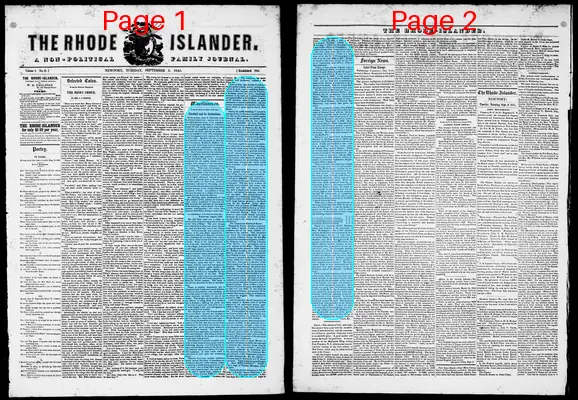
The Rhode Islander
Newport, Newport County, Rhode Island
What is this article about?
A detailed 1845 correspondence from Hartford, CT, praises the city's cultural and institutional endowments, including the Charter Oak, asylums, Trinity College, public buildings, and the Wadsworth Atheneum's Historical Society with its rare books and relics from American history.
Merged-components note: Continuation of the article on Hartford and its institutions across pages 1 and 2.
Clippings
1 of 2
OCR Quality
Full Text
From the Newark Daily Advertiser.
Hartford and its Institutions.
Of the second class of American towns Hartford stands first; second only to the four chief Atlantic cities, in its manifestations of the higher attributes of civilization though far from being equal to, some others of its class in population and wealth. At least such, we think, must be the judgment of every impartial visitor who compares its social arrangements and aspects with those of other cities. Readers who are so much more familiar with the names of New Haven, Providence, Rochester, Buffalo, Cincinnati, and other large towns of remarkable growth and commercial consequence, may perhaps doubt its title to this distinction. But if communities, like individuals, may be judged by their fruits, Hartford may at least claim a high position in our social Union, and safely refer to her munificent provisions for the public benefit—to the number and character of her institutions; for in these she certainly surpasses any of her sisters. These rare endowments, the fruits of voluntary contributions among a people remarkable rather for their social equality than for individual resources, indicate a highly advanced state of society; for there is scarcely what in Boston—primus inter pares—or New York, would be reckoned a rich man in the place, nor do we know that she can claim any pre-eminent name in science or art, though decidedly the patron of both. A condition of things that may be taken as a pledge of the practicability of our American theories.
As affording some justification of this high estimate of the position of a country town, with a population of less than 14,000, we invite the attention of our readers to the following outline sketch by a disinterested correspondent, who writes from personal observation during a recent visit:
Correspondence of the Newark Daily Advertiser.
Hartford, August, 1845.
My last letter gave you a slight account of the most striking points of interest in the 'City of Elms.' The cars brought me to Hartford in about two hours thereafter, and my first visit was to the Charter Oak. One penetrated with a sense of obligation to the past, could scarcely fail to experience feelings of awe and veneration when touching the iron bark of the venerable tree in whose bosom Liberty once found a home. Even in the time of Andros it was, I am told, considered the oldest tree in the village; and since then a century and a half have passed: yet the old Oak has been permitted by Providence to give forth its green summer leaves, unscathed by lightning or tempest. Like the tomb of Washington, and Bunker's Heights, let it ever be revered as one of the shrines of Liberty. 'Woodman spare that tree!' The old Charter, with the royal seal and signature, is preserved behind a glass frame in the Secretary of State's office, together with the box in which it lay concealed for four years in the cavity of the Oak. Within the last eight years this cavity has closed— having, as a good old Puritan suggests, fulfilled the Divine purpose. The trunk of the old tree measures 31 feet in circumference.
There is another remarkable tree in Hartford which I had never heard of before; an Elm of extraordinary size, standing as one of the posts of a fence, arching with its noble branches the width of one of the streets. The boughs are so perfect on every side as to cast a shade of a hundred feet in diameter; making the whole area of the tree to exceed the sixth of an acre. It is the largest I ever saw, and appears to be in the height of its glory.
The Retreat for the Insane and the Deaf and Dumb Asylum are situated on the same range of hills about a mile from the city, and two miles from each other. They claim the attention of visitors alike on account of the fact that they are the oldest institutions of the kind in our country, and because they are in all respects admirably conducted and located. The grounds about the former especially, are highly beautiful and attractive. The Orphan Asylum, sustained chiefly by the Ladies, also stands on the same high ground.
The Retreat, it should be added, overlooks a wide extent of picturesque scenery, embracing the city, 5 or 6 flourishing villages, and the fertile valley of the Connecticut, adorned with every feature of a beautiful landscape. It were worth while to come here to look upon this enchanting scene.
Trinity College, another institution which adorns this place of munificent endowments, has two noble-looking edifices occupying a commanding position on College street: one of them 148 ft. long, 43 ft. wide, and 4 stories high: the other 87 ft. by 55, and 3 stories high, embraces the chapel, library of some 6,500 vol., mineralogical cabinet, philosophical chamber, laboratory, &c.
The institution has seven teachers and professors, including the President.
There are here also, besides 3 well conducted public schools, several private seminaries of good repute; including Brace's Young Ladies Institute, and the Pavilion, a boarding school for boys, charmingly situated in the midst of a cultivated grove and grounds filled with shrubbery. I counted 13 churches, some of which are good specimens of sacred architecture, and was deeply interested by the spacious city Cemetery, which is quite equal to that at New Haven.
Among the public buildings, I noticed in passing the State House, a spacious edifice 114 feet by 76, standing in a public square fronting on Main street, surrounded with trees, and enclosed with an iron railing which cost $10,000: the City Hall a large Doric building on Market street: two public Markets, an Arsenal, &c. &c. In the way of trade, let it be added that Hartford has 5 Banks; a Savings Institution, 4 Insurance Companies, some 300 stores; numerous factories; eleven printing offices; 2 Daily, 10 weekly, and 3 semi-weekly newspapers, and 6 other periodicals.
The same regard for neatness is exhibited in this place as in most of the New England towns which it has been my privilege to visit, though there is perhaps scarcely as much taste displayed in its general arrangements as in New Haven. But leaving its various other objects of interest for another occasion, let me introduce to you an Institution of recent date: which would be an ornament to the metropolitan city of the Union.
The Wadsworth Atheneum, standing on ground of historic interest in the heart of the city, is a spacious and imposing castellated edifice built of granite. It cost about $60,000. The interior consists of three nearly equal divisions, of two stories each. The first story is about 14 feet high, and is divided into rooms, with stairways and halls: the second is 25 feet, with a single room in each division, arched, and lighted by spacious windows and sky-lights. The central division is occupied as a Gallery of Paintings and Sculpture, (which includes some of Trumbull's large historic pictures.); the North wing by the Hartford Young Men's Institute, with its Library of 2000 volumes, and the Natural History Society of Hartford; and the South wing by the Connecticut Historical Society. Each of these places of resort would furnish interesting materials for a letter, but I shall confine myself to-day to the rooms of the Historical Society.
The Connecticut Historical Rooms.
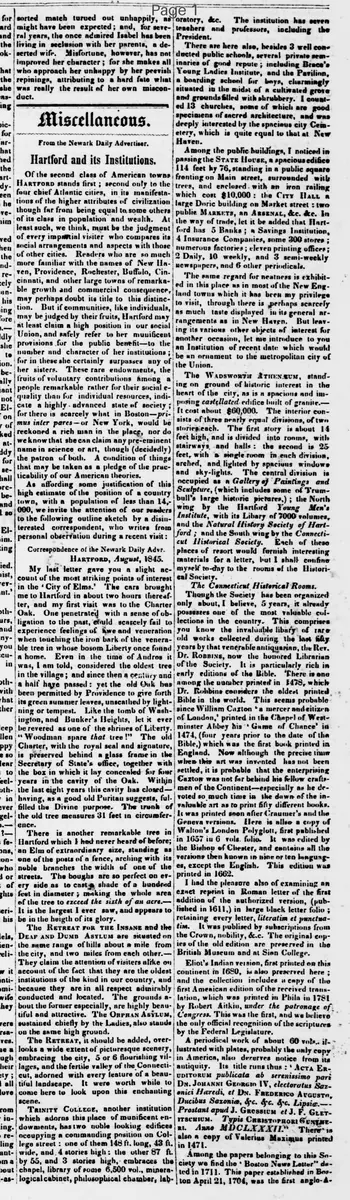
Though the Society has been organized only about, I believe, 5 years, it already possesses one of the most valuable collections in the country— This comprises you know the invaluable library of rare old works collected during the last fifty years by that venerable antiquarian, the Rev. Dr. Robbins, now the honored Librarian of the Society. It is particularly rich in early editions of the Bible. There is one among the number printed in 1478, which Dr. Robbins considers the oldest printed Bible in the world. This seems probable since William Caxton 'a mercer and citizen of London,' printed in the Chapel of Westminster Abbey his 'Game of Chance' in 1474, (four years prior to the date of the Bible,) which was the first book printed in England. Now although the precise time when this art was invented has not been settled, it is probable that the enterprising Caxton was not far behind his fellow craftsmen of the Continent—especially as he devoted so much time in the dawn of the invaluable art as to print fifty different books. It was printed soon after (Cranmer's and the Geneva versions. Here is also a copy of Walton's London Polyglott, first published in 1657 in 6 vols. folio. It was edited by the Bishop of Chester, and contains all the versions then known in nine or ten languages, except the English. This edition was printed in 1662.
I had the pleasure also of examining an exact reprint in Roman letter of the first edition of the authorized version, (published in 1611,) in large black-letter folio; retaining every letter, literatim et punctatim. It was published by subscriptions from the Crown, nobility, &c. The original copies of the old edition are preserved in the British Museum and at Sion College.
Eliot's Indian version, first printed on this continent in 1663, is also preserved here; and the collection includes a copy of the first American edition of the received translation, which was printed in Phila. in 1782 by Robert Aitken, under the patronage of Congress. This was the first, and we believe the only official recognition of the scriptures by the Federal Legislature.
A periodical work of about 60 vols. illustrated with plates, probably the only copy in America, also deserves notice from its antiquity. Its title runs thus: 'Acta Eruditorum publicata ab serenissimo pari Dn. JoHanni GeoRGio IV, electoratus Saxonic Heredi, et Dn. Frederico August, Ducibus Saxoniæ, &c. &c. &c. Lipsiæ. Prostant apud J. Grossium et J. F. Gletschium. Typis Christophori Suckhe Rt. Anno MDCLXXXII.' There is also a copy of Valerius Maximus printed in 1471.
Among the papers belonging to this Society we find the 'Boston News-Letter' dated in 1711. This paper established in Boston April 21, 1704, was the first anglo-American newspaper.
American newspaper published on this Continent. There is also a volume of the Connecticut Gazette, printed in New Haven Jan. 1, 1755—the first paper established in the colony of Connecticut. Also the first volume of the Connecticut Courant—the first paper from Hartford and the third from the Colony. There is a complete set of the N. Y. Evening Post in 16 vols. from the year 1801 to 1817. Original records of the Laws passed by the colony of Connecticut from 1676 to 1705 are also preserved.
There is here also an original copy of the old Bishop's Bible, a translation made by the English Bishops under the superintendence of Archbishop Parker, and printed in London in 1563. It was presented to Dr. R. by the late Duke of Sussex in 1839, and his kind and complimentary letter to the Doctor is preserved in the fly leaves of the book. Like the former Bible the paper and print are surprisingly good.
On the walls of this room are hung valuable portraits of Increase Mather, John Phillips, LL. D. (a meaning title in those days.) William Penn, Gov. Saltonstall, Rubens, and other individuals of note. Busts of Noah Webster, La Fayette, Mrs. Sigourney, and others, also grace the room.
But let us pass on to some relics of great interest. Here is a large and perfect chest made of Norway Pine, with the identical key which formerly turned the bolt of its now rusted lock—once the property of Elder William Brewster, and which he brought over in the Mayflower in 1620. By its side stands Captain Miles Standish's dinner pot, which has been piously preserved in the line of his descendants, not, however, without injury, since there is a hole in the bottom. Both relics were brought over in the Mayflower.
Here, too, is a sword worn by Sergeant Hayden in the Pequot war in 1637—the first war which the settlers had with the Indians. I have just handled a ruler made from a beam of the first house which Sir Harry Vane built in Boston. There are besides many canes cut from trees and houses of interest to the antiquarian. Nor can I forget to mention a rude old chair brought over in 1650, which is said to resemble in its antique appearance, the coronation chair of England.
There is, besides, an exquisitely wrought chair, brought early from the mother country by the Wyllis family, perhaps the ancestor of those upon whose lands the Charter Oak stands. In mentioning Elder Brewster's chest I should have noticed a beautifully carved box, which some of the pilgrims brought with them. There are also some bricks preserved from the old forts made in Europe, and numerous MSS. of the old Puritan Fathers. It would be impracticable to enumerate here the numerous Indian relics which are scattered through the room—such as tomahawks, shoes, bows, &c. I mention one—a pipe cut from the sacred pipe stone of the Sioux—much revered by them.
There was a drum of much interest in the room which was used 1718 by the citizens of Farmington to call the people together on the Lord's day, and on public occasions; to the archives of which village the following record is attached—
Paid Stephen Andrus for drumming. 0 13 4
Paid Nathaniel Cowles for drumming, 0 13 4
Paid Daniel Woodruff for drumming. 0 13 4
Paid Joseph Bird for drumming, 0 13 4
There is a beautiful scarlet Ottoman, which was formerly in the possession of Mrs. Washington: also a lead inkstand used by the General, and presented by Gen. E. Huntington, his aid. A large link of the chain which the British placed in the Hudson near West Point to cut off the passage of our ships in the Revolution, but which affected as little restraint as their chevaux-de-frise, is preserved in one corner of the room. Let honorable mention be made, too, of Gen. Israel Putnam's tavern sign, having as its device Gen. Wolfe in defensive attitude, and the hero's name underneath to tell who the fierce looking figure was intended for. Poor old Put how singular was his history! He would almost seem to have descended—for his character was much similar—from the Cambrian race of Ap-Rhaider, Ap-Head. Long!
I will not intrude longer upon the patience of the reader than to note one other relic, which brought to mind more forcibly than anything else the patriotism of the patriot of '76, and the cowardice and brutal inhumanity of his mercenary oppressor. Here hangs in a glass case the identical shirt, with the letters W. I., No. 2, and the white vest, which Col. Ledyard wore when murdered by the British emissary of the infamous Arnold at Fort Griswold. In the vest are two cuts through which the sword entered and passed through. The Ledyard family have also presented to the Society their old family Bible. I must not omit, in closing this protracted sketch, to recognize my obligations to Dr. Robbins—clarum et venerabile nomen—and the gentlemen of the Committee who have charge of this noble institution for their courtesies to visitors.
Yours, &c.
What sub-type of article is it?
What keywords are associated?
What entities or persons were involved?
Where did it happen?
Domestic News Details
Primary Location
Hartford
Event Date
August, 1845
Key Persons
Event Details
Correspondent describes Hartford's institutions including Charter Oak, asylums, Trinity College, public buildings, trade establishments, and the Wadsworth Atheneum's Connecticut Historical Society with rare books, newspapers, and historical relics from colonial and revolutionary eras.